
Palestinian factions strike a reconciliation deal
JVL Introduction
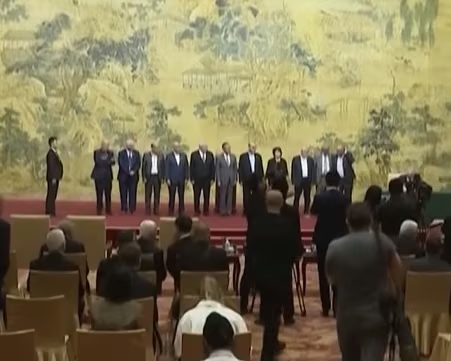
The latest China-sponsored Palestinian unity agreement, blind-sided most observers – but will it be any different from past attempts to agree?
What is new now is the situation – with the Gaza genocide, Israel’s threat to annex the West Bank and much more.
In addition it is clear that the old leaderships are all out of touch with street. In the last decade young Palestinians “have been manifesting national unity through their own actions – in mass mobilizations and political and cultural work”.
Most have no recollection of what divided Fatah, Hamas and other in 2006 and care less.
We are seeing the various leaderships trying to catch up with the street, not vice versa, with the split between factions seen largely as self-serving and not in the interests of the Palestinian struggle, however it is to be waged.
At stake is who speaks for the Palestinian people.
As Muaddi says, new elections are needed, with all factions taking part, not only for the PA’s presidency and legislative council, but also the representative bodies of the PLO, to include Palestinians in the diaspora, and as much as possible in ‘48 Palestine.
Can this move towards unity be sustained in practice?
RK
This article was originally published by Mondoweiss on Fri 26 Jul 2024. Read the original here.
Palestinian factions strike a reconciliation deal – will this time be any different?
The new reconciliation deal between rival Palestinian factions could not come at a more critical time. As Palestinians face the Gaza genocide, the political survival of the Palestinian leadership might hinge on finally finding unity.
Loading article text…


The China initiative in bringing together the Palestinian groups might be very productive and long-lasting.
Both “sides” are able serve the other party’s interests and goals, in a world where other power blocs (the USA and to a certain extent the EU) aren’t very friendly (or are positively hostile).
China wants to deepen and extend its influence in the global South – which backing the Palestinians will do. The embryonic State of Palestine needs a Super-Power ally with a seat on the UN Security Council.
The representatives of both Palestinian groups will need to meet face to face often enough to develop mutual understanding and a shared view on the way forward. The risk of Israel assassinating these leaders must be lower than it would normally be because of China’s close engagement in the process, control of the meeting locations and global reach.
China isn’t pro-Israel (or anti-Israel either) so can act as an honest broker between the PA and Hamas – as the USA and European governments can’t.
Partly because of China’s own history and practice in the patient arts of building working relationships between mutually hostile “governing” groups, China has the skillset necessary to foster a new common purpose between the Palestinian leaders.
What’s necessary to give the embryonic State of Palestine a fighting chance of survival will be Palestinian leaders more like Ukraine’s President than mere technocrats – highly intelligent, self-controlled leaders who understand how to make regional and international politics work for their people and are gifted in governing in difficult conditions. Few such people are in today’s Palestine Authority – more will be from Hamas. China is probably the only power strong enough to deter other governments from unfriendly action towards the new ministers / administration.
Regardless of how real and effective this agreement is, it demonstrates the waning power of US imperialism. Their mad dog interventions, both directly and through puppets have created a space for an alternative power to act diplomatically and economically. The China-brokered Saudi/Iranian raprochement should have been a warning, and their blind support for the Gaza genocide has alienated most of the non-Western world and even some of their hitherto staunch allies.
Perhaps there is a corollary. After the USA left Afghanistan, China offered to link the country to the Belt and Road program, effectively a financial blood transfusion to a destroyed country. This would provide investment to build the nation and markets to sell their products…BUT only on the condition there was no violence. As soon as violence reared its head, the umbilical cord would be broken.