
Genocide – South Africa rattles Israel
JVL Introduction
South Africa’s decision to take the Israeli government to the International Court of Justice, accusing it of “genocidal acts”, is a serious intervention that could have massive repercussions.
We reported on the application to the Court here and linked to the full legal 84-page application, a very serious indictment which is well-worth consulting.
We post here a number of further contributions on the subject.
- a statement by South African Jews for a Free Palestine welcoming their government’s application;
- an editorial by Ha’aretz describing this as “a wakeup call for Israel”;
- an article by Uri Misgav which chronicles the calls for genocide by senior Israelis;
- a detailed discussion with lawyer Daniel Machover and Owen Jones of what is at stake;
- a legal briefing on the Genocide Convention case brought by South Africa against Israel by Lawyers for Palestinian Human Rights.
RK
PS: A late addition: John Mearsheimer, Genocide in Gaza, 4th Jan 2023
South African Jews for a Free Palestine
Press release, 3 January 2023
South African Jews for a Free Palestine welcomes the decision by the South African Government to invoke the 1948 Genocide Convention and institute proceedings against ‘The State of Israel’ at the International Court of Justice
On the 29th December 2023, The Republic of South Africa instituted proceedings against the State of Israel at the International Court of Justice (ICJ) and requested the Court to indicate provisional measures aiming to end Israel’s genocide in Palestine. On the 2nd January 2024, the Israeli Government announced that it will appear in The Hague at the ICJ and the first hearing is set for the 11th and 12th January 2024.
South African Jews for a Free Palestine (SAJFP) wholeheartedly welcomes South Africa’s submission to the ICJ as part of a set of tactics towards justice in the pursuit of a free Palestine and the absolute ending of the genocide in Gaza. The genocide in Gaza has its roots in the ongoing Nakba that marked the establishment of the apartheid Zionist settler colony of Israel in 1948 in continuity with the establishment of the Apartheid State in South Africa in the same year. 1948 was also the year in which the Convention on the Prevention and Punishment of the Crime of Genocide (CPPCG), or the Genocide Convention – on which grounds South Africa has made its submission to the ICJ – was adopted by the United Nations General Assembly.
Thinking together about these connected apartheids and legal architectures from our vantage point as Jewish South Africans, we express our absolute condemnation of the genocide in Palestine and of the violent vandalization of our Jewish faith as it has been manipulated to support apartheid and settler colonial genocide in Palestine and globally through the conflation of Judaism and Zionism and antisemitism and anti-Zionism. This conflation is ahistorical, inaccurate, racist, and dangerous.
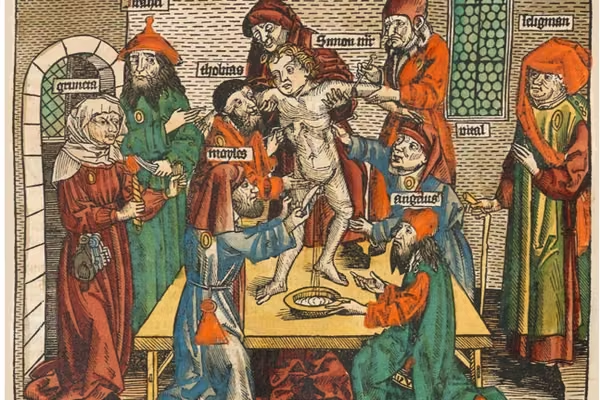
On the 2nd January 2024, Israeli Government Spokesperson Eylon Levy confirmed that Israel would defend the application “to dispel South Africa’s absurd blood libel”. Blood libel is an antisemitic trope in the form of a false accusation levelled against Jewish people for murdering Christians and using their blood in the performance of religious rituals. It is a trope that has provided fuel for the centuries of discrimination, persecution and pogroms experienced by the Jewish people, and it is one which we take deeply seriously. Labelling the application to the ICJ in terms of the Genocide Convention “blood libel” is not only a complete misrepresentation of what blood libel is, it is a further instance of Jewish historical experience being weaponised in service of Israel’s settler colonial project.
This trope joins a significant deployment of dog whistle and explicit anti-Palestinian racism from both the Israeli government and Zionists globally and in South Africa in response to the submission. We refuse in the strongest terms the attempts to smear this process by Israel and its allies as well as by South African Zionist institutions and individuals such as the South African Jewish Board of Deputies, the South African Zionist Federation, and Chief Rabbi Warren Goldstein. Their words do nothing more than manufacture further violence and fail to honour the living and the dead.
One of the key principles that guides Jewish faith and morality is tzedeq, which means justice. It is this principle, among many others that guides us to unwaveringly dream and fight towards a world of justice and freedom in Palestine and globally. While we will not conflate law and justice, we commend this move as part of a repertoire of justice, guided by principles of solidarity, freedom, and tzedeq.
In this spirit, we reiterate our welcoming of this legal action and hope to see a ceasefire in the immediate term, alongside complete end to the genocide, and the dismantling of the apartheid settler colonial Zionist project of the ongoing Nakba in Palestine.
Genocide Charge Against Israel Must Serve as a Wake-up Call
Haaretz Editorial, 3rd Jan 2024
South Africa’s filing to the International Court of Justice in The Hague accusing Israel of genocide and demanding proceedings against the state is a wake-up call for Israel.
South Africa cites extensive harm to civilians in the Gaza Strip, including starvation of residents and the dire humanitarian situation. Also, “genocide” is not defined only as the acts a certain state carries out, but also as an intent to bring about the destruction of a substantial part of a certain group.
The fact that Israel is led by the most extremist government in its history, whose members talk about “wiping out Gaza,” openly discuss the idea of transfer and call to occupy the Gaza Strip and to build settlements on it; and the fact that the public dialogue within Israel normalizes the killing of 50,000 or 100,000 Gaza residents, the starvation of a population and the withholding of humanitarian aid as an instrument of pressure on Hamas are liable to help the court in The Hague to attribute to Israel genocidal intent.
Israelis do not hear themselves. Since the war began, lawmakers and cabinet members have repeatedly made statements that could be seen as indicating an intention to carry out crimes against humanity. On Tuesday MK Moshe Saada of Likud said: “[A]s it is clear to everyone today that the right was correct about the Palestinian issue, now it’s simple, you go anywhere [and] they tell you ‘destroy them.'”
On Wednesday a gathering was held at the Knesset that specified the goal: Palestinian emigration from the Gaza Strip and the settlement of Jews in the territory. MK Tzvi Succot of the Religious Zionism party, for example, said, “At least the northern Strip we must first of all conquer, annex, raze all the buildings and build neighborhoods.”
When Finance Minister Bezalel Smotrich says “If there are 100,000 or 200,000 Arabs in Gaza and not 2 million, the entire discussion on ‘the day after’ will be different”; when Minister Orit Strock blasts the IDF for pilots’ alleged refusal to bomb civilians; when National Security Minister Itamar Ben-Gvir calls for “a project to encourage the emigration of residents from Gaza”; when Minister Amichai Eliyahu says “dropping an atom bomb on Gaza is one way” – Israelis may dismiss these things as cheap populism, but the world takes them seriously.
Israel’s defense strategy will be to show that it is doing everything possible to prevent harm to innocent civilians, that it frequently allows humanitarian aid into the Strip and acts only against Hamas.
But the most effective way to undermine the filing is to remove from the government those who incite war crimes. This is the only way to persuade the world that the deranged ideas they are spreading do not reflect reality. This must be done urgently, before they cause Israel’s standing to deteriorate to that of a war criminal.
The above article is Haaretz’s lead editorial, as published in the Hebrew and English newspapers in Israel.
Opinion |
The Road to The Hague Is Paved With Israeli Calls for Genocide of Gazans
Uri Misgav, Haaretz, 3rd January 2024
No one has any idea what the “day after” picture in Gaza will be. The government and the man who heads it have refused for three months to deal with the topic. It’s easier to diagram the day after for Israel: We will be more leper-like, hated and persecuted than ever before.
Israelis are now living in a movie, a sealed bubble designed by Channel 12 military correspondent Nir Dvori and IDF spokesman Daniel Hagari. They have no idea what we have left behind in Gaza, and what is said about us in the world. Commanders and soldiers fighting in Gaza are talking about unprecedented destruction. About the total lack of restraint that they had known in the past.
About a situation that when they finally identify a rare terrorist emerging from underground and fleeing for home, they simply bring down the building with the help of the air force. After we leave here, one of them told me, it won’t help us to show pictures of the massacre at Be’eri. Senior Wall Street Journal correspondent Yaroslav Trofimov said this week, “The word ‘Gaza’ will be remembered in the annals of history like the word ‘Dresden.'”
The bill will be sent. It’s a purely strategic matter, which goes beyond moral and ethical questions (which should also have room in an advanced, liberal and life-loving society). But even at the level of pure Israeli interest, it seems that no one in the political or military echelon is wise and courageous enough to see if this issue is also weighed on the scales.
In this respect, it is highly ironic that the first claim filed against Israel with the International Court of Justice in The Hague was by South Africa; they still remember what it was like to be a regional and even nuclear power, rich and thriving compared with its failed neighbors, but still leprous and isolated.
The detailed statement of claim attributes to Israel “by its acts of commission and omission” suspicion of genocide in Gaza and gives extensive weight (eight whole pages) to the climate that enabled and prepared it, according to the petitioner.
In truth, this is a fascinating and depressing document, beyond the legal quibbling and practice. It cites dozens of quotes, comments, and actions by well-known Israelis from a range of fields. Benjamin Netanyahu, who spoke about the extinction of Amalek, appears alongside Eyal Golan, who declared on Channel 14, “Wipe Gaza out, leave no one there.”
President Isaac Herzog writing on a shell.Credit: Haim Tzach / GPO
Isaac Herzog, photographed signing an artillery shell, is mentioned alongside pop star Kobi Peretz, who danced with soldiers singing “Let their village burn.” Agriculture Minister Avi Dichter, who declared that Israel is now carrying out the Nakba in Gaza, is presented alongside broadcaster Yinon Magal, who enthusiastically participated in a video with soldiers singing, “I will eradicate the seed of Amalek” and declaring that there are no innocent civilians in Gaza.
It goes on and on. Minister Amichai Eliyahu with his atom bomb and the musings of MK Nissim Vaturi. The disturbing tweets by MK Tally Gotliv and the delusions of mass extermination of Eliyahu Yossian. The dreams of Finance Minister Bezalel Smotrich and National Security Minister Itamar Ben Gvir, and the fantasies of MK Boaz Bismuth and MK Galit Distal Atbaryan.
Only the sought-after commentator and lecturer on genocide Zvi Yehezkeli has been deleted for some reason. MK Moshe Saada missed the train for some reason; the petition was filed a day before he declared, “As it is clear to everyone today that the right-wing was right about the Palestinian issue, today it is simple – everywhere you go, they tell you to ‘destroy them.'”
This horrifying picture of bestialized society and public dialogue has been drawn up before our eyes since that cursed Saturday. The barbaric invasion of the Muslim jihadists, followed by the bloodthirsty looting mob, presented Israel with a very difficult challenge: how to respond with the proper strategic and deterrent power while still preserving a shadow of humanity and the ability to distinguish between the terrorists and the population in which they operate. How to beat our enemies without becoming like them. We have totally failed in this and the price will be painful.
Israel should be very worried
You might think that South Africa’s case against Israel for genocide is doomed – that Israel will just ignore the International Court of Justice if it issues a provisional ruling ordering it to cease its murderous onslaught against Gaza. But as lawyer Daniel Machover explains – this could have major consequences for Israel. He explains – very clearly – what the legal case means – and where it could lead:
LPHR legal briefing on the Genocide Convention case brought by South Africa against Israel 04 January 2024
“I have stressed, in face of the persistence of human cruelty, the great need for a people-centred approach, keeping in mind the fundamental right to life, with the raison d’humanité prevailing over the raison d’Etat.”
Judge Antonio Cançado Trindade in his separate opinion on the Application of the Convention on the Prevention and Punishment of the Crime of Genocide (The Gambia v. Myanmar), January 2020
On Friday 29 December 2023, the same day that the UK government delivered a grave speech on Gaza at the UN Security Council entitled, “Many more will die from attacks, disease and famine if we do not stop the humanitarian catastrophe”, the International Court of Justice announced that South Africa had brought proceedings against Israel for alleged violation of its obligations under the Convention on the Prevention and Punishment of the Crime of Genocide (Genocide Convention).
This historic case will be run in distinct phases. The first phase, focusing on whether or not the Court will order provisional measures primarily aimed at protecting Palestinians in Gaza, should be concluded within the next couple of months. Public hearings will be held before the Court on Thursday 11 and Friday 12 January 2024. In contrast, further phases that address jurisdiction and then potentially the merits of the application, will likely take a few years to conclude.
The crime of genocide
The Convention on Genocide was adopted in 1948 in response to the atrocities committed during World War II. It has been ratified by an overwhelming number of States, including South Africa (1998) and Israel (1950). The jurisprudence of the International Court of Justice considers the prohibition of genocide to be a peremptory norm of international law, and the principles of the Genocide Convention to be binding on all States under general customary international law.
Article 1 of the Genocide Convention establishes that State parties are obliged to prevent and punish the crime of genocide. Article 2 then provides:
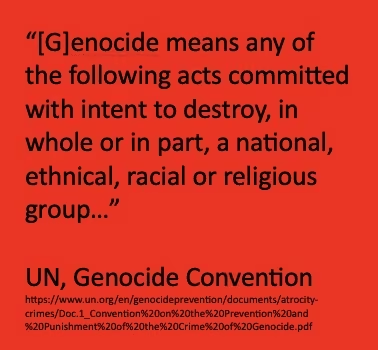
“…[G]enocide means any of the following acts committed with intent to destroy, in whole or in part, a national, ethnical, racial or religious group, as such: (a) Killing members of the group; (b) Causing serious bodily or mental harm to members of the group; (c) Deliberately inflicting on the group conditions of life calculated to bring about its physical destruction in whole or in part; (d) Imposing measures intended to prevent births within the group; (e) Forcibly transferring children of the group to another group.”
A distinguishing feature of the crime of genocide from other serious international crimes is the requirement that a perpetrator must intend, when committing one or more underlying acts of genocide, to destroy a protected group in whole or in part, as such. Proving specific intent on the part of the perpetrators to destroy a protected group is the most difficult legal element to determine. It can be established on the basis of circumstantial evidence, which is important as it is recognised by international courts and tribunals that genocidal intent will rarely be expressly stated.
The UK government, in a joint written submission to the ICJ in the case of The Gambia v. Myanmar, asserts that circumstantial evidence – such as the scope and severity of the atrocities committed – “will typically be highly significant in drawing inferences of specific intent”. The UK approves the Court’s “only reasonable interference” test as the appropriate standard to be applied when determining whether the totality of the evidence meets the threshold for inferring genocidal intent.
South Africa’s Application under the Genocide Convention
In its Application, South Africa alleges violations of the Genocide Convention through “acts adopted, condoned, taken and being taken by the Government and military of the State of Israel against the Palestinian people, a distinct national, racial and ethnical group, in the wake of the attacks in Israel on 7 October 2023.” Specifically, South Africa argues:
“The acts and omissions by Israel complained of by South Africa are genocidal in character because they are intended to bring about the destruction of a substantial part of the Palestinian national, racial and ethnical group, that being the part of the Palestinian group in the Gaza Strip (‘Palestinians in Gaza’). The acts in question include killing Palestinians in Gaza, causing them serious bodily and mental harm, and inflicting on them conditions of life calculated to bring about their physical destruction. The acts are all attributable to Israel, which has failed to prevent genocide and is committing genocide in manifest violation of the Genocide Convention, and which has also violated and is continuing to violate its other fundamental obligations under the Genocide Convention, including by failing to prevent or punish the direct and public incitement to genocide by senior Israeli officials and others.”
South Africa’s 84-page Application concludes with an urgent request for the Court to exercise its power to indicate provisional measures to protect Palestinians in Gaza. It lists nine specific measures for the Court to consider making, including that Israel “immediately suspend its military operations in and against Gaza”, and that it “desist from, and take all measures… to prevent:
(a) the expulsion and forced displacement from their [Palestinians] homes;
(b) the deprivation of:
(i) access to adequate food and water;
(ii) access to humanitarian assistance, including access to adequate fuel, shelter, clothes, hygiene and sanitation;
(iii) medical supplies and assistance; and
(c) the destruction of Palestinian life in Gaza.”
Determining the request for provisional measures of protection
The Court will only grant provisional measures to preserve certain rights claimed by South Africa for the protection of Palestinians in Gaza if it considers the following conditions to be satisfied:
i) It appears, prima facie, to have jurisdiction to hear the dispute.
ii) The rights asserted by the applicant and for which it is seeking protection from the Court are at least plausible.
iii) There is a link between the rights claimed by the applicant and the measures requested.
iv) There is an urgent need for the measures in order to prevent irreparable harm.
Judge Antonio Cançado Trindade – in his humanistic separate opinion in support of the ICJ’s Order of 23 January 2020 to indicate provisional measures of protection for the Rohingya in the case of The Gambia v. Myanmar – makes the supplementary relevant observation:
“Invocation of extreme human vulnerability is a key element to be taken into account in a decision concerning provisional measures of protection, in a case like the present one, on the Application of the Convention against Genocide.” [paragraph 72]
As noted above, the outcome of this initial phase of the case should be expeditiously conducted by the Court, leading to a decision on provisional measures of protection within the next couple of months. A positive decision on provisional measures would be legally binding on Israel with immediate effect; however, there is no accompanying enforcement mechanism.
Potential significance of the case
This case may have very significant ramifications for Palestinians in Gaza. In addition to the possible order of provisional measures of protection, a potential full hearing on the merits of South Africa’s application could ultimately lead to a Court order of remedies, including reparations, for victims.
The concurrence of these ICJ proceedings with the separate criminal investigation into the Situation of Palestine at the International Criminal Court may also entail critical consequences, given the tight nexus between State responsibility and individual criminal responsibility for the crime of genocide.
Conclusion
LPHR will closely monitor this Genocide Convention case before the International Court of Justice. In respect of its initial phase, we strongly encourage the Court to be guided by the spirit of the late Judge Cançado Trindade’s approach of placing primacy on protecting the extremely vulnerable.
Whilst this significant legal case takes its course, we also strongly emphasise that it remains deeply imperative that all diplomatic measures be urgently exercised to deliver an immediate ceasefire. Even should the ICJ impose provisional measures of protection in the next few weeks, it will not, on its own, end the extreme human suffering being cruelly inflicted on the civilian population of Gaza.
Tareq Shrourou

The so called human rights lawyer who masquerades as the leader of the Labour party must be thinking twice about his support for the Israeli Genocide of the Palestinians
Ditto the Chief Rabbi and the Archbishop of Canterbury
There’s no going back to business as usual after this, 97% of people support a Ceasefire 97% of our representatives don’t
Genius is knowing when to stop