
There are two sides to the story of Exodus

JVL Introduction
Jewish people are celebrating the annual Pesach (Passover) festival. As well as family Seders (the ceremonial meal usually just for the first two nights of the eight night festival) there are many Freedom or Liberation Seders where we remember not only that “we [Jews] were slaves in Egypt” and yearned for and were given freedom, but also remember the many peoples today who are not free. JVL held a liberation Seder with the British Shalom Salaam Trust. There is a video of the Seder and you can donate to support the work of BSST. At these Seders most obviously we talk about the oppression of the Palestinians by Israel ostensibly, according to them, in the name of all Jews. We remind everyone that they do not speak or act for us or the growing number of Jews across the world who stand for justice for Palestinians.
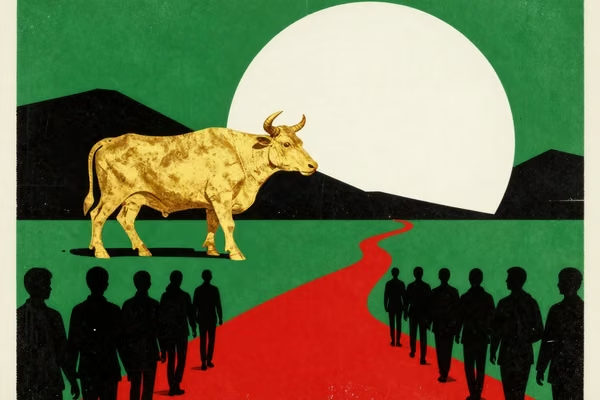
However, Ofri Ilany reminds us that there is more to the story of the exodus from Egypt than we usually talk about. He argues that while the story of Exodus remains a central and influential myth, it must be approached critically. It is not just a tale of refugees escaping oppression—it’s also a story of armed settlers displacing others. As Palestinian intellectual Edward Said noted: From the perspective of the native Canaanites, who were displaced and destroyed in the Israelites’ conquest, the Exodus represented violence and oppression.
The Egyptologist Jan Assmann also noted that the Exodus has profoundly shaped Western history and ideology, especially among early American Puritans who viewed themselves as a “New Israel.” Exodus can be read as both a success story of a persecuted people that rose from the ashes, as well as a story of dispossession and occupation that has no end. The story is simultaneously an inspiration to oppressed peoples everywhere, and fuel for those who practise exclusionary and violent ideologies.
LL
This article was originally published by Ha'aretz on Thu 10 Apr 2025. Read the original here.
Why the Passover Story Is a Colonialist Myth
Exodus is a story of liberation from slavery, but it has also inspired numerous colonialist movements. It’s a myth that needs to be treated with caution
Loading article text…



We forget that “settler colonialism” has only recently been seen as a bad thing.I n much of the 20th century is was celebrated as encouraged as the “White Man’s Burden” to civilize “inferior” cultures and races. Racism and eugenics were seen as legitimate until the Nazis went a “bit too far”. In many states of the USA (about 13 I think) inter racial marriage was illegal until 1967. About then they also made LYNCHING illegal (so what was it before???). Historically genocide was seen as quite normal.
As a Christian, I was brought up on the story of the Exodus as a seminal story of the emancipation of slaves, but there is something deeply problematic about it that it took me many, many years to notice. The story is not, in effect, anti-slavery at all, it’s just anti-Hebrew-slavery. The angel of death kills the firstborn of everyone in Egypt who is not a Hebrew, including the prisoners, the slaves and the cattle.
Moreover, Leviticus 25 authorises the enslavement of non-Israelites while explaining that the Israelites themselves literally belong to God, as his slaves (too many translations euphemise this as “servants”).
Perhaps this is why the story of the Exodus has helped to inspire settler colonialists – its concept of “being free” is so very selective.
I hope that someone will correct me if I have got this wrong.