
The recent Council Election Results
JVL Introduction
We include in this posting:
- the bare election results as crunched on the keeplondonspecial website – link below.
- Phil Burton-Cartledge’s analysis on his blog All that is Solid…
Both suggest that Labour has remarkably little chance of winning the next general election, especially while its hostility to those who joined under Jeremy Corbyn and the leadership’s political cowardice continues.
Council Election Results for England
On Sunday 8th May 2022, Lisa Nandy wrote an opinion piece in the Independent stating that the Labour gains were a turning point for her party.
Exactly which gains was she referring to?
The three early gains in London, which were cancelled out by losses over the weekend?
Or the gains in Socialist-friendly Wales which had no connection with Starmer?
She obviously wasn’t looking at the overall councillor numbers in England when she discharged her opinions.
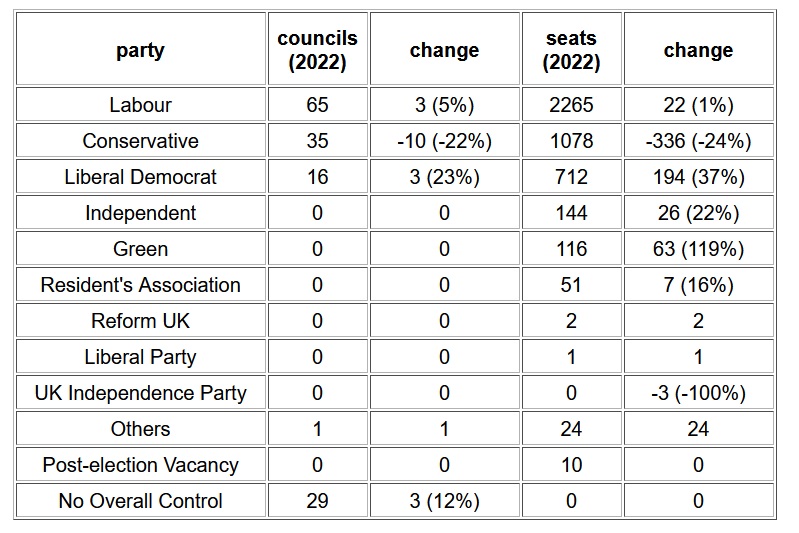
If Lisa Nandy, the Shadow Secretary of State for Levelling Up, believes that a one percent rise over a four year period is cause for celebration, then she might have set the bar very low for cancelling out any inequality.
Here are some statistics for the results in England. The data has been derived from the BBC website and it required minor adjustments because the BBC’s “Change” values did not include the four newly formed councils.
No doubt the Conservative activists will be licking their wounds, while the LibDems and Greens have every reason to celebrate. But the Starmer team must need their heads tested if they think this is a good outcome for their experiment in turning a democratic party into a hostile dictatorship.
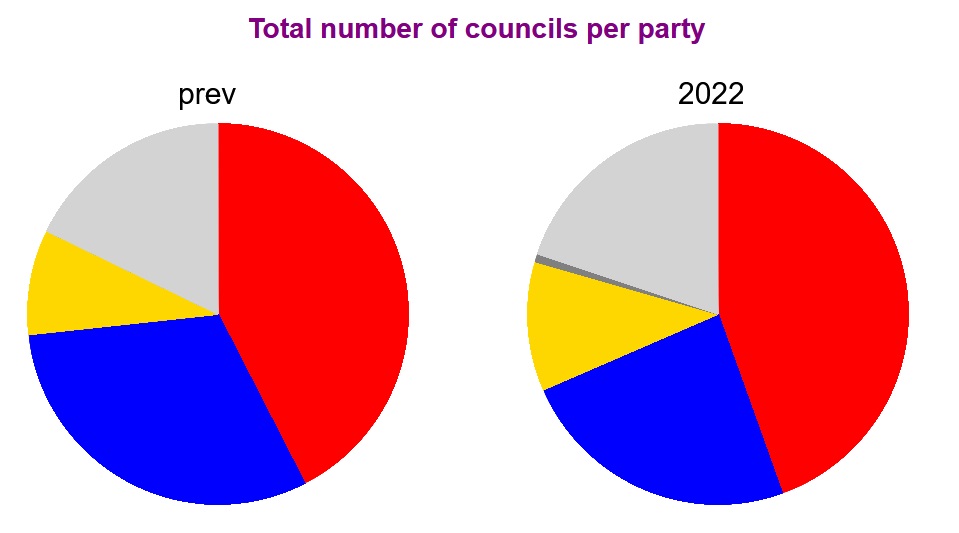
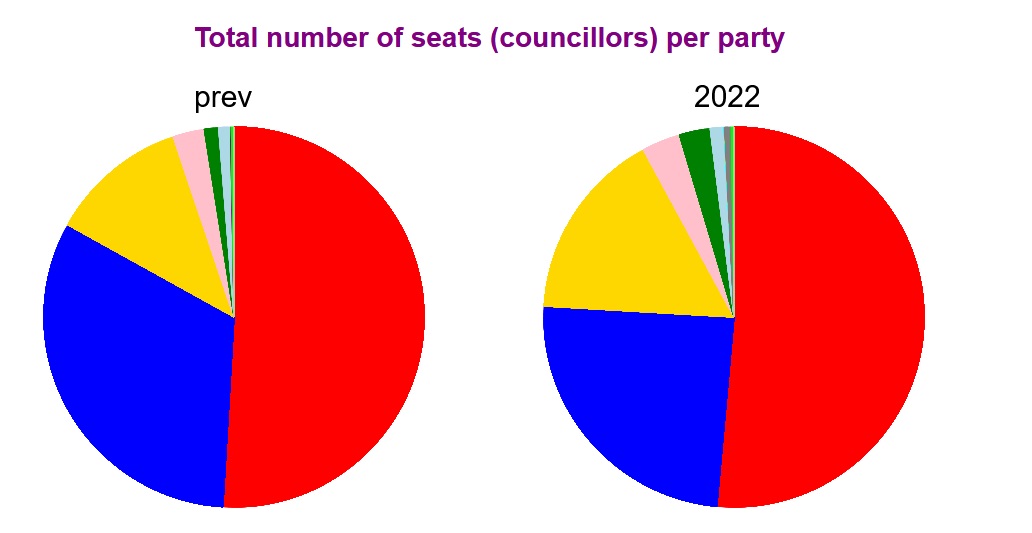
Changes in control
| ASPIRE GAIN FROM LABOUR | Tower Hamlets |
| LABOUR GAIN FROM CONSERVATIVE | Barnet Southampton Wandsworth Westminster |
| LABOUR GAIN FROM NO PARTY MAJORITY | Crawley Kirklees Rossendale Worthing |
| LABOUR WIN NEW COUNCIL | Cumberland |
| LABOUR LOSS – NO PARTY MAJORITY | Croydon Hastings |
| CONSERVATIVE GAIN FROM LABOUR | Harrow |
| CONSERVATIVE WIN NEW COUNCIL | North Yorkshire |
| CONSERVATIVE LOSS – NO PARTY MAJORITY | Castle Point Huntingdonshire Maidstone West Oxfordshire Wokingham Worcester |
| LIBERAL DEMOCRAT GAIN FROM CONSERVATIVE | Gosport |
| LIBERAL DEMOCRAT GAIN FROM LABOUR | Kingston-upon-Hull |
| LIBERAL DEMOCRAT GAIN FROM NO PARTY MAJORITY | Woking |
| LIBERAL DEMOCRAT WIN NEW COUNCIL | Somerset Westmorland & Furness |
Councils with no change
| LABOUR HOLD | Barking & Dagenham Barnsley Birmingham Blackburn with Darwen Bradford Brent Bury Calderdale Cambridge Camden Chorley Coventry Ealing Enfield Exeter Gateshead Greenwich Hackney Halton Hammersmith & Fulham Haringey Hounslow Ipswich Islington Knowsley Lambeth Leeds Lewisham Lincoln Manchester Merton Newcastle-upon-Tyne Newham North Tyneside Norwich Oldham Oxford Preston Reading Redbridge Rochdale Salford Sandwell Sefton Slough South Tyneside Southwark St Helens Stevenage Sunderland Tameside Trafford Wakefield Waltham Forest Wigan Wolverhampton |
| CONSERVATIVE HOLD | Adur Amber Valley Basildon Basingstoke & Deane Bexley Brentwood Bromley Broxbourne Cannock Chase Cherwell Dudley Epping Forest Fareham Harlow Havant Hillingdon Kensington & Chelsea Newcastle-under-Lyme North East Lincolnshire Nuneaton & Bedworth Pendle Redditch Reigate & Banstead Rochford Rugby Runnymede Rushmoor Solihull Swindon Tamworth Thurrock Walsall Welwyn Hatfield |
| LIBERAL DEMOCRAT HOLD | Cheltenham Eastleigh Kingston-upon-Thames Mole Valley Richmond-upon-Thames South Cambridgeshire St Albans Sutton Three Rivers Watford Winchester |
| NO PARTY MAJORITY | Bolton Burnley Colchester Derby Elmbridge Hart Hartlepool Havering Hyndburn Milton Keynes North Hertfordshire Peterborough Plymouth Portsmouth Sheffield Southend-on-Sea Stockport Tandridge Tunbridge Wells West Lancashire Wirral |
| party | num councils | gains | num cllrs | gains |
|---|---|---|---|---|
| Labour | 65 | 3 (5%) | 2265 | 22 (1%) |
| Conservative | 35 | -10 (-22%) | 1078 | -336 (-24%) |
| Liberal Democrat | 16 | 3 (23%) | 712 | 194 (37%) |
| Independent | 0 | 0 | 144 | 26 (22%) |
| Green | 0 | 0 | 116 | 63 (119%) |
| Resident’s Association | 0 | 0 | 51 | 7 (16%) |
| Reform UK | 0 | 0 | 2 | 2 |
| Liberal Party | 0 | 0 | 1 | 1 |
| UK Independence Party | 0 | 0 | 0 | -3 (-100%) |
| Others | 1 | 1 | 24 | 24 |
| Post-election Vacancy | 0 | 0 | 10 | 0 |
| No Overall Control | 29 | 3 | 0 | 0 |
| party | losses | gains |
|---|---|---|
| Aspire | Tower Hamlets | |
| Lab | Croydon Harrow Hastings Kingston-upon-Hull Tower Hamlets |
Barnet Crawley Cumberland Kirklees Rossendale Southampton Wandsworth Westminster Worthing |
| Con | Barnet Castle Point Gosport Huntingdonshire Maidstone Southampton Wandsworth West Oxfordshire Westminster Wokingham Worcester |
Harrow North Yorkshire |
| LibDem | Gosport Kingston-upon-Hull Somerset Westmorland & Furness Woking |
Labour’s Electoral Discomfort
Phil Burton-Cartledge, All that is Solid, 11th May 2022
Last Thursday’s local elections were bad for the Conservatives. Very bad. Dropping 500 seats was awful enough, but there’s a seldom told story that was lost amongst the spin and is only now coming out. On the BBC’s election programming, Yvette Cooper was wheeled out to put a brave face on Labour’s modest gains. Gains, in case folks stopped paying attention, that got more modest as the weekend wore on. But on the further advances the Tories made in the so-called red wall, she argued that if you looked at the vote share since 2019, Labour’s recovery in many of these places was in fact underway. It’s tempting to dismiss this as self-serving spin, but this was a broken clock moment: her claims were fundamentally sound.
Over at Prospect, Stephen Fisher has crunched the numbers. While plenty of people have pointed out Labour hasn’t made much progress compared to 2018, the last time these seats were fought under Jeremy Corbyn, that Thursday’s results almost put them on a par with four years ago suggests support lost at the general election might be returning. Indeed, Labour was up six points in “Leaveland” versus three points in remain-voting constituencies. Stephen goes on to suggest that the below-the-counter electoral pact between Labour and the Liberal Democrats would actually strengthen Labour’s chances in its former strongholds, what with the anti-Tory vote not getting splintered. For example, doing some quick sums from the Newcastle-under-Lyme Borough Council elections for contests in the constituency boundaries, Gareth Snell found that Labour polled 9,500 votes – a thousand more than the Conservatives while the LibDems managed 1,500. This despite the Tories winning new seats on the council at Labour’s expense.
Therefore, the Tories are in a worse position than their apparent consolidation suggests. Except, happily, the news for the Tories is even grimmer than that. As we know, older people are more likely to vote and older people disproportionately favour the Tories. Therefore, as council elections are second order elections this age bias in voting becomes even more attenuated. Last Thursday was said to favour Labour because it was fighting more defences than any other party, but the demographic profile of the average local government election voter leans more toward the Tories and, indeed, helps explain why last year’s results were so bad. A shift toward Labour among this constituency spells bad news for the Tories regardless of whether the seats are Labour or Tory leaning. Even worse, in the circumstances of a general election when turn out is up and more working age people go to vote – who in the last decade have had a clear preference for Labour – assuming things stay as they are, the Tories could be in for an even worse pummelling.
But that’s the red wall. One cannot get away from the fact that the Liberal Democrats were the runaway winner in England, with the Greens in a very respectable second place in terms of seats won. Why are these parties picking up seats across the south? Why are they proving more potent than Labour in the so-called Blue Wall? Firstly, what it isn’t is “Long Corbyn”. No one except for those who have an interest pretending otherwise can maintain Labour is unchanged under Starmer. We’ve gone from a radical, transformative politics to an authoritarian mess in which progressive positions are the exception rather than the norm. And yet Starmer’s Labour aren’t performing like a viable proposition across the south. Why? Reflecting on his party’s drubbing, Damian Green writes that Tory culture war obsessions are turning off swathes of Conservative voters, such as those comfortable with the social liberalism of the coalition government or found Theresa May’s (rhetorical) social justice pledges attractive. Johnson isn’t interested in conserving anything and he’s given the green light to his subordinates to bulldoze their way key British institutions, like broadcasting. And so this electorate rebels by turning to the smaller parties.
Why aren’t Labour capitalising on this growing anti-Tory mood in the shires? While the leadership has cosplayed authenticity and patriotism to win back property-holding pensioners in the north, Starmer’s straight up refusal to support the right thing unless it’s electorally expedient has been noticed. Labour did not make a concerted attack on the government’s privatisation of Channel Four. Labour chose to emphasise the cost of transporting refugees to Rwanda rather than taking a values position. He did not jump on the ‘one rule for them’ bandwagon until the focus groups said it was a good idea, and when it comes to other aspects of what you might loosely term liberal Britain, Starmer is nowhere seen to be defending it. In other words, despite sticking up for the status quo by promising nothing Starmer is as inconsequential to this layer of voters as they have been in his electoral strategy. How this differs from Tony Blair who affected enough liberal hero concerns to be seen as a champion self-defined “progressive” or modern one nation centre right voters could believe in. At least before 1997. The LibDems, now realising there are gains to be made from concentrating their fire on the Tories, are the natural protest repository for this substantial layer of soft Conservative support. It doesn’t matter what the actual detail of LibDem policy is, they’re known for liking nice causes and a little bit of constitutional radicalism. They want a better, kinder politics, so vote for them instead. It’s to the Greens’ benefit that they too are carving a similar space out for themselves, but with added environmentalism.
But this is only part of Labour’s woes in the south. While the old and retired turned out disproportionately for these elections, so did the comparatively smaller politically-engaged working age population. And it’s a concern that these, by and large, kept their distance from Labour in the south. It’s almost as if they reached for whatever tool was at hand to bash the Tories about with, and in many cases decided the LibDems and Greens were better placed to do it. Nor is it difficult to fathom why. Despite Labour enjoying polling leads among working age people, it has done nothing to maintain this advantage. It goes out of its way to present itself as socially conservative, just as those values are shrivelling up and dying off. It makes a virtue of not highlighting anything that responds to their interests, such as deaing with the housing crisis, crap wages, lack of opportunities, and so leaves the field wide open for others. Political science ain’t rocket science. For obvious historical reasons this layer, particularly the younger workers, aren’t going to find the LibDem pitch too attractive apart from their not being the Tories, but the Greens are different. Their raison d’etre is the climate crisis, which the other parties only pay lip service to. You don’t need me to tell you why this matters more the younger one is, and so from the off they enjoy an association with tackling an existential crisis that can only get worse. Second, while the Greens oscillate between the centre and the radical left, formally speaking its values impeccably line up with that of the rising generation. And for those who look a bit further, its policy platform is more robust in addressing the interests of working class people than Labour’s. Is it any wonder they were the go to in parts of the south instead of the party supposedly rooted in the labour movement?
This matters. Contrary to the impression Labour’s vote is unified in the “recovering” red wall, the Greens in particular pose it some real difficulties. If Starmer carries on as he does, and he will, what we’ve seen in the south we could see elsewhere. Local elections come up, and Labour is blunted by a bleed to the Greens and LibDems. If any lessons have been learned from the UKIP surge, it’s that protest votes can firm up into general election votes, or offer a gateway to the Tories. Contrary to the dim bulb analysis clung to by the Labour leadership, the red wall is a demographically complex place. Among other things, because Starmer is offering our class nothing, particularly the young, then it’s quite likely that enough of this vote could be peeled away by the Greens and LibDems in the Tory-held seats Labour needs to win back. In other words, the Tories aren’t the only ones suffering southern discomfiture. The local election results could show Labour a future where challenging the Tories is hopelessly split because of the political cowardice of its leadership.









I have read nothing about turnout in these local elections. I’d like to know how it compares with the last local elections in these areas. The stay-at-home/ none of them reflect my views/ they are all the same are surely an important aspect of any assessment of the parties.
The underlying pattern seems to be that Labour gained votes on the right from disillusioned Conservatives and lost them on the left, where people who had been Labour supporters (or members) moved to the Greens or the Liberal Democrats. It is worth remembering that before 2010 the LDs had a lot of success among people who found New Labour too right-wing , which is one reason why entering the coalition was so damaging for them. There is every indication that they will try the same strategy again.
We can assume that before the next election the Conservatives will make a serious attempt to woo back the voters who have abandoned them. There is no indication that the Labour Party, under its present leadership, will try to do the do the same; rather the reverse, in fact.
This also suggests that the idea of a ‘progressive alliance’ against the Conservatives is delusory. People who have deserted Labour since 2019 are one of the main pools in which the Greens and the LDs are fishing. For them to start cosying up to Starmer now would be catastrophic for them.
A fine article, with plenty of facts and good arguments. It is rather substantial for me to assimilate in a single read-through. However, it is a common fact that Starmer and adherents are worse than useless. Let us hope for change.
@ Emma Tait
I was interested in the voter turnout issue too. Someone suggested reviewing the 2022 local election pages in Wikipedia which listed results and turnout constituency by constituency. I didn’t get round to it!
I voted Labour as a recent non-renewer…I have a high regard for local comrades. I held my nose tho’.!
If Starmer does not change…or we do not change Starmer …we have a busted flush.
Worthy & analytical but too long. key points & they are important, re demographic & Labour failure to produce policy, failed defence of status quo, are buried in a text most peoole wont have the time or patience to read
I wd encourage the autbor to pull key points out of the text and reproduce them with more punch – worth reposting often in diffferent spaces,