
A closer look at Starmer offers no good news – two articles

JVL Introduction
Peter Oborne looks at the great opportunities facing Keir Starmer, but fears he will not take them and will fail.
Instead of defining his project as Labour leader against Rishi Sunak as one of establishing (as did Atlee) a new public realm, he would rather define himself against his predecessor Jeremy Corbyn (the days when he stood as continuity candidate are long gone!). He now demonises Corbyn vindictively.
(Note in passing Oborne’s reference to Labour’s double standards. Jenny Manson refused to retract, let alone apologise for her assertion on Newsnight that claims of antisemitism in the Labour Party had been exaggerated, and was exonerated; while Corbyn, whose case is all but identical, remains in exile.)
(Oborne compares Blair and Atlee, so it is important also to note that while Atlee had many things to his credit that Blair has not, the two share complicity in Israel’s oppression of Palestinians. Atlee’s government facilitated the Nakba by refusing as the occupying power to enforce the UN partition agreement while Blair’s condoning of Israeli aggression is well known)
But Starmer’s project is doomed: “He stands no chance, “ affirms Oborne, “if he continues to embrace a bankrupt political and economic model.”
Our thanks to Middle East Eye for permission to repost this article.
________
Mark Seddon, too, is clear that Starmer will not bring about the much needed transformation of British society as he explains in Keir Starmer the shapeshifter.
As someone who was persuaded to vote for Starmer as leader, he is grievously disappointed: “Each of his pledges, let alone his values, has since been discarded, along with the party’s former leader and a significant portion of its fee-paying membership.”
Attlee, not Blair, must be Starmer’s inspiration
By restoring morality to public life, challenging the failing neoliberal economic model and rebuilding the UK, Starmer can emulate his magnificent predecessor Attlee. If not, he will fail
Peter Oborne, Middle East Eye, 24th January 2023
Britain’s post-war history can be divided into three distinct and contrasting stages.
The first, which lasted from 1945 until 1979, can be called the Age of Attlee. The self-deprecating Labour prime minister has often been mocked in comparison with Winston Churchill, whose loyal understudy he had been during the Second World War.
But his achievement was profound. Clement Attlee established British social democracy, creating the modern welfare state and the National Health Service. Even though he enjoyed a relatively short period as prime minister (1945-51), the Tory governments which succeeded him never dared dismantle the Attlee model.
The victory of Margaret Thatcher in 1979 was as momentous as Attlee’s triumph in 1945. Along with Ronald Reagan in the United States, she inaugurated an epoch of neoliberalism, defined as free markets and the sale of state assets. Her legacy was guaranteed in 1997 with the victory of Tony Blair’s New Labour. Rather than restore Attlee’s vision, Blair embraced Thatcher’s.
Today the epoch of neoliberalism has ended. The financial crisis of 2008 was the first sign. Looming global recession, mounting debt, the rise of protectionism and the US weaponisation of the dollar as a tool of foreign policy have undermined it further.
More than anywhere else, this is the case in Britain. Here, neoliberalism has degenerated in a remarkably short space of time into a system of state plunder by members of a financial elite. Attlee’s idea of the public domain, embattled though not destroyed under Thatcher and Blair, is under systematic and brutal assault – as a fresh series of scandals over the weekend demonstrate. There will be more to come.
A failing system
This brings me to Keir Starmer. Starmer has taken over the Labour Party at a turning point in history when, under a corrupt government, the dominant ideology of neoliberalism has collapsed. Yet in his three years as opposition leader, Starmer has done everything he can to prop up a failing system.
Let’s take Attlee’s greatest legacy – the National Health Service. Earlier this month, Starmer adopted the hardcore neoliberal position that the NHS must “reform or die”, with the private sector given a larger role – a position already championed by the shadow health secretary, Wes Streeting.
Starmer set out this new position in the Daily Telegraph, a paper so far to the libertarian right that it even supported Liz Truss’s calamitous budget.
It’s the same with trade unions. Starmer has refused to support this winter’s strikes and banned Labour MPs from appearing on picket lines – even though opinion polls show that many of the strikes enjoy a great deal of public sympathy.
On Brexit, it is a similar story. As evidence mounts that leaving the European Union has been a disaster for the UK, Starmer endorses the same denialism adopted by the prime minister, Rishi Sunak, and his ministers. This position is all the more baffling because all opinion polls show that public opinion on Brexit has shifted irrevocably.
So, it seems that Starmer has made a strategic decision to fight the coming general election on Tory terms – as a supporter of neoliberal policies, but as someone who can manage them better.
But there is a twist to this strategy. Starmer has chosen not to define his leadership of the Labour Party against the prime minister – as one would expect of an opposition leader.
Instead, he defines himself against his predecessor, Jeremy Corbyn. This has led to bizarre intellectual contortions, because Starmer was one of Corbyn’s most senior lieutenants at the 2019 general election. Yet at the next election, which must be held before January 2025, he will stand as the Labour leader who, while agreeing with many Tory policies, repudiates Corbyn and all his works.
The Tories have worked out Starmer’s strategy, and ruthlessly play on it. At prime minister’s questions late last year, Sunak accused Starmer of supporting Corbynite plans to abolish the armed forces, withdraw from Nato and scrap the nuclear deterrent.
Demonisation of Corbyn
Starmer would have known that Labour’s manifesto contained none of these proposals. But he did not say so – or even lift a finger in Corbyn’s defence, even when he was smeared by the Tories in parliament. Starmer’s strategy (also adopted by his front bench) involves the vindictive demonisation of Corbyn.
To give another example, last year Labour’s national executive committee cleared Jenny Manson, co-chair of Jewish Voice for Labour, after a long investigation into her assertion on Newsnight that claims of antisemitism in the Labour Party had been “exaggerated”.
Starmer’s Labour made this ruling even though Manson refused to retract, let alone apologise for, what she said. Corbyn, whose case is all but identical, remains in exile.
Here is the defence of Starmer: he is not seeking doctrinal purity. His ruthless objective is to win the next election, whatever the means. His prime target is middle-of-the-road Conservative voters who are understandably repelled (as any decent person must be) by the incompetence, corruption and personal greed of Sunak’s morally derelict Conservatives.
The opinion polls suggest this policy is working. One-nation Conservatives, led by the former Conservative chancellor Ken Clarke, say they want Starmer to win. I expect others, probably including former cabinet ministers, among them the former Tory star and leadership contender Rory Stewart, to follow suit.
A deep crisis
This is exactly the strategy followed by Tony Blair ahead of his famous 1997 general election landslide. It is often forgotten that Blair, like Starmer, was neurotically cautious, endorsing his opponent’s economic policies.
Blair, again like Starmer, behaved as if his main opposition was the Labour left (above all the unions). Blair, in another analogy with Starmer, was guided by focus groups. (This is another important reason why Starmer’s policies are almost identical to Sunak’s, who is equally obsessed with this dismal political technology).
 Such an approach might help him to win the next election, but it is not leadership – and will make actual government much harder.
The British state has entered its deepest crisis since Clement Attlee was elected prime minister three-quarters of a century ago.
This crisis has handed Starmer a historic opportunity to emulate his magnificent predecessor, by restoring morality to public service and rebuilding Britain.
He stands no chance, however, if he continues to embrace a bankrupt political and economic model.
The views expressed in this article belong to the author and do not necessarily reflect the editorial policy of Middle East Eye.
Peter Oborne won best commentary/blogging in both 2022 and 2017, and was also named freelancer of the year in 2016 at the Drum Online Media Awards for articles he wrote for Middle East Eye. He was also named as British Press Awards Columnist of the Year in 2013. He resigned as chief political columnist of the Daily Telegraph in 2015. His latest book is The Fate of Abraham: Why the West is Wrong about Islam, published in May by Simon & Schuster. His previous books include The Triumph of the Political Class, The Rise of Political Lying, Why the West is Wrong about Nuclear Iran and The Assault on Truth: Boris Johnson, Donald Trump and the Emergence of a New Moral Barbarism.
Keir Starmer the shapeshifter
Fracturing the Labour Party won’t win him the election
Dogged by the Covid lockdowns and hamstrung by no discernible charisma quotient, Keir Starmer has spent the best part of his nearly three years in office telling voters what was wrong with his own side, while attacking the Government without ever really explaining what the cure might be. Now, as the party that Starmer now portentously refers to as “my Labour Party” becomes accustomed to a double-digit poll lead, the question is: what does he really believe in?
Starmer and his Shadow Chancellor, Rachel Reeves, spent the past week in the somewhat unlikely setting of Davos in Switzerland. Their reason for attending the World Economic Forum — that exclusive club of business magnates and like-minded politicos — was clear: to demonstrate that Labour had moved back to what is euphemistically described as the “centre ground” (the “centre” is wherever an exclusive set of pundits and politicians decide it to be). Clearly now in better, more refined company, Starmer, in an interview with Emily Maitlis, rather let the cat out of the bag: “Westminster is too constrained,” he said. “Once you get out of Westminster, whether it’s Davos or anywhere else, you actually engage with people that you can see working with in the future. Westminster is just a tribal shouting place.”
Read the full article here.














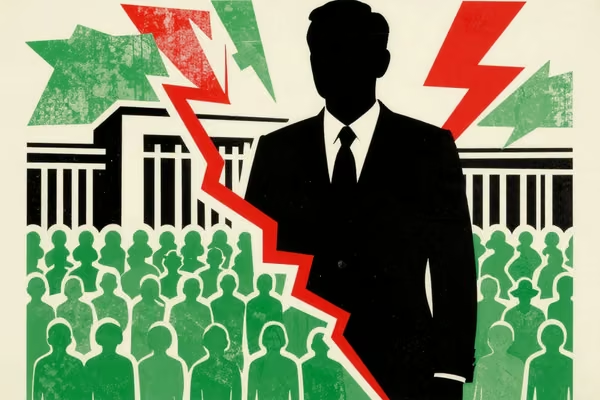

“..Starmer can emulate his magnificent predecessor Attlee”.
I have great respect for Peter Oborne, but this is the sort of phrase which probably stems from an honest but evident lack of knowledge of colonial history which he may have imbibed from his conservative background..
What I find more disturbing is the stubbornly rose colouredl nostalgia for the Attlee government to be found amongst so many democratic socialists and JVL supporters. In practice the foreign policy the Attlee government was as viciously reactionary and racist as that of Blair or anything we may expect from the Starmer clique in government. The postwar Attlee government adopted anti-colonial rhetoric but pursued murderous and well documented colonial war crimes in Vietnam, Indonesia, Greece, Malaya, Kenya, India, Palestine, Iran and Korea. The ugly truth is that the domestic postwar “social contract” and welfare state were economically dependent on the continuation of colonial and later neocolonial exploitation.
Furthermore the postwar Attlee government’s UK immigration policy was also overtly antisemitic and racialised. As John Newsinger pointed out:
“The extent to which Labour’s immigration policy was ‘racialised’ could not be more dramatically demonstrated than by the preference for Ukrainians and Balts who had fought in the SS over black men from the Caribbean who had fought in the British armed forces.”
For more details see:
https://journals.sagepub.com/doi/pdf/10.1177/0306396818779864
Starmer has also threatened any Labour MP who supports an honest discussion of how the war in the Ukraine came about. In doing so, he has helped put all our lives at risk.
It is one thing to disagree with them but it is quite another to permanently remove the whip from them and thus ensure that they cannot stand for Labour again.
Starmer is an absolute disgrace.
While agreeing with all the criticism of Starmer, I have always argued that the fundamental problem is the *British electorate and the need for power-seeking politicians to appeal to the majority of those who vote. I don’t think that Corbyn’s near miss in 2017 really undermines my claim at all; May combined uselessness with complacency with equivocation.
* I am not convinced that voting SNP in 2017 was beneficial to anyone. Government from Cardiff anyone?
HEALTH NEWS
Writing in the Telegraph
The paper of the people
Starmer tells the Masses
Reform or die. Work harder
For your Masters. Longer
Faster. I’ll reward you
With this promise. Trust
Me. I’m a doctor. Shipman
But with Brylcreem. Me
And Comrade Streeting
I am deeply grateful to George Wilmers for his link to the article by Professor Newsinger which I have just read. It left me feeling shock and shame – particularly as my Indonesian daughter-in-law was sitting beside me. It should be read by every member of the Labour Party – but particularly by members of the Parliamentary Labour Party.
Starmer must be forced to resign, along with his self serving, bought and paid for, racist, far right, ‘centrist’ cronies!
Starmer once in charge of a corrupt CPS. brightonscandal.org.uk
Tony Benn said that once the right wing of the Labour Party have expelled the Trotskyist’s they will move on to the Socialists. The Labour Party will then be a second Tory party and the voting public will have no choice but a right wing government.