
Sanders Bill would hike taxes on big corporations
JVL Introduction
Labour’s lack of vision is startling. It would do well to listen to more radical voices in the States.
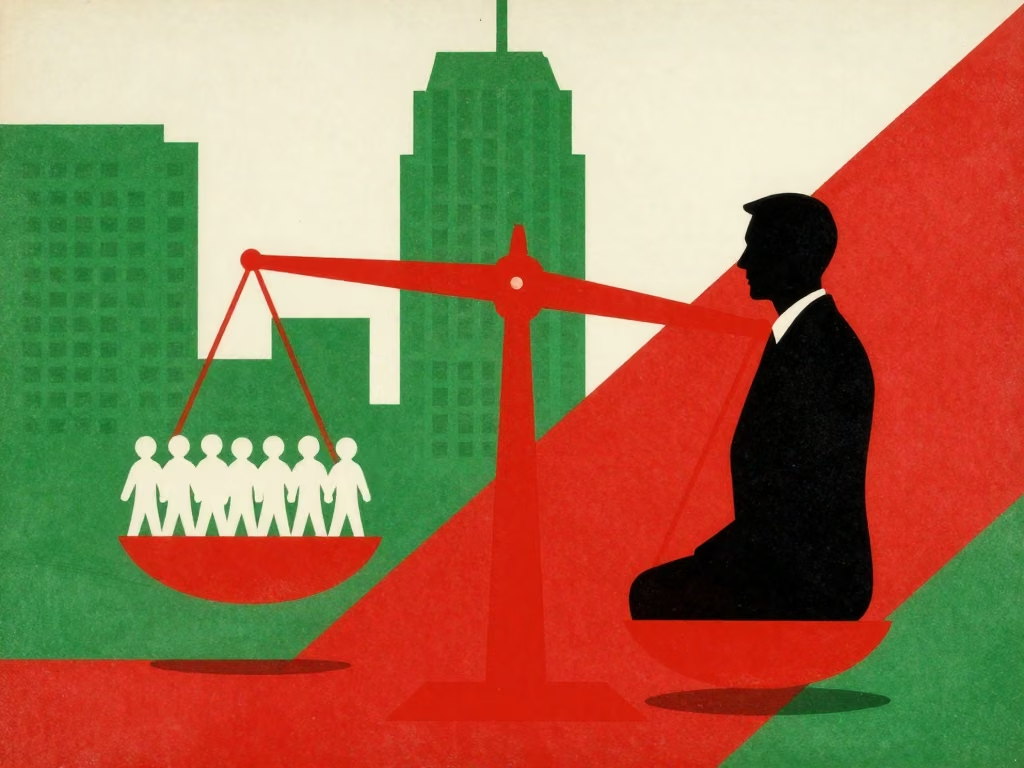
There, Bernie Sanders is trying to drive through legislation that would rise taxes on large corporations who pay their CEOs over 50 times what the average worker gets.
Contrast this with Keir Starmer and the shadow chancellor, Anneliese Dodds, who voiced strong opposition to tax rises in the week leading up to the budget earlier this month.
Where is Labour’s vision for a huge programme of public investment in a green new deal, public services and social care?
Where is Keir Starmer?
This article was originally published by Common Dreams on Wed 17 Mar 2021. Read the original here.
Sanders Bill Would Hike Taxes on Big Corporations That Pay CEOs Over 50 Times More Than Median Worker
Loading article text…










Dodds and Starmer support a windfall tax on excess profits and McDonnell agrees with their position that now is not the time for a general corporation tax rise on SMEs. Your article is a straw man.
Love Bernie Sanders.
Obscene the amount of tax avoidance/dodging of these big companies.
It might also be asked when is Bernie Sanders ever mentioned
by the Labour Party here?
You would think that given he self identifies as “Democratic Socialist” and has a high profile in the US now he would receive some recognition but no ..
A Resounding Silence ..
@Liz Pole: Your comment merely underlines the lack of socialist vision in the Labour leadership. You and they want nothing more than to emulate Conservative party polices in the hope of copying their vast success in elections. To what purpose beyond that? Labour needs to be a real party of the people which certainly includes increasing corporation taxes now – not at some vague point in the future.
I agree with James
Please allow me to inject a dose of economic realism into this discussion.
Sadly I cannot see this initiative by Bernie Sanders as anything more than political tokenism.
According to the figures cited in the article the measure, if passed, would bring in some $150 billion over a decade, which works out at an average of about $45 per citizen per annum. The most dramatic sounding figure cited of increased tax which would have been payable last year under the scheme is attributed to the case of Walmart: $854.9 million. That represents just 0.6% of Walmart’s gross profits for the year. Is that really what passes for “democratic socialism”? It doesn’t even begin to address the problem of oligopolistic structure. of capital ownership or even the problem of low pay. It merely provides a suitable distraction which will doubtless generate a storm political posturing by various factions of the Democratic party, howls of “Communism” from the Republicans, and it will at best end with some meaningless compromise.
Part of the problem here is that when government revenue or spending are discussed in the media, there is often a complete lack of appreciation of scale when large numbers are mentioned: it seems that for many journalists millions, billions, and trillions are all much of a muchness when discussing government finance. My normative suggestion for dealing with this problem is that all such measures of government finance should always be divided by the size of the population, so that an economic measure is arrived at which represents to the ordinary citizen what the sum really means in its significance for the local economy, in a readily comprehensible manner. Anyone can understand what $45 per annum means to them personally.