
“Knowing but not knowing”
JVL Introduction
The author, Yuli Novak, is a political activist, former executive director of Breaking the Silence, the organisation of soldiers who have chosen to speak out about what they saw and did while serving in the Israeli army of occupation.
Here she relates the story of a white South African living under apartheid, “knowing but not knowing” about the realities of the world she lived in.
As she explains: “You have to understand, the story we were born into was that if the Black people took over it would be a disaster…”
She recognises that it would be more comfortable to reinvent her past and say she was one of those who joined fully in the struggle against the evil that was apartheid. But she didn’t.
She realises, too, that there is a lot to learn from how people like her got on with their lives – and by so doing allowed the apartheid regime to flourish.
This article was originally published by Ha'aretz on Tue 12 Oct 2021. Read the original here.
'For Us, Mandela Was Just Another Terrorist'
A white South African on her experience during the apartheid regime, and the moral failure of progressives to challenge the racist system
Loading article text…

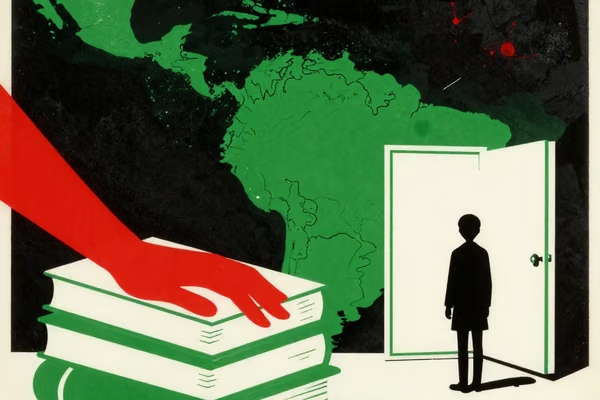
From the 1960s and before we in the West read about the treatment of political prisoners .. and life in the townships. Some of us in fact met those who had been expelled from the State during the 1960s.
It is therefore hard for us to realise what it was like to live there for people like the author – what an honest article ..
My cousin worked as a gynaecologist in Soweto. Yet when we went to the Apartheid museum in Joburg he came out saying he didn’t know all that had gone on in the apartheid era
And on it goes, Assange is imprisoned by “Good people” we each have a lot to answer for, good lawyers find reason to acquiesce with the political leaders thrust.
Very good reflection on what was possible & the belated guilt. The children of Nazis must feel the same. How do we plan for the future?
I’d never stopped to think about the media’s part – the S African media – in shaping and influencing what people thought and believed, so I did a search, as such, and came across some very interesting and informative articles, including the following piece:
https://truthout.org/articles/media-and-the-end-of-apartheid-in-south-africa/
The article resonates with repressionist regimes down the ages and I am sure that not many people will need to be told which ones are uppermost in my mind. Most people in most ages simply want to provide for their families and they tend to believe the people, the elite, who are in power, who tend to hide the worst of their atrocities in a blame culture from Witch hunt to Witch hunt in successive persecution of those who oppose their regimes. when the tables are turned the witch hunt begins again in reverse and it is the minions who suffer the most.
There’s a parallel here between the SA liberals and the neoliberals that are now dominating the Labour Party. The latter turn a blind eye to the atrocities committed in Israeli, “knowing and not knowing”. There is no alternative to the two state solution, despite the fact that the land which would constitute the Palestinian state is steadily being absorbed by the Israeli state.
“The possibility of living together, in one country, in which everyone would (will) be equal? Don’t make me laugh; that wasn’t (isn’t) an option that anyone took (takes) seriously.”
A very thought provoking account indeed! It identifies so clearly how good people can be manipulated, kept in the dark or so taken up with their own lives that they enable, without understanding their role, the very evil they deplore.
Very reflective article indeed. However I still struggle to understand how and why so many ‘good’ people, some of whom are friends of mine, can simply turn a blind eye. Or is it a deaf ear? I am not implying that everyone has or should have the capacity of a Joe Slovo, a Dennis Goldberg, Ruth First and so many other brave white activists against apartheid. Simply, why is it possible not to “tremble with indignation at every injustice” (Che). I’m afraid I can’t buy into the excuse of the “story we were born into”.
There is knowing and not knowing, and there is refusing to look. My sister, who lives in Italy, is convinced that the Palestinians and the Israelis can never live together in peace because their ‘stupid religions’ prevent it. When I put it to her that Iraelis might be motivated less by religion than by the ancient evils of blood (race) and soil (land), she decided that I was an antisemite with whom she could no longer communicate.
My sister has always held vaguely left-wing views, but her refusal to accept that Palestinians might be entitled to live as free and equal citizens in their own country – much as apartheid-era South Africans thought of the indigenous Africans they ruled over – looks disturbingly like anti-Arab racism. There are some of course who who!ld put that bias down to Islamophobia, but that also seems like a deliberate avoidance of the issue. The Palestinians have been robbed of their land, stripped of their rights, and rendered homeless and stateless by a colonizing force that uses the Holocaust as a pretext for their continuing abuse of a people who had nothing to do with that vile atrocity. Why is that so difficult to understand?
I can relate to this experience, having moved from London in 1967 aged 10 to live in Capetown until l was 17 and returned to London ; the white kids were wholly subscribed to the fearmongered lies about ‘separate but equal’, which was the foundation of ‘apartheid’. This was made possible by heavy censorship and the unavailability of television. Whites employed black people in their homes and businesses but never went to the offlimits townships, let alone the schools where 1/10th was spent per black pupil,compared with white. It wa a bittersweet time, struggling to fit in with perfectly nice white classmates whilst failing to persuade them of the iniquity of their situation.