
Israelis who refuse to fight – Book Review
JVL Introduction
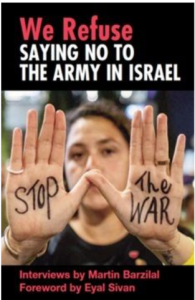
We Refuse: Saying NO to the Army in Israel by Martin Barzalai with foreword by Eyal Sivan
‘Today the State is Israel is not the state of the Jewish people, but rather a violent power apparatus over another people.
Violence has become the essence of the State of Israel. Among us, violence has become current currency, and we have become used to living with it”
Yeshayahou Leibowitz (Israeli philosopher)
This short and thought provoking book is mainly a collection of testimonies from fifteen Israelis who refused to fight in the Israeli Army. A wide range of issues are touched on, some of which are included in this review but there is, of course, much more in these essays derived from interviews by Martin Barzilai who writes in the closing chapter of the book:
“Israelis are steeped in a culture of militarism from a very young age. Throughout their schooling they participate in training courses and receive visits from military personnel who explain the importance of national service. Nevertheless, a certain number see through things and don’t go along with them. Every young recalcitrant embodies divergence, a discontinuity in this society – something thought of as a monolithic militarist bloc, one in which service is almost the precondition to citizenship.”
Most of the contributors were interviewed before October 7th 2023; the postscripts were added before the October 2025 “ceasefire” so there were still Israeli hostages being held in Gaza.
This book is about those few who do see through the pervasive inevitability of joining up; some are clear before they are called to enlist and others arrive at their conclusions based on experience of fighting, in one case this included time fighting in Gaza after October 7th 2023.
The army and weapons are ubiquitous in Israeli society, In 2012, I recall seeing off duty soldiers on their way home for Shabbat in full uniform with their rifles on their shoulders. So here we get some insight into why and also how they – and some others – resist. This can be via “grey” ways such as having a psychiatric diagnosis as well as serving but without fighting, for example in an administrative role as well as those like the “absolutists” in the first world war who would not fight or do anything that supports the fighting. But there are other ways in which people are perhaps not – or not able – to be fully engaged in the Israeli Army and I was astonished to learn from Barzilai’s concluding essay that “less than 60% of Israelis complete the full term of their service”.
The book also provides a glimpse into some different aspects of Israeli society, for example coming from an ultra (strictly) orthodox family compared with those who came from more liberal, left wing backgrounds. I think all were from Ashkenazi (Eastern European) backgrounds and several commented that it can be harder to refuse for those from Sephardi or Mizrahi communities.
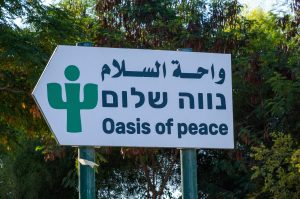
Barzilai’s grandfather, originally from Thessaloniki had fled France in 1940 for Uruguay but when Barzilai’s father needed to leave Uruguay he rejected the possibility of moving to Israel as they did not want to “leave one place where a coup d’état was approaching, to go to another land where war was threatening”. The family then moved to France. One contributor is the daughter of a refusenik herself and she was one of the two who had been brought up in Neve Shalom, Wāħat as-Salām or Oasis of Peace, where Palestinian and Jewish Israelis live and learn side by side.
Barzilai’s interest in meeting with and understanding refuseniks had gone on for two decades and more. In France, in 2017 a similar book by Barzilai was published “Refuseniks: dire non a l’armée en Israel”. After October 7th 2023, he found that many with whom he had had discussions as far back as 2008 and 2009 had left the country in disgust.
The personal testimonies here all show the difficulty of refusing, at how isolated you are likely to be in a society where “everyone joins the army” and “The entire people is the army”. Many have spent time in prison for their refusal to fight.
The refuseniks know that they will be hated and, most likely, threatened; for women this may well include rape threats.
“In such a climate” write Sival “the simple fact of refusing becomes a revolutionary act. More than an act of one individual conscience it is a political outcry, a refusal to be an executioner in a war machine that crushes lives.”
Most are not refusing the idea of service to their society and one contributor, Itamar Greenberg, says:
“I will certainly do some civilian service after prison; to have legitimacy in Israeli society I think that’s important. To contribute to peace-making I have to have legitimacy. I believe in law. Things would be untenable if everyone did as they please.”
Greenberg is from a strictly orthodox background and wants more involvement of this community in Israeli society but does not think the army is the answer.
“If the price of equality is killing and occupation then it’s unbearable. We haven’t obtained security with 300,000 soldiers and won’t get it with 366,000 either.”
Greenberg later spent 197 days in prison for his refusal to fight.
Michael Ofer Ziv joined the army as a left wing Zionist believing that it is good to join and change things, to “do things better” but once in the army he understood that “the problem was what we did, rather than the way we did things.”
Several of those in the book referred to how little Israelis know about what is happening which is made even easier by how little – if any – contact Jewish Israelis have with Palestinian Israelis let alone Palestinians in the West Bank and Gaza. “We are not shown horrific images of Gaza in the news”.
Sofia Or met other young women in prison who had fled the military because of sexual harassment over which there is a “law of silence when they complain”. These are among those who would be considered “deserters” and this can mean you cannot get a driving licence or leave the country. Nonetheless they were not interested in political discussion and hated Palestinians.
She was very clear about the dangers of conflating Judaism and Zionism and of learning the wrong lessons from the Holocaust as she says:
“Many people in Israel see a genocide of the Palestinians as a solution…They think: ‘That should never happen to us again’. The discourse of remembering the Holocaust amounts to saying that what happened to us gives us the rights to defend ourselves by any means – instead of reflecting in the mechanisms which engendered this horror or reflecting about the sorts of mentality that people had to have, to allow such things to happen.”
October 7th
Several referred to the western left considering Hamas as heroes and Judith Butler was cited as one example: this is not my experience, even though many who support justice for Palestinians do emphasise the context for the October 7th attack, few support Hamas or the nature of the attack that day.
Much as Avichai Mohar said:
“[Since October 7th] it has become even more difficult to defend an anti-colonial point of view. But for Israel, I think 7th October is exactly that which the left warned against. It does not make Hamas’s actions any more acceptable, but it does prove that violence is never a solution, it obstructs the future”.
It is clear that October 7th was difficult for the refuseniks even if, for most of them, it did not change their view about not fighting. The oldest contributor Chen Alon, 63 in 2023, had refused in 2002 having done reserve duties many times. He said that in 2000:“
I could see the expansion of the colonies in the occupied territories. Checkpoints, roadblocks, and cameras were multiplying…Palestinians had less and less freedom and my Prime Minister (Ehud Barak at the time LL) pretended that we had no interlocutors for peace talks. We were eating the pizza while pretending to negotiate how it should be divided up”.
He believes that the Zionism of the past was necessary, that if his grandfather had not fled Poland for Palestine that he would not exist:
“I respect the Zionism of the past. But I do not respect what was done in the Nakba: the massacre of Palestinians, I don’t respects occupations, apartheid and all the rest….”
Alon became active in Combatants for Peace and noted that after October 7th, it was his Palestinians comrades who called him that day to know how he was doing. But meetings of the group became difficult eg, the Israelis wanted the Palestinians to condemn Hamas and the Palestinians wanted the Israelis to condemn the attacks on Gaza. Combatants for Peace lost members from both sides. Some Israeli members rejoined the Army.
********
Do read these testimonies; we must not fall into the trap of dehumanising Israelis as too many have dehumanised Palestinians.
The book can be purchased from Central Books online and others such as Quaker Books.
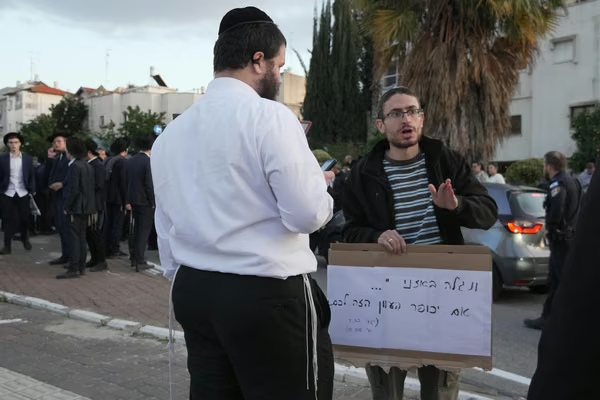

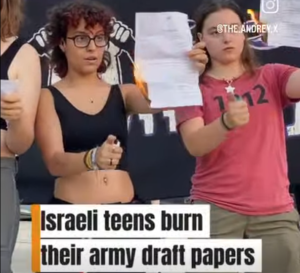
The teenage refusenik in the photo with the 1312 top shows that some refuseniks definitely are more politicalised.
Israel is coming apart at the seams. It didn’t have to be like this. But the leaders of the early Zionists [with the perfidious collusion of the British] chose to ignore the reality on the ground – the existing non-Jewish communities in Palestine – and the rest is history. If the early settler-colonialists hadn’t behaved so appallingly towards the indigenous Arabs – so badly that Achad-Ha-Am was sickened by what he witnessed and said so in no uncertain terms – a modus vivendi could have been found. But the ‘supremacist’ Jews weren’t having any of it. So much for Rothschild’s shot across the bows of the Zionists “…That {Balfour] Declaration places Jews on their honour…” addressing the jubilant throng crammed into the London Opera House on November 18 1917 after the signing of the Balfour Declaration. Why the discordant note of caution in such a joyous atmosphere? He feared the worst. That’s why. And his instincts have been borne out. God said, commanded, in terms ‘DO NOT establish a State of Israel before my return’. They knew better. Better than God. And now they’re wondering why they were so arrogant. Is the Jewish God an angry God?
https://www.timesofisrael.com/liveblog_entry/coalition-secures-extra-quarter-billion-shekels-for-haredi-education-opposition-alleges-theft/
Record Israeli emigration continued for third consecutive year in 2025, study finds | The Times of Israel
Ex-general assailed as a ‘traitor’ as Haredi demonstrators attack event for ultra-Orthodox draftees | The Times of Israel