
Hundreds arrested for opposing genocide: Shabana Mahmood can stop this charade!
JVL introduction
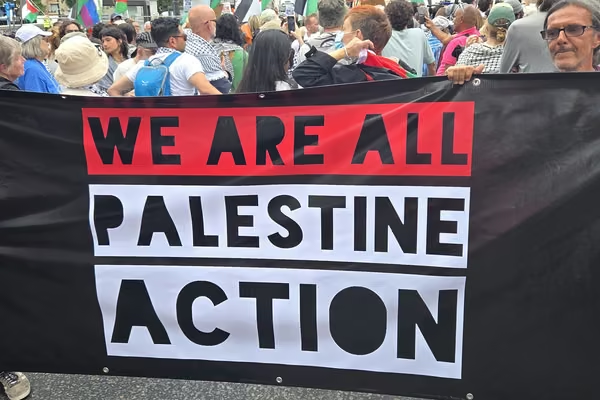
Shabana Mahmood, described by the BBC as Starmer’s new hardline Home Secretary, could put a stop to the madness we witnessed in Parliament Sq on Saturday in an instant by reversing her predecessor’s decision to proscribe Palestine Action.
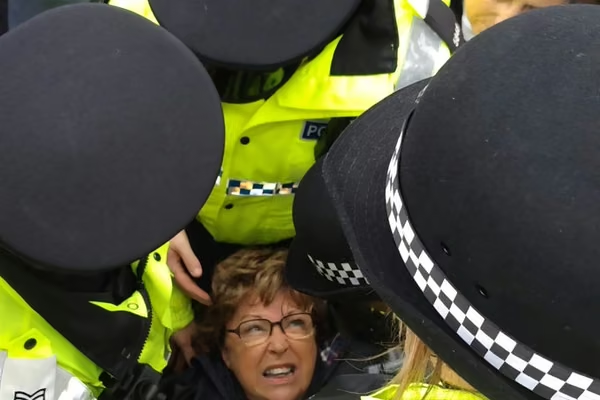
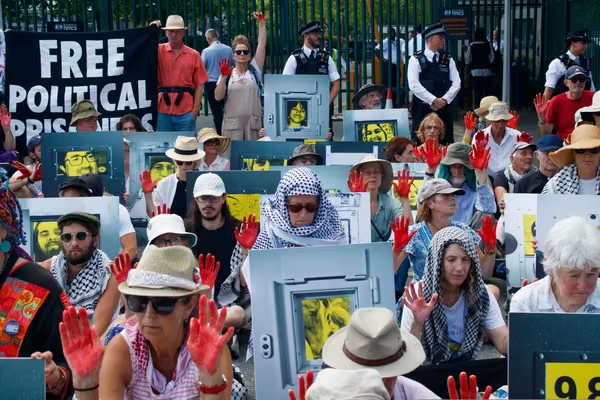
Massive police resources were squandered in persecuting hundreds of peaceful citizens engaged in an inspiring collective act of non-violent resistance. Legions of officers were diverted from other duties to join arrest squads carrying away seated protesters old, young and from all kinds of backgrounds; a whole temporary encampment was set up away from prying eyes in a sterile zone on Millbank, with a long line of gazebos sheltering dozens of plain clothes detectives with laptops, serviced by portaloos and miles of cabling, processing each of the 857 arrestees individually; dozens of vehicles transported prisoners to police stations all over Greater London until the last few arrestees, including this editor (number 851) were handed over for booking at around 0600 on Sunday.
Palestine solidarity supporters who came as witnesses to the protest were boisterous in their interactions with the police and there were some angry altercations. There were some arrests but media reports of violence against the police were wildly inaccurate, as their own photographs of squads of officers carrying away unresisting protesters clearly illustrated.
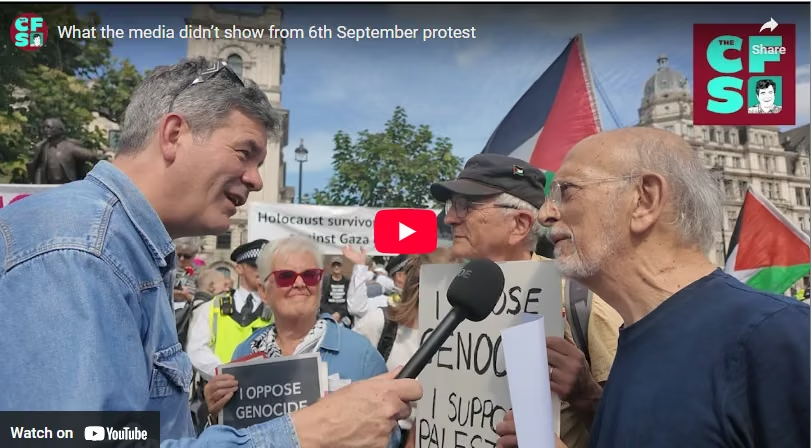
See below Crispin Flintoff’s film of the occasion and a report from Skwawkbox which cites Jonathan Cook’s article. You may enjoy this tongue-in-cheek write-up from Council Estate Media.
NWI
____________________________________________________________________________________
_____________________________________________________________________________________
Jewish victim of Met’s arrest spree and ‘protester violence’ lies: ‘state has clearly overreached, mass resistance works’
By Skwawkbox, September 8, 2025
Naomi Wimborne-Idrissi describes experience after almost 900 arrested for peacefully holding anti-proscription placards
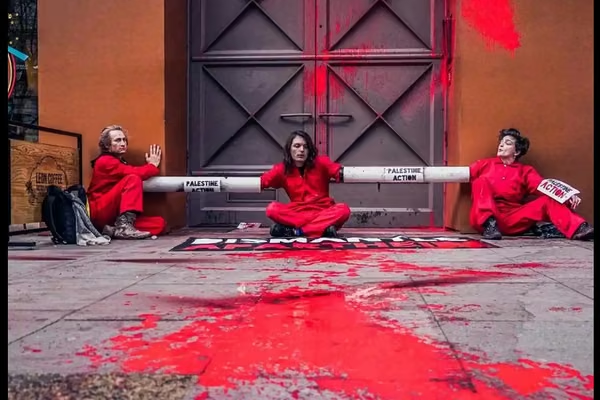
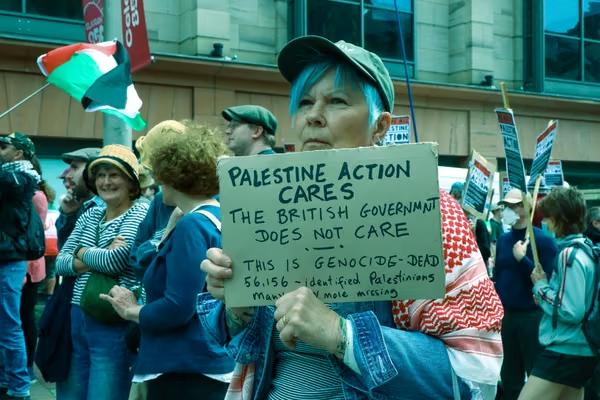
The Met Police have smeared Saturday’s ‘Defend Our Juries’ (DOJ) protest – against the proscription of Palestine Action, a non-violent direct action group as a terrorist organisation for its sabotage of Israeli and Israel-linked arms factories – as violent and abusive, despite an apparently complete lack of evidence in the public domain, among hundreds of hours of footage circulating on social media, of any such behaviour by protesters.
This was in contrast to the actions of some police officers, who appeared to ‘snap’ as protesters shouted “Shame on you” as officers arrested demonstrators, many of them elderly and/or disabled, often pushing protesters who were non-violent and injuring some.
Police overreach and their readiness to use underhand tactics to try to cope were evident – an impression reinforced by comments from Jewish activist Naomi Wimborne-Idrissi, who was arrestee number 851 on Saturday – out of almost nine hundred – at the demo about her experience after her arrest, which she and others described to Skwawkbox:
I’ll start by saying that the Met’s accusation of violence by the DOJ protesters towards police is completely without foundation. I was arrestee number 851, there for 9.5 hours before finally being carted off to one of the vans. Every single DOJ protester was 100% non-violent. There was anger, along with some hostile words from a very few pro-Pal protesters who came to offer welcome support and became understandably irate as one quiet, peaceable anti-genocide protester after another was carted away.
But the state clearly overreached on Saturday – the strategy of mass resistance works! Cops had clear strategy of trying to get people to accept street bail. 3 tactics:
• Arresting officer being overly friendly with ‘prisoner’, establishing ‘buddy’ relationship, suggesting that it would be much quicker and easier for all concerned to volunteer name, address and DOB and accept street bail
• Plain clothes cops coming up and down the processing line, enticing people to jump the queue and get a quick exit if they volunteered their details
• Cops spreading rumours that London custody stations were becoming very full, and that people who didn’t volunteer info quickly could be taken to stations in Gloucestershire, Wales, even Scotland and have to find their own way back to London.
In my own case one of the four plain clothes officers who processed me at Millbank repeatedly alluded to me being transported to Bournemouth if I refused to confirm my address. I ended up in Brixton.
Logistically overwhelmed
The police were clearly logistically overwhelmed by the task and many officers were disgruntled about what they were being asked to do and the way they were being assigned and treated.
After arrest, I was in the processing queue along Millbank from 10.30pm to 3.00 am. My arrest was one of the last, so by that stage there were far more cops than prisoners, loads of them hanging about with little to do apart from chat in small groups.
As they were tired and had let their guard down the chat was very revealing. Many resented being asked to arrest people protesters as terrorists – I heard some saying they should be arresting real criminals. They complained about the long hours (one mentioned being on shift more than 25 hours), leave being cancelled, not be allowed to go home, mandatory overtime, not enough coffee available, being expected to be back on shift after less than 11-hour rest period, and the general chaos. They talked about the unprecedented scale of the event and how they’d never experienced anything like it before.
The state expected their strategy of expediting street bail to work – the Welsh cops were not expected to be so long in London and I overheard conversations about them having to find emergency hotel accommodation for them – to the obvious resentment of some of the Met!
I was then in a stationary cop van at Millbank from 3am–6am before being taken to Brixton.
In the van, their operational radio was on constantly and was relaying exchanges between cops in vans to and from each other and their control room. It was obvious that they were struggling to find enough places in custody stations, and were taking people as far out as Bromley, Harrow, Colindale, Barking, Heathrow etc…
They also didn’t have enough drivers to get the arresting officers back to their home bases from the custody stations – into the early hours in particular, they kept requesting those officers who had completed the arrests at the custody stations and were finishing their shifts to stay on and do extra hours ferrying other officers back home from custody stations.
They called this task ‘welfare’. They couldn’t get enough volunteers for welfare, so ended up abandoning it and asking all sergeants to tell arresting officers that they’d have to arrange for their own teams/units/areas to arrange transport back to home base. They also appeared to be struggling with control room shifts ending and not having enough people to keep specific channels operational. In in all, every indication of chaos…
Protestors smeared
The arrestee’s experience is mirrored in that of other victims on Saturday – and in analysis from journalist Jonathan Cook, who wrote, in an article about the Met’s smears against protesters:
I was at the protest from its start till 5.20pm, about the time this claim was issued by the police. For much of that period, I should have been in a position to see examples of such violence because the police had made remarkably few arrests by then. Most came later.
If this claim from the police is true, they need to produce the evidence from the body cams all the officers there were wearing. Punches thrown at the ranks of police would be clear in such footage.
What I saw was what the police are terming “verbal abuse”: that is, every time a group of 10 or so officers were dispatched to arrest one of the silent protesters sitting on the green in Parliament Square, many of them elderly or infirm, other protesters who were observing the proceedings would gather around the arresting officers and try to shame them.
Chants of “Shame on you!”, “You’re on the wrong side of history!” and “What will you tell your grandchildren?” were intended to make the task of carrying out the arrests as difficult as possible for the officers involved.
It was clear that many of those officers were struggling emotionally with the task of arresting peaceful pensioners. Most looked down at the ground or at the chests of the chanting protesters, but refused to meet our gaze.
A few looked like they were cracking under the pressure. I noticed one male officer who was pale, sweating profusely and his eyes darting around erratically. Shortly afterwards he started lashing out, trying to push the chanting protesters over. From what I could see, most of the “scuffles” in video footage are examples of something similar: incidents in which one or more police officers “explode”, releasing pent-up frustrations at the protesters for reminding them of how illegitimate and demeaning the job of arresting silent pensioners trying to stop a genocide was.
Cook concludes that he has no sympathy for the overwrought police:
If the police are not happy about being made to enforce Palestine Action’s proscription because so many people reject it as an abuse of state power, then they can make their feelings known – very strongly, if they wish – to the government. They have many private and public channels to communicate their view that are not available to us.
But that is precisely the opposite of what the police command is doing at the moment.
The police are, as so often, acting as the ready and even eager enforcement arm of a state elbow-deep in collaboration with Israel’s slaughter of innocent Palestinians in Gaza – approaching half a million in almost two years of Israel’s genocide so far – and engaged in a ‘lawfare’ war against the rights of UK citizens and their freedoms of speech and assembly.
_________________________________________________________________________________





Very impressed by Naomi’s report; I’ve forwarded it to everyone I know who’s likely to be receptive.
Well done Naomi and Jonathan — heroes!
I find complete it madness that police have arrested disabled pensioners and others. Because Starmer’s government supports Israels slaughter of Palestinian people Genocide even though Lammy denied that.