
German festival blocks prize for film linking 2020s genocide and 1930s fascism
The Proscription of Support for Palestine
German festival blocks prize for film linking 2020s genocide and 1930s fascism
Tony Booth and Noah Mirlach
JVL introduction
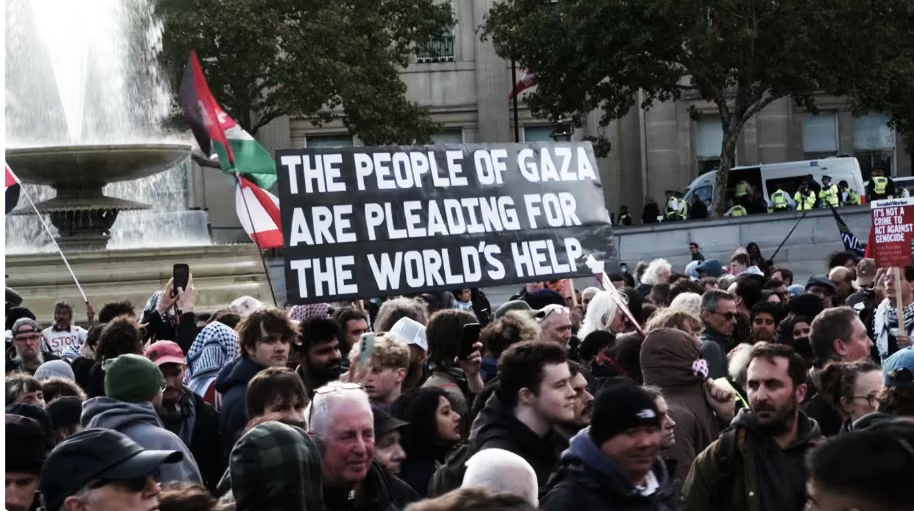
Tony Booth environment officer for JVL and Noah Mirlach, a young filmmaker, describe here the background to, and responses to the showing of the film The Descendent of Cable Street at the Flimmern&Rauschen Student Film Festival in Munich in March 2026. It covers the protest over the proscription of Palestine Action on October 4th, 2025, in Trafalgar Square where Tony was arrested, eighty-nine years to the day after his father’s arrest as one of the organisers of the resistance to Mosley’s British Union of Fascists at the Battle of Cable Street in 1936.
It is a brief family memoir as well as a story of political continuity and discontinuity in one Jewish family. One of Tony’s two sisters emigrated to Israel in 1962.
The film can be seen here. An account of Tony’s previous arrest for protesting proscription can be read here.
Tony writes about the context to the decision to make the film and then provides an edited interview with Noah about his experience at the festival, before offering a brief afterword.
The events leading up to the creation of the film
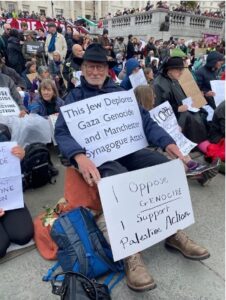 On October 4th, 2025, I sat with hundreds of others in Trafalgar Square to continue the struggle to have the proscription of Palestine Action overturned and to assert citizens’ rights to protest including by direct action. It was two days after the knife attack on the congregation of the Manchester Heaton Park Synagogue where an attacker fatally stabbed a worshipper and injured two others. In shooting the attacker the police also shot a second worshipper and injured another. The Metropolitan Police and the government called for our protest to be delayed out of respect for the victims. I supported the view that protest against genocide and action to combat antisemitism were part of the same struggle and entirely respectful to the dead and injured in Manchester. I sat with two placards. One, like everyone else’s, said: “I Oppose Genocide: I Support Palestine Action”. A second placard said: “This Jew Deplores Genocide and Manchester Synagogue Attack.” The sign brought me attention from the press and others present to offer their support to arrestees. Several times I found myself repeating in answers to questions that my Jewish experience gave me a duty to stand against both antisemitism and genocide.
The October 4th protest also held special significance because it was 89 years to the day since my father was arrested as he started to walk home after the Battle of Cable Street. He was pointed out to the police as one of the organisers of the resistance. They grabbed him and beat him up, then took him to the police station, beat him up again then charged him with assaulting a police officer. At the subsequent trial he was given a four-month prison sentence.
Noah, a young man studying film production at Westminster University was about to make a short film for his course. He is committed to the campaign for justice for Palestinians and thought that the proscription of Palestine Action and the defence of the right to protest would be a worthy subject for his film. After we talked, and I told him about the coincident connections on that day between my and my father’s Jewish activism he asked if he could make a film about this family story.
He produced an outline, gained approval from his tutors and assembled a student crew to work on location in and around Cable Street in London and in Cambridge where I live. He already had footage of the Trafalgar Square protest and my arrest. Noah explained how he shaped the film and its central theme:
My initial pitch for the film was more broadly about Palestine Action and the right to protest. When Tony agreed to be our participant it became something else – the historical parallels to his father’s involvement in the battle of Cable Street, his thoughts on Jewish identity and the complex family dynamics became key elements of the narrative. A lot of the work on the film was taking Tony’s rich stories and crafting a narrative that could fit into a 12-minute documentary. I realised that at its core, the story is both about the opposition to fascism and the opposition to Israel – the first is usually welcomed in western democracies, while the latter is too often shut down with antisemitism claims. However, Tony’s perspective shows that both fights stem from the same root.
The film included family photographs, some of which showed my sister who has lived in Israel since 1962. When I told her that the film was being made and that a few family photographs were to be included, she said that I did not have her permission to use any photographs of her. I thought long and carefully but decided to include them arguing to myself that this was a film about me and my family and that she was an important part of the story. With our political differences we were never going to reach agreement for me to include her image in a film equating protest against genocide in Gaza with the fight against fascism of our parents. We have started to speak with each other, again about ailments and family and the destruction in Tel Aviv where she lives during the war on Iran. We are not able to talk about politics or lives lost in countries other than her own.
Noah Mirlach reports on the showing at the Flimmern&Rauschen Student Film Festival in Munich

The film was shown at the end of March 2026 to a small audience of around 30. This was at the beginning of a new block of short films. People watching the previous block had just left to get drinks or some fresh air. But the reactions from this small audience were very positive. There was just time for a few questions. One audience member didn’t really have a question but just wanted to share his reaction: “the film is really great and very important”. This was greeted with a round of applause. One woman, who probably didn’t like the film as much, asked if the film was more about politics or just a personal portrait. I said that it started off as a political project, but it became both a political and a personal story as I got to know Tony. She then asked if I had considered including the other side of the story, whereupon the moderator interrupted and said that we were running out of time. Maybe she didn’t want a political debate or maybe there genuinely wasn’t any time left. A few other people from the screening came up to me afterwards and said they really liked the film.
The awards ceremony was at the end of the day. The jury had probably made the decision some weeks earlier, but the winners were announced at the ceremony. The category of university productions came up where my film was mostly competing with films from the Film and Television School in Munich. We didn’t win. Then the special category on the theme of justice came up and we didn’t win that. Then, finally, it came to the prize based on audience reaction. It generally goes to films that have bigger audiences shown in the evening. We didn’t win that either. Naturally, I was sitting feeling rather disappointed.
Then, after the ceremony, two jury members approached me. They realised who I was and the film I was involved with, because I was wearing a keffiyeh. They spoke to me for a long time. They appeared to be apologising for the jury’s decision. One said, “we made an amazing documentary and the jury wanted to give us the prize”. It had made a “strong emotional impact” on her and immediately afterwards she had sent it to her activist grandma who wanted to pass it to her friends. She said she was super disappointed by her colleagues, and it was important to her to explain how this happened. They both made it clear that political considerations had swayed the decision. They said that the most disappointing thing for them was that they felt the jury had done the wrong thing, morally. They knew that it was the kind of thing that was happening in Germany but had hoped that film festivals were more immune to government pressure than big institutions and stories like mine could be given a fair viewing and hearing.
During the Jury’s deliberations one person had raised a concern about the statement that would be read out at the ceremony which explains the jury’s support for a winning film. There was a fear that this would be seen as the festival taking a political stand on Palestine. Out of the 80 films at this festival, ours was the only one they rewatched from start to finish and had the longest conversation about. After an intense debate the decision was taken to give the prize to a different film. It’s difficult to know precisely how the jury’s preference to give the prize to my film was overturned through the raising of political concerns. It suggests that power dynamics were at play.
If the decision was affected by political considerations this must have been specifically about Palestine since other political films, one about the Ukraine war for example, were awarded prizes. There was even a special category with the theme “justice”. The political bias is obvious and it’s not surprising that this happens around the film industry and especially in Germany. I’m sure you’ve seen this stuff many times. I will say that for me, experiencing it with our own project, it really stings. The jury members encouraged me to keep trying, saying that: “hopefully, other festivals will have the balls to support it”. I am determined to submit it to other festivals including in Germany, so we shall find out. After all, ‘No Other Land’ won the Berlinale Documentary Award at the Berlin International Film Festival in 2024 and went on to win an Oscar for the Best Documentary Feature. It’s definitely worth trying.
Tony Booth afterword
I like the film. I think Noah and his student colleagues did an impressively professional job. Paring down the footage from a number of lengthy interviews meant that much nuance and detailed argument were lost but this was essential to allow an engaging story to be told in a short film. I particularly liked the linking of the fight against fascism of my parents in the 1930s with the struggle against genocide in Palestine at the present time. I see these, alongside the protest to preserve a liveable planet, as central to my Jewish Identity. Of course, they are central to many other people’s identities too. I reject the idea that because I am a Jew I must focus my energies on either on preserving a Jewish State or on opposing its tragic deformation in Israel. I am saddened but not surprised by what happened with the film at the Munich Festival. I am impressed with the courage of the two jurors to speak out about the political manipulation of the jury. They have made an important addition to the story.
I would be glad to see the film, well done Tony and Noah. Could JVL or the North London Peaceniks feature this short film at a fundraising event and discussion? A link for home viewing would also be great.
BTW – as a sister! – I didn’t see why pics of Tony’s sis had to be included against her expressed wishes. He could have mentioned her without using her images, surely? We all have to feel our way towards expressing differences and it’s unusual for any of us to be in complete agreement with family members on everything!
I’m also wondering why the festival committee couldn’t have safeguarded themselves by nominating more than one film for the award/s. Must have been horrible sitting through the ceremony with the film being ignored, but so good that audiences loved it. This can be the start for more grass-roots organising.
Congratulations on making the film on the parallels between the 1930’s and now.
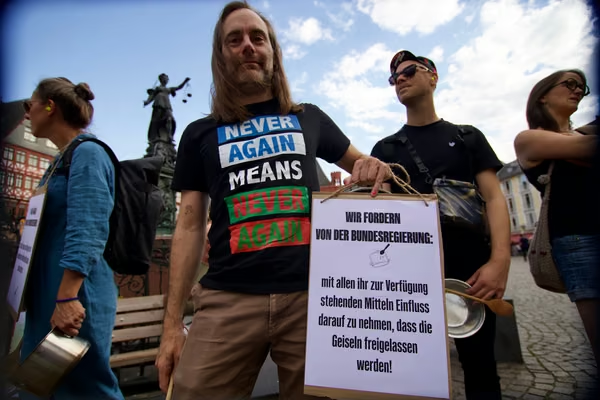
This is just another example of how the German State and its hirelings, including the Committee that made a decision to override the Jury’s preference, interpret Never Again as meaning Israel is entitled to perpetrate a genocide because Jews were once victims of a genocide.
This is the morality of our ruling class and that of the West
This is an incredibly moving film. It makes a lot of political points very succinctly.
I agree with Amanda that it could be used by JVL and say Older Women Peaceniks to get more publicity.
As a note to Amanda it is already available on the website and I just watched it
I very much enjoyed the documentary. It not having been awarded i think is due to the worst kind of sensorship: the precautionary one inflicted on oneself.