
Freedom of speech increasingly under threat
JVL Introduction
First it was a film – Oh Jeremy Corbyn, The Big Lie. Relentlessly hounded by the so-called Campaign Against Antisemitism and the Board of Deputies of British Jews, it has been unjustifiably labeled as antisemitic and conspiratorial, with venue after venue bludgeoned into refusing to screen it.
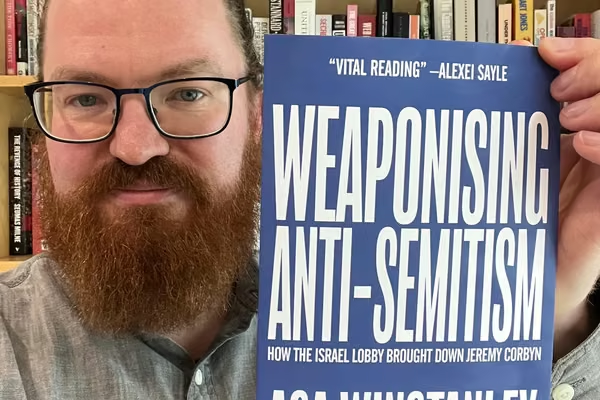
Now it is a book – Asa Winstanley’s Weaponising Anti-Semitism – which is ironic as the very processes Winstanley chronicles in it are now at work trying to get the book banned.
Well, not actually banned, but it is Unite the Union – which really should know better – refusing to allow its premises in Bristol to be used to host a discussion of the book.
It’s not an accident, some mistake by a low-level official making a bad decision. This comes from the very top, with Unite’s assistant general secretary Gail Cartmail justifying it by claiming that “Asa Winstanley’s publication has already caused deep hurt among Jews in Britain.”
It is a sad day to see a trade union caught up in the censorship of ideas on the grounds that some people are hurt by them. On that basis can the expression of any dissident social, political, or religious view ever really be safe?
RK
This article was originally published by Electronic Intifada on Sun 23 Jul 2023. Read the original here.
UK union cancels “Weaponising Anti-Semitism” book launch
Loading article text…


















We owe a great debt to Asa Winstanley. Buy this book and read it. It gives chapter and verse on how the slander of antisemitism was used by the right wing in the Labour Party and the right wing press to get rid of Corbyn – who was seen as a challenge to the established order. I know EXACTLY why Unite did this: they don’t want to get bogged down in a debate with a bunch of right wing pro-Israel extremists because they see it as a time consuming diversion. But they are wrong not to take this pro-Israel fanatics on. Isn’t it amazing that the BBC covers sympathetically the ‘threat’ to democracy in Israel…and hardly mentions the Palestinians at all?
I WAS in Unite the Union – the emphasis being on “WAS”.
I resigned and cancelled my membership just a minute ago.
The list of ironies grows ever longer – banned from ‘Tony Benn House’. Poor man must be turning in his grave. Remember his formidable live on-air defiance of the cowardly BBC’s refusal to broadcast a Disasters Appeal for the Gaza victims in 2009? We need to take our fight to them – the media, the government, Starmer”opposition’ and now the so called progressive movements whether Unite, Glastonbury or anyone else who chooses to follow this shameful path of silencing and intimidation.
Yes – buy it and read it. I did. Worth every penny.
JVL will undoubtedly censor this message (oh the irony), but as a reader seeking to explore the multifaceted issue of anti-Semitism, I recently delved into the controversial book, “Weaponising Anti-Semitism.”, the book presents a critical examination of the potential misuse and exploitation of anti-Semitism for political or ideological purposes. While the topic is undeniably significant, the book falls short in its execution and overall neutrality.
The book commences by providing historical context on the long-standing problem of anti-Semitism, tracing its roots back centuries. This comprehensive backdrop allows readers, regardless of their prior knowledge, to understand the complexities of the issue. It offers valuable insights into the different manifestations of anti-Semitism throughout history, including religious, racial, and political dimensions.
One of the book’s strong points is its emphasis on the dangers of weaponizing anti-Semitism for ideological gain. The author effectively highlights instances where political actors and interest groups have used anti-Semitic tropes or incidents to advance their own agendas, often at the expense of marginalized communities. This aspect shines a light on a crucial aspect of contemporary socio-political discourse, urging readers to be vigilant against the manipulation of hatred for ulterior motives.
However, as the book progresses, a noticeable shift in tone becomes evident. The author’s objective analysis gives way to a more subjective viewpoint, detracting from its credibility. The book occasionally veers into promoting a specific political ideology rather than focusing on the larger issue at hand. This deviation compromises its potential to be a truly balanced exploration of the subject matter.
Furthermore, the lack of comprehensive research and failure to cite credible sources raises concerns about the book’s accuracy and veracity. While some historical aspects are well-supported, the analysis of recent events seems shallow and anecdotal at times. A more rigorous examination, supported by diverse sources, would have enhanced the book’s credibility and made it a more persuasive read.
Moreover, the book somewhat overlooks the complexity of modern anti-Semitism. The subject is not merely a tool for political manipulation but a deeply ingrained societal issue that demands an interdisciplinary approach. The book’s focus on the politicization aspect is just one part of the puzzle, leaving readers with an incomplete understanding of the broader problem.
Despite these shortcomings, “Weaponising Anti-Semitism” does manage to evoke thought-provoking questions about the responsibility of media, politicians, and society in addressing this pressing concern. The book serves as a reminder to remain vigilant against any form of prejudice while also encouraging critical analysis of the narratives presented by different actors in the public sphere.
In conclusion, “Weaponising Anti-Semitism” addresses a vital and timely issue concerning the manipulation of anti-Semitism for political gain. However, the book’s lack of impartiality, insufficient research, and limited scope hinder its effectiveness as a comprehensive exploration of the topic. Readers interested in this subject would be better served by supplementing this work with more balanced and well-researched resources to gain a broader perspective on the complex nature of anti-Semitism.
Thank you for your review of Asa Winstanley’s book and please note that we have no problem publishing comments from people who do not agree with an article, or indeed, with JVL unless they veer into abuse or hate speech. We would, however, be rather interested in recommendations for these objective texts you think should have been referred to; we also note also that this was not a book about antisemitism but specifically about how it was used as a tool to attack the leftward shift of the UK Labour Party. Also that it provided a narrative different from that of the mainstream media’s, etc and so was perhaps seeking to provide some balance given that particular context.