
The NUS and antisemitism: a critical discussion
JVL Introduction
We’re grateful to Vashti and its weekly newsletter the Pickle for permission to repost its Twitter space discussion of the Tuck Report on Antisemitism and the NUS, broadcast on 16 January 2023.
The report below has extensive contributions from two of the participants, Barnaby Raine and Tony Lerman and brief extracts from two others.
As Raine and Lerman make clear, the Tuck Report is not impartial, permeated as it is by the uncritical and unfounded assumption underlying the IHRA Working Definition of Antisemitism that criticism of Israel underpins a new form of antisemitism.
They unpick in detail the effects of this in showing how the Tuck Report frames the problem, rendering it little more than a further ideological contribution to demonising Palestinians and left-wing, particularly Jewish, critics of Israel – all in the guise of making universities a safe space for (Zionist) Jews.

Hey, it’s Aron.
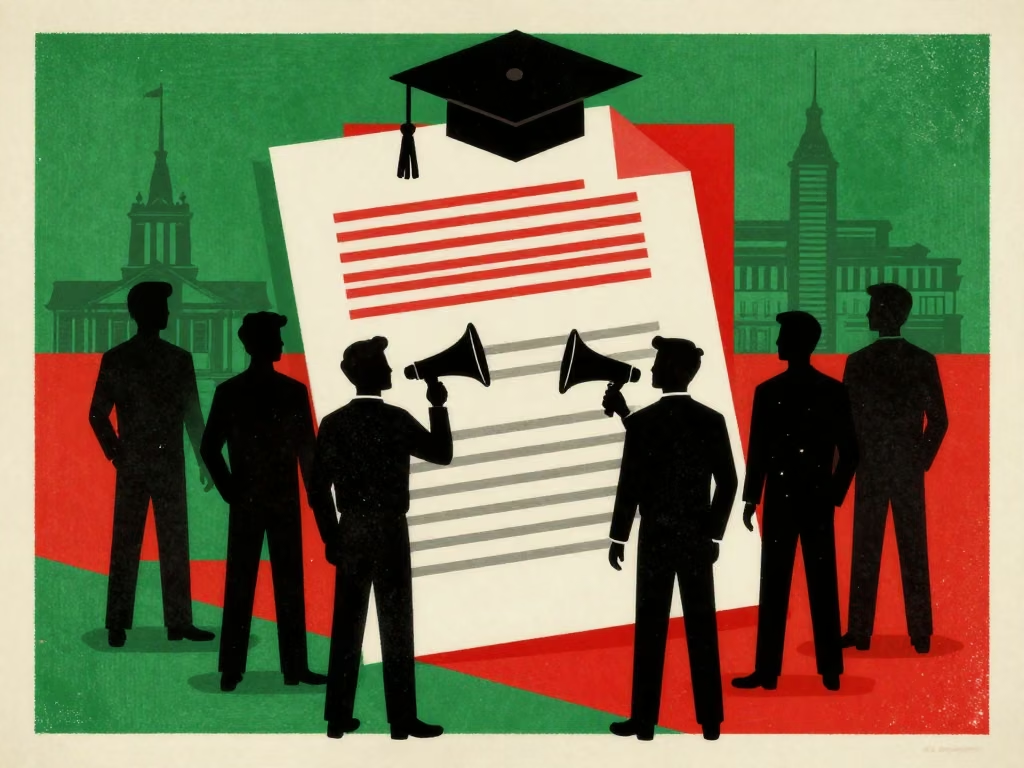
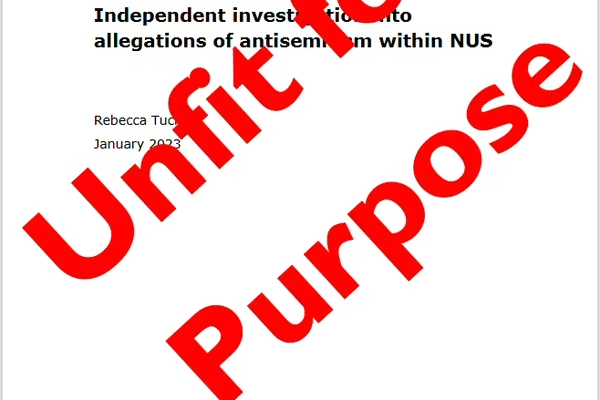
Last week, the National Union of Students (NUS) published its report into anti-semitism. The report, authored by lawyer Rebecca Tuck KC, was commissioned in May 2022 to investigate several high profile cases of alleged anti-semitism within the organisation. Drawing on interviews with dozens of individuals and groups, Tuck concludes that the NUS failed to adequately challenge anti-semitism within its ranks and created a “hostile environment” for Jewish students.
Critics of the report have questioned its credibility given its heavy reliance on perspectives which appear to endorse the conflation of anti-semitism with legitimate advocacy for Palestinian rights. The report’s bias towards the “new anti-semitism” framework – perceiving anti-Zionism or excessive criticism of Israel’s government as the most prominent manifestation of anti-semitism – results in some glaring omissions. For example, though she dedicates several pages to discussing definitions of Zionism, Tuck fails to cite the views of a single Palestinian on the issue.
On Monday evening, Vashti held a Twitter Space to discuss the report with an expert panel, comprising the director of the British Palestinian Committee Sara Husseini, Jewish student activist at the University of Oxford Jack Klein, anti-semitism scholar Antony Lerman, historian Barnaby Raine, and Diaspora Alliance organiser Debbie Shamir.
This week’s Pickle is an edited transcript from the event.
Minority Report
Debbie:
There have been numerous allegations of anti-semitism within NUS for several years now, and any Jewish student who has been at university over the past 10 or 15 years will be able to attest to this. So much so, and as the report suggests, Jewish students have increasingly felt that they’re unsafe in NUS spaces, and some other student spaces. And so this report was commissioned with the support and guidance from the Union of Jewish Students (UJS), in order to encourage accountability within NUS to be a more safe and inclusive space for Jewish students.
Barnaby:
The broader context is a general campaign around rising anti-semitism, concentrating on a so-called “new anti-semitism”. Traditional, far-right anti-semitism receives barely any attention in this report – with each passing report on anti-semitism the compulsory passing mentions of the far-right become more and more passing, even as the violent threat remains.
Instead, the focus is now very heavily on the left – especially on people of colour, Palestinians and Arabs and their global supporters, and anti-imperialism, especially opposing the state of Israel. These frightening enemies of Western civilisation were once called savages and communists and now they can be feared again as carriers of a left-wing, anti-semitic disease. That can then be tied to fears that anti-capitalism becomes a kind of anti-semitic discourse. At these two levels, geopolitical and economic, fears of radical politics are given a progressive hue through this new anti-anti-semitism of the right.
In 2017, amid the anti-semitism dramas in the British Labour party, Jo Johnson, the then minister for universities, wrote to Universities UK (the regulatory body) highlighting a particular definition of anti-semitism – the so-called International Holocaust Remembrance Alliance (IHRA) definition. The IHRA text is contentious for attaching to a fairly anodyne definition a list of “examples”, the vast majority of which are concerned with how we talk about Israel. Johnson wanted to pressure universities to adopt it. At least one university, Central Lancashire, shut down an Israel Apartheid Week event in response. And so that definition was wielded – much to the chagrin of one of its co-authors, who complained about this – in these highly partisan anti-semitism battles, just as Israel was engaged (like other colonial states have always engaged) in policies of containment and murder towards the colonised population. Preventing the colonised and their supporters from speaking about their colonisation might feel unsurprising in an imperial heartland, but hinting that the colonised are bigots in contrast to the enlightened, tolerant society that funds and sustains their ongoing ethnic cleansing is the telling move here.
Then in 2021, Johnson’s successor, Gavin Williamson, threatened to cut off funding to universities unless they adopted the IHRA definition. In 2022, the government formally disengaged from NUS, citing what they called “insufficient progress on anti-semitism” and attaching to their press release the IHRA definition. Why has NUS attracted this focus? I think it tells us a lot about the new anti-anti-semitism. Campuses have long worried conservatives as spaces where radical ideas might reach the young. In recent years, students of colour have been prominent in using NUS to challenge racism in quite radical ways – the recent wave of state attacks on NUS began after the union opposed the Prevent agenda, which chills dissenting speech especially among Muslims in the name of counter-terrorism. Establishment politicians who sail close to the winds of Islamophobia – Michael Gove, for example – have seen the charge of anti-semitism as a useful battering ram with which to delegitimise the left in general, and, in particular, to cast young people of colour who get involved in politics as dangerous savages.
One important moment in the report – I should say two moments, since this same story is repeated twice in the report for emphasis – concerns NUS officers worrying that the anti-semitism campaign has especially targeted women of colour as wrongdoers. The report notes that their worries were never seriously investigated, but then proceeds to insist they were wrong. Consider that. Jewish students, we are told, must have our “lived experience” reflected if we encounter campaigns by the colonised to boycott their violent coloniser as an attack on us in London and Manchester for our religious identity: repeatedly the report says BDS and Israel Apartheid Week are troubling, apparently because some Jewish students raised in firmly Zionist settings feel that way. But when women of colour worry about racism, a totally different set of standards apply. This racialised campaign has come alongside a genuine global problem of rising anti-semitism, which has resulted in synagogues being attacked, cemeteries being desecrated, people being harassed in the street. All this makes it very difficult to have serious conversations about anti-semitism.<
Sara: While the report claims to focus on anti-semitism, anyone who reads it will immediately see that the vast majority is focused on Palestine and Israel, and in many places serves to conflate Palestine advocacy (and associated criticism of the state of Israel) with anti-semitism, which unfortunately makes it very relevant for Palestinians, and at the same time undermines the fight against anti-semitism.
To give a couple of examples, the terms “Palestine” and “pro-Palestinian” appear a total of 74 times across 124 pages of the report. Of the 11 references to Palestinians themselves, there isn’t a single reference that pertains to a Palestinian voice or a Palestinian student experience. By contrast, far-right anti-semitism merits just two mentions in the report, despite the fact we know the rise of the far-right ideology in the UK is a major threat to the Jewish community and many other minority groups.
There is also a characterisation throughout the report of Jewish students versus pro-Palestinian activists or groups. The former are characterised as people with an identity, while the latter are a vague unspecified group whose main concern appears to be being labelled anti-semitic. This is noteworthy for a number of reasons. Firstly, there’s no acknowledgement of the experience or the reality of Palestinian students who feel unable or unsafe speaking to the history or speaking to their ongoing lived experiences of oppression, or that of their family and friends, at the hands of the Israeli government. That’s all the more shocking when 2022 was the deadliest year in the West Bank for Palestinians, and there’s an ever-growing body of evidence pointing to Israel’s laws, policies, and practices as meeting the legal definition of apartheid, which has now been exacerbated by the election of the most extremist right-wing government in the state’s history. Also this false dichotomy between pro-Palestinians and Jewish groups eradicates the many Jewish academics and groups who have engaged with the investigation, and have been critical around the IHRA redefinition of anti-semitism.
Finally, the report makes no distinction between racism and the discomfort felt on the basis of political disagreement. So, for example, being uncomfortable with Israeli Apartheid week or some of the facts of the Israeli government’s oppression versus something is actually bigotry. There are a number of Jewish scholars and experts who have stressed that when it comes to discourse on Israel and Palestine, there is a key difference between things that may cause offence, and things that are anti-semitic.
So, the dichotomy set up by the report embeds this false narrative: that Jewish student safety and Palestinian human rights are at odds. It plays into this dangerous and divisive game, which comes full circle back to the pressure exerted by the UK government. It’s a government that’s already pushing very oppressive authoritarian measures, as we’ve seen around issues of immigration, the right to protest, and the right to boycott. It sees student organising as a key site of struggle against these structural injustices.
Tony:
I’ve been researching and writing about contemporary anti-semitism for more than 40 years. My latest book, Whatever Happened to Antisemitism? Redefinition and the Myth of the ‘Collective Jew’, traces how, over the last few decades, anti-semitism has been redefined as “new anti-semitism” and codified in the IHRA working definition as anti-semitic anti-Zionism – of which the Palestinians are allegedly the principal purveyors. IHRA is therefore a racist charter effectively prohibiting Palestinians and anyone promoting Palestinian rights from exercising freedom of speech. Unfortunately, though perhaps not surprisingly, IHRA permeates the judgments, conclusions and recommendations of the entire report, from which the responses of the accused pro-Palestinian activists are almost completely excluded.
The report therefore shows how completely the redefinition of anti-semitism as “new anti-semitism” influences and dominates public understanding of anti-semitism. However smart a KC like Rebecca Tuck might be, as someone who confessed to me that she knew virtually nothing about the subject, she was never likely to challenge this new orthodoxy.
Nonetheless, the question of definition crops up throughout the report, and there is a dedicated section that purports to be a balanced discussion of some pros and cons of IHRA, citing various writers (including myself). But she might as well not have bothered. She is completely out of her depth. She starts by giving undue prominence to those who made submissions saying the alternative Jerusalem Declaration on Antisemitism is a “wrecking document”, then gives most space to pursuers of dissenting Jews, such as Howard Jacobson, Rabbi Mirvis, CST, JLC, and David Hirsh, who completely mangles the history of anti-Zionism to justify his prosecution of “anti-semitic Jews”. But how would Tuck know otherwise?
Time and again she states that “many anti-semitism complaints relate to the issue of anti-Zionism as anti-semitism”. She says “Much of the distress caused to Jewish students has been when Israel/Palestine is the topic for debate or conversation”. Again, she stresses that “The underlying reason for this poor relationship [between Jewish students and NUS] stems from views about and attitudes towards Israel/Palestine”. And time and again she is sympathetic to the view that anti-semitism is in play. Perhaps her most transparent inclination to see pro-Palestinian activism as anti-semitic is in relation to BDS. The “BDS campaign is specifically and unashamedly anti-Israel”, she writes. In the same breath, she takes for granted UJS claims that Jews face anti-semitism disguised as political comment on Israel, that media bias against Israel is fuelling persecution of Jews; that students feel intimidated by tactics used to boycott Israel. She is implicitly praiseworthy of Jewish students who responded with a “Bridges not Boycotts” campaign: “an informed and intelligent approach to the Israel-Palestine conflict over the hate and hostility of the BDS movement” – clearly characterising BDS as anti-semitic. And yet elsewhere Tuck writes: “I’m not saying BDS is inherently anti-semitic”.
We also see in this approach that Tuck is guilty of treating pro-Palestinian advocacy in NUS as “political”, and therefore implicitly biased or anti-Jewish, and pro-Israel advocacy as “factual” and “balanced”. This loaded view of politics also emerges when she says, “In my view there are times when politics must be put to one side and the welfare of students must be the overwhelming message”. For Tuck this seems to include being “sympathetic to survey evidence showing many Jewish students feel that Israel forms part of their identity as Jewish people”. By contrast, a Palestinian student could say that Palestine forms part of their identity as a Palestinian, or a Muslim – but expressing this is perceived by some Jewish students as “hostility and/or anti-semitism”, a view which Tuck seems inclined to endorse.
The report in effect recommends the avoidance of the discomfort Jewish students feel in debates and meetings through the suppression of active debate on Israel/Palestine. Tuck Calls for “a sensitive, nuanced approach to Middle East politics” – but one person’s “nuanced” is another person’s “obfuscation” and “denial”. In the same vein she proposes bringing in an “experienced facilitator”; but this could reinforce the notion of equivalent narratives, masking the true picture of oppressor and oppressed.
Among her final words is evidence that she fails to acknowledge or come to terms with the negative consequences of redefinition: “[there is] overwhelming evidence that anti-semitism is being endured by Jewish students which arises (at least initially) from campaigning and comment concerning Israel/Palestine”. I’m sure this is music to the ears of the IHRA guardians.
Jack:
I found the report very disappointing. It didn’t really align with my experiences as a Jewish student on campus. Rather, I feel that the mainstream Jewish spaces that are controlled by JSocs, which are in turn part of UJS, which of course set the terms of reference for this report. I have felt that those spaces have been quite alienating, partly because of the inherent and sometimes explicit political biases of UJS as an organisation. There are so many examples of this: they host Israeli leadership talks where they welcome the Israeli ambassador to the UK, Tzipi Hotovely, who said among other horrific things that Jews and Arabs shouldn’t get married.
I think Jewish left-wing student activism is important because we’ve seen left-wing people, Palestinians, or advocates of other marginalised groups denigrated in our name. For Jewish students, we want to offer a space where support for Israel or unquestioning support for Zionism aren’t taken for granted – a space for Jews with alternative points of view. The need for activism on campuses is very important. We saw this with the protests against Hotovely at LSE, Cambridge, and Oxford. Jewish students were really at the forefront of protesting her invitation to speak, and so I hope that we can provide a space for Jewish students who don’t feel comfortable being aligned with the actions of racist governments▼
You can listen to the entire Twitter Space, including the audience questions, via Twitter or by downloading the audio file from this link.








It’s about time that the inner source of all this were systematically explained. Western imperialism absolutely depends on Zionist Israel as its in situ cop in the Middle East, which is indispensable to the needs of imperialism. The Zionist machine there also provides absolutely critical intelligence gathering throughout the region. The US alone provides up to $5bn in military aid. All straight bourgeois parties in imperialist countries have a mass of antisemites within them, but that they are under a no-fail command to bottle up their deep antisemitism so as not to blow apart the imperialist relationship. However, as soon as the Zionist bantustanning state falls to bits and is no longer capable of playing its role of cop — all the bottled up antisemitism will erupt in all the assorted bourgeois parties. What then from these “antisemitic” govts? This essential reality has to be propagandised wide and far, systematically.
The immediate local, national & international acceptance of the IHRA definition of anti-semitism, should give you a clue about the power of the Zionist lobby; but then by saying that I am an anti-semite by their definition.