
A New Left Party; learning the lessons from Europe
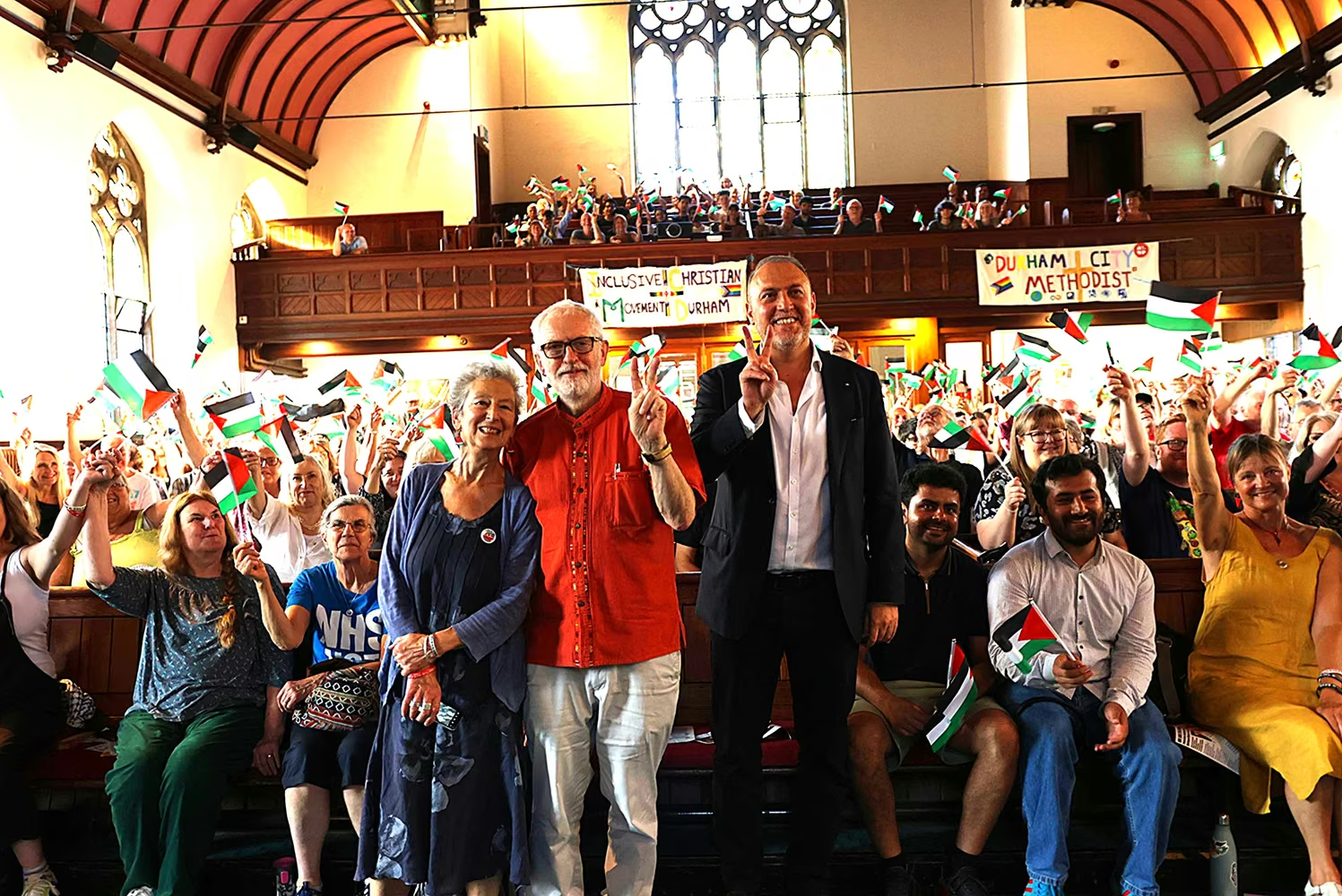
JVL Introduction
John Rees writes a cautious welcome to the New Party of the Left and emphasises the importance of understanding what happened, eg to Syriza in Greece, Podemos in Spain and Die Linke in Germany. He stresses that the pull of Labourism and of a push to focus on elections are to be resisted. Like James Schneider (whose article we published yesterday) he emphasises the importance of organising beyond electoralism but he is critical of some of Schneider’s analysis.
This is another useful contribution to the necessary debate as we work to develop a New Party that is genuinely rooted in working class communities, where community organising rather than electioneering takes precedence.
LL
This article was originally published by Counterfire on Sun 27 Jul 2025. Read the original here.
Party like it’s 1900?
The new party is a step forward but must not become a Labour Party mark 2, argues John Rees
Loading article text…



“All that came tumbling down in 2015 when the Syriza government was routed by the European Union elite and international bankers imposed a grotesque austerity programme on Greek society”
As the electoral fortunes of Varoufakis show, this type of national- socialist messaging about socialism in one country, based on international conspiracy theories rather than on a decent socio-economic analysis, have
no electoral appeal because the forever grievance slot is already occupied by other parties. In the UK by SNP/Alba, Plaid, and Reform.
Bearing in mind that yourparty is unlikely to obtain an absolute parliamentary majority at the next GE, I suggest that, at this stage, rather than agonising over and proclaiming an abstract ideology, it shd set forth specific policies its MPs wd be prepared to support and promote – practical aims rather than pie-in-the-sky theories. A good start wd be the re-nationalisation of utilities – promised, but quickly reneged on by Starmer’s Labour. There must be other policies which an incoming govt might be prepared to implement with the support of the new party.
Thought provoking peace to ponder on
I agree 100% with John Rees
An excellent piece in my view as he reminds us of the importance of history.
I think Rees is throwing out the baby with the bathwater. It is one thing to want to strengthen bottom-up organisation of the working class, but his excessive emphasis on it is falling into the error of historical anarchism. This is romantic mistake, as it always was, but especially in context of modern capitalism. It relegates top-down electoral polices to secondary importance. Both approaches must be applied at the same time, each one strengthening the other.
Having just read this critique of what Corbyn/Sultana may or should major on, to date it is the most thoughtful I’ve read but there is one thing I can’t agree with: that the usual suspect, “The capitalist state” was the major architect of Corbyn’s downfall. It was certainly, as always, on hand to exploit whatever popped up, but the trigger was pulled by the Israel Lobby. Initially led by Margaret Hodge (plus expletive) and other prominent LP members resigning and threatened resignations, the theme (Corbyn being an ‘existential threat’ to Jewish people in the UK) was taken up by the Chief Rabbi, the Jewish BoD, Labour Friends of Israel and virtually all MSM* in damning Corbyn as an antisemite. In addition Labour departments in charge of day-to-day PLP business and procedure, permanently run by the right wing and always at least miffed by any even vaguely left-leaning leader, actively took up arms against him including during elections. This was exemplified in the ‘leaked report’, the leaking of which prompted not an enquiry into its findings but one into who leaked it, leaked, as there were no signs of KS ever releasing it. Any debate around the treatment of Corbyn was banned at Branch and CLP level.
The capitalist state acted as expected and pitched-in but it was not necessary for it to be the catalyst this time.
* https://www.lse.ac.uk/media-and communications/assets/documents/research/projects/corbyn/Cobyn-Report.pdf
One can ask oneself “What happens if we throw ourselves behind this new party?” but equally, we should ask ourselves “What are the consequences of not doing so?”
I suppose I should be glad that the SWP and its offshoots like Counterfire are not going to enter the new left electoral party.. but I’m sorry that JVL bothered to republish this rather predictable position paper. One problem with earlier efforts at a left party has been the incursion of other small leninist-influenced groups rather than building grass roots local organisation.
That’s why I haven’t signed up to the new party yet, but have signed up to my local Camden People’s Alliance (which is obviously linked but has a different focus). Over the three decades I’ve been in Camden nearly all of the tenants’ associations have been scrapped along with a big network of progressive activist groups. Some , like Camden Abu Dis Friendship Association, used to be appreciated by the council and visited by the mayors, unbelievable as this seems today!
Building up community inks will take a long time and I am hampered by age, class, illness … many things. But we can make a start, and imo the Renters’ Union, and the new unions like IWGB for precarious workers, would be valued partners.
A concerning mention in Rees’ article is Ukraine. This could drive a wedge between Independents and the Greens if it becomes doctrinal. The Muslim activists I know are outraged by the double standards applied between Ukraine and Palestine, but not opposed to supporting Ukraine per se. (There are also people on the left such as Ukraine Solidarity Campaign; I regret that they seem obligated to spend so much time arguing their case in their unions, and I don’t want this quarrel to spill into the new party).
I would definitely like there to be some kind of electoral pact between Greens and Independents. When he spoke to JVL’s Education seminar, Zack Polansky seemed to be dead-set on standing a Green candidate in every constituency at general elections so as to get parliamentary ‘Short money’, but perhaps in the local elections next year the Greens and Independent/new party candidates can reach a better working agreement.
“to the Blair catastrophe over Iraq”
Which didn’t stop Jeremy remaining in the party and advocating that people vote Labour.
What can people conclude from that regarding where his loyalties are – with Labour or the global working class ?
I enjoyed reading this (and the earlier article by James Schneider) but it’s important to approach the new Party with an awareness that it will develop in a much more haphazard manner than we’d like. Events will inevitably derail some intentions while reinforcing others, the democratic structures will almost certainly be imperfect and the business of trial and error while inform reality as much as the ideological framework suggested by the writers …. we have a pronounced tendency to demand perfection and this often creates division and division and division …. while we’re doing this the Right occupy and consolidate ….
Spot on. These are the points that Ralph Miliband made in his excellent book Parliamentary Socialism.
I find Rees’ approach completely misconceived.
When I joined in the 1960s the Labour Party was seen as divided between a left wing strongly committed to public ownership and a revisionist wing (associated with Tony Crosland) which believed that public ownership was only needed for critical infrastructure and natural monopolies and that otherwise capitalism could be constrained to work in the public interest by strict regulation, while society could be made more equal by increasingly progressive taxation. By current standards, of course, both groups would be seen as raving left-wing loonies.
By contrast the current leadership rejects both the left, through its commitment to privatization, and the revisionists, through its hostility to regulation and its rejection of progressive taxation.
What I found exciting about the Corbyn movement was that it brought together both parts of the traditional Labour Party, which could unite through their shared belief in the need to challenge unrestricted capitalism and its apologists, in and out of the party. This movement seemed to get some real public traction. What Rees sneeringly refers to as ‘a more radical version of Labour’s electoralist strategy’ sounds pretty good to me. Certainly it is what hostile forces really feared after the 2017 election.
By contrast Rees’ conception of a new party is clear only in its rejection of any attempt to get people to vote for it (‘electoralism’). Essentially he wants this party, as a matter of principle, to reject and alienate the vast majority of people who belonged to, or voted for, the Labour Party. He seems to be one of those who sees every political development only as an opportunity to create yet another tiny left-wing faction, as irrelevant as all those that have gone before.