
The Radical Jewish Tradition: history matters and the tradition lives on
JVL Introduction
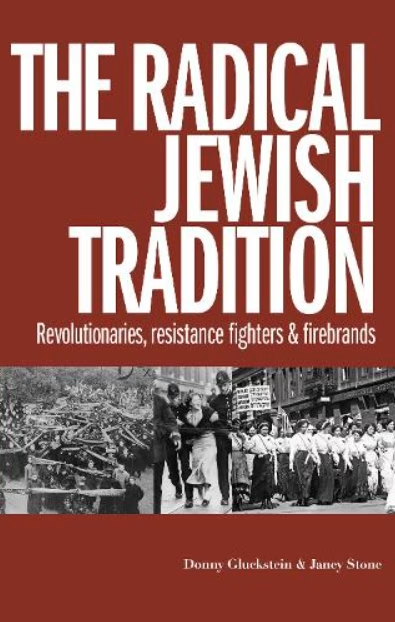
Donny Gluckstein, together with Janey Stone literally “wrote the book” on The Radical Jewish Tradition, Resistamce Fighters and Firebrands. He has written this piece for us based on his presentation at the 2026 Historical Materialism Conference session and we are pleased to publish this as we published the others presented at the conference by Julia Bard and Rob Ferguson.
This is a far reaching paper that provides historical context as well as examples of radical Jews in history working with others for liberation for all. Amongst many other points, he argues that Zionism is an abberation for Jewish historical development. But his piece is much more than a criticism of Zionism and takes us through the beginnings of emancipation and integration, the way that industrialisation swept actoss the Pale of Settlement, the working class movement against capitlaism and all forms of oppression, the Russian Revolution. Also how Jews being outsiders helped anchor many in the language and acts of internationalism, even influencing Zionism. Gluckstein also, of course, includes the all to easy turn to scapegoating, especially in Tsarist Russia and pogroms and the Holocaust, the impact of that trauma and the failure of internationalism to save them that was part of leading to the domination of Zionism as a “default” ideology for most Jews. This is changing. Read On….
Zionism is an aberration in Jewish historical development. For it to gain a foothold the powerful Jewish radical tradition, which was deeply anti-Zionist, first had to be destroyed by the Nazi Holocaust and Allied government indifference to the fate of millions of Jews.
In 1948 the founding declaration of Israel said: “the people remained faithful to [Israel] throughout their Dispersion and never ceased to pray and hope for their return to it”. This is nonsense. Rather than being some 2000 years old, Zionism began in 1897 with the publication of Herzl’s The Jewish State. Between that time and the 1930s, when Hitler came to power it had very little support.
The Jews became an international people in classical times because they were located at the key intersection of trade and caught between powerful imperial blocs such as Egypt and Mesopotamia. The diaspora meant Jews were an international people, indeed probably the most dispersed people on the planet. In itself this distinctive status did not make Jews particularly radical. That came about through social change under developing capitalism.
It is interesting to consider the view of Arthur Ruppin in the early 1930s. He was an important Zionist figure, founder of Tel Aviv, and head of the Jewish National Fund. Ruppin noted that social changes then taking place threatened the entire Zionist project which was based on a history of Jewish separatism and isolation. Ruppin pointed to five walls which had in some way kept European Jews apart from non-Jews since the Middle Ages. These were separate economy, laws, language, education and religion.
Economy: Under feudalism Jews had had to fulfil certain commercial and banking roles which Christians were not allowed to practice. But starting from Renaissance Italy Christians got in on the act. This spread through western Europe and began encroaching on the East. Jewish emigration to places like the United States, which had no entrenched Jewish roles, added to undermining economic separation.
Laws: The next wall to begin falling was separate legal status which in extreme cases kept Jews confined to ghettos. On 28 September 1791 the French Revolutionary Convention emancipated the Jews and freed the slaves. One by one countries across Europe emancipated their Jewish population (though this only happened in Russia in 1917).
Language: The language barrier between Jews and people where they resided also began to crumble. Yiddish disappeared from most of Western Europe, driven in part by the fall of another separating wall – education. With the expansion of public schooling in the vernacular separate Jewish schooling began to fade away. Even in Russia the Yiddish language rapidly declined. In 1900 97 percent of Russian Jews spoke it. By 1939 it was 54%.
Religion: Only 12% American Jews linked to synagogues in 1916 and in 1945 60 percent of Jewish shops in New York remained open on the sabbath. Rates of marriage to non-Jews escalated. Between 1900 and 1930 intermarriage in Germany rose from 8 percent to 22 percent. In the USSR it reached 42 percent.
All this points to a process of Jews gradually integrating in the post-feudal age into the surrounding societies of the diaspora. This did not mean extinguishing Yiddish culture. That flourished to its greatest heights at this very time; but it did work against the isolationist ideas of Zionism, which is why Ruppin was so alarmed. Incidentally, Yiddish culture was systematically extinguished in Palestine/Israel, as was the culture of Sephardic Jews from Arab lands.
There was something else going on, however, which put everything described above at risk. The revolution of rising capitalism undermined the strictures of feudal society over Jews. But it produced a new ruling class which would also require scapegoats if it got into difficulty.
Once capitalism was in the saddle it was prone to periodic crisis and Jews would be a convenient target once more – this time in a modern form not based on religious difference but on claimed ethnic/racial difference. This ideology became known as antisemitism.
We must now travel to the major concentration of Jews in Europe (44 percent of all) living in the Pale of Settlement under the brutal regime of Tsarism. Jews were confined to this space which included Poland, much of the Ukraine, Belarus, Lithuania and so on. But at 12 percent of the population they were still a minority there.
This area was subject to a geographical accident – industrialisation passed from West to East via Poland. In 1900 the industrial output of the Kingdom of Poland matched the whole of the rest of the vast empire. One effect was to break the unity of the Jewish community. There had always been tensions inside the kehilla (community) between richer and poorer Jews. But now there was a sharper class division on the lines of bosses versus workers throughout society – Jews included. A labour movement took off and because Jews were an exceptionally urban population, they were central to it, despite their overall minority status. Exploitation led to unions, strikes, and confronting the bosses and state.
So, within the Russian empire you had, in concentrated form, a combination of feudal and capitalist scapegoating to divide and rule the populations. On top of this working-class Jews were becoming militant as were the non-Jewish working class.
In 1881 a wave of pogroms began as the Tsar and state fought back. They had a slogan – ‘Save the Tsar. Beat the Jews’. This vicious oppression produced a wave of emigration. 4 million were on the move. This moment tells us a lot about Jewish views at the time Zionism was founded. A huge opinion natural experiment was being conducted, in fact. If you were a Zionist there was only one place you could emigrate to – Palestine. If you were not, other places were an option. So, the figures are interesting. By 1914 inward migration to Palestine had raised the Jewish population there to 94,000. The US alone had received 3 million Jews! Between 1900 and 1939 the world’s Jewish population increased by 5 million, but only one thirteenth were to be found in Palestine. In the interwar period before doors were slammed shut to immigrants, most went anywhere else but Palestine – US, Argentina, Australia, South Africa, Britain – anywhere.
It was not simply that Zionist arguments were unconvincing. Zionism lacked a natural base. Wealthier Jews tended towards assimilation where they lived and had no interest in emigrating to an uncertain future in the Middle East. Religious Jews rejected Zionism on doctrinal grounds that said that until the appearance of the Messiah no return to biblical Israel was possible. And the mass of Jews who were poor and worked for a living were not about to up sticks from lands they had lived in for centuries. They tended towards a radical tradition which rejected Zionism on principle.
The existence of this Jewish radical tradition had a profound impact on the evolution of Zionism itself. Herzl’s idea was conceived at a time when nationalist and colonial settler movements were surging, but unlike them it lacked the two fundamental attributes needed for success – a land and a people. Though Zionist leaders were reacting against oppression, Herzl had no bargaining chips. His programme did not have the backing of a large-scale nationalist movement and so he depended on personal appeals to the heads of imperialist powers as they alone could hand him the homeland required. In return all he could offer was the idea of removing Jews from their countries. Before his death in 1904 Herzl’s efforts with the Tsarist regime, the Kaiser, the Sultan and Pope fell on stony ground. Weizmann had more success with a British imperialism embroiled in war against the Turks and obtained the Balfour declaration in 1917.
There was a division of labour within Zionism. While Herzl & Co touted for imperialist support, at the opposite end another wing sought to attract those in a radical and sceptical population. This brand of Zionism therefore posed as left-wing or socialist. Indeed, Labour Zionism dominated the movement from 1933 to 1970. Institutions such as the egalitarian kibbutz, or the powerful Histadrut trade union (which doubled as a shipping company, bank and much more) were characteristic of the other face of settler colonialism.
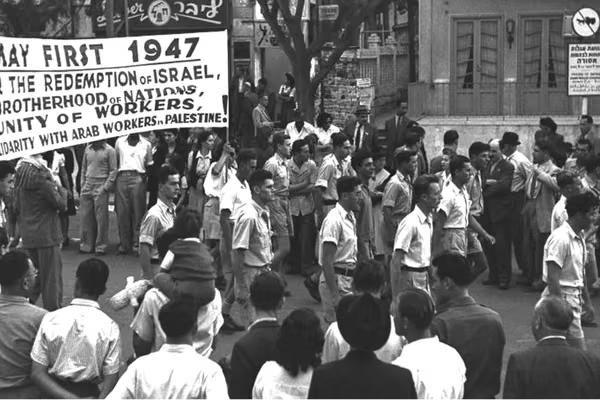
To return to the Pale of Settlement – the combination of fighting exploitation and oppression at the same time was explosive. The outcome was a mass working-class movement which was economic in character because of the travails of industrialisation, but also political. It was revolutionary against Tsarism and its antisemitism. This movement was not separatist and believed in class solidarity with rest of working class. That was essential because despite a concentration relative to Jews worldwide, they were only a minority of the population in the Pale of Settlement. Working alongside others, solidarity, and mutual support, were essential. This was shown in concrete terms during the 1905 revolution whose epicentre was in Poland and was described so effectively by Rosa Luxemburg in her pamphlet on The Mass Strike.
The Jewish radical tradition was internationalist (and therefore anti-Zionist) not only because the community was international, but because nationalism in Europe was a major threat. If nationalist ideology within the multiethnic Tsarist empire seduced the Poles, Lithuanians, Ukrainians and so on, and they obtained independence on that basis, it would leave Jews as outsiders and strengthen pre-existing antisemitism. This is indeed what happened after the First World War.
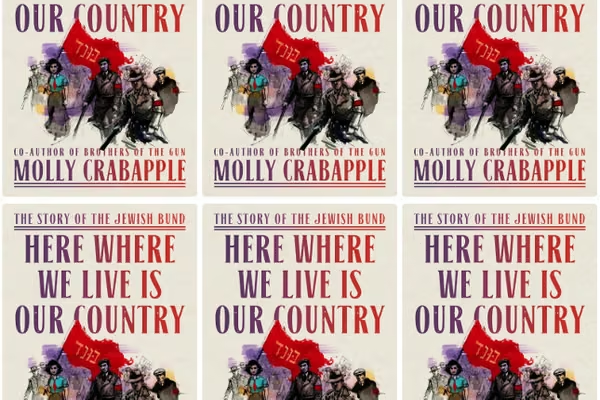
The radical tradition took various forms – anarchism, Bundism, and Marxism. A key principle was doykeit (hereness). You fought oppression and exploitation where you lived, and so rejection of Zionism which advocated running away, followed almost automatically. Signs of what this meant were to be seen worldwide. There were huge strike movements and organised struggles against pogroms in Poland and elsewhere in Eastern Europe. In the early decades of the twentieth century young Jewish women in Lower East Side New York were at the forefront of broader labour struggles and strikes. International Women’s Day that is celebrated every year and has come down to us in the bowdlerised form of Mothers’ Day commemorates one such strike in 1909. In 1936 it was the joint struggle to resist the British Union of Fascists at Cable Street in East London that broke the back of fascism in Britain. During the Second World War Jewish resistance continued. Its finest moment was the heroic but tragic fight put up by the Warsaw Ghetto Uprising in 1943.
The Jewish radical tradition can also be seen as theorised in the ideas of internationalism and class solidarity in the works of key Jewish intellectuals like Karl Marx, Rosa Luxemburg, and Leon Trotsky. As Jews they were outsiders to the capitalist system, and so gained a perspective that was harder to achieve for people living inside it. But it is important to remember this was not specifically Jewish set of ideas – it was a universal contribution. If you say Marx it is important to remember he was paired with Friedrich Engels, a non-Jew. Luxemburg’s name is linked with Karl Liebknecht. And for Leon Trotsky the pairing is with Vladimir Lenin. Since much of the Jewish radical tradition would be physically destroyed, the fact that it lives on in the left understanding of the world is significant. It is not so much Jewish but a recognition of universalism and of human solidarity irrespective of ethnic origin. Nothing could be further from Zionism and its parody of what it is to be Jewish.
What was the scale of the Jewish radical tradition? One indication is what happened when the Russian Social Democratic Labour Party was formed in 1897. At the time the Jewish Labour Bund had 30,000 members. The rest of the party (which included future Bolsheviks and Mensheviks) had 8,400. There were tensions within the Jewish radical tradition, however. In 1903 the Bund walked away from the RSDLP because it would not accede to the idea of a separate Jewish organisation operating within a federal party structure. The rest of the RSDLP was convinced of the need for a tightly organised revolutionary party in the face of Tsarist repression. Nonetheless, all involved were convinced anti-Zionists.
The 1917 Russian revolution which flowed from the formation of the RSDLP was the greatest single act of emancipation and liberation in Jewish history because so many Jews had been under Tsarism. When France emancipated its Jews they were just 0.15 percent of the population. The Bolsheviks were the first government in the world to make racism (in the form of antisemitism) a crime.
That event inspired Jews everywhere and the Jewish radical tradition, both through diaspora emulation and emigration intensified still further on an international scale. One indication was in the USA. In the 1930s 1 in 40 of the population were Jewish, but 50 percent of the American Communist Party was. In the International Brigades during the Spanish civil war up to a quarter was Jewish. For anti-colonial struggle let’s consider South Africa. Jews were 0.3% of the total population and 2.5% of White population. At the first major trial over fighting apartheid, the so-called Great Treason Trial – half of whites in the dock were Jews. At the trial where Nelson Mandela was convicted, every white in the dock beside him was a Jew!
But by 1948 the Jewish Radical Tradition was virtually destroyed, only to be replaced largely by Zionism. What changed the equation was the crisis of capitalism and its imperialism. The Wall Street Crash of 1929 helped Hitler come to power in 1933. He immediately began persecuting Jews as scapegoats for the crisis. Alongside that was the refusal of capitalist countries across the globe to take Jewish refugees trying to flee. From the Dominican Republic to Shanghai, Switzerland to Sweden, the doors slammed shut in the same way that refugees today are demonised and blocked.
When WWII began the danger increased further. The Holocaust cost 6 million Jewish lives (and 4 million others). The Allies did absolutely nothing to stop this. They were only interested in victory for their own armies. Despite gaining control of the skies over Auschwitz in mid-1944 and knowing full well what was going on there from reports smuggled out, they refused to bomb the gas chambers or crematoria. Hundreds of thousands of lives that could have been saved were consciously sacrificed. (We see the same inhuman disregard meted out to refugees today).
By the time the killing stopped not only were millions, many of whom would have been Jewish radicals, dead, but the entire community was traumatised and had largely lost belief in the possibility of internationalism and solidarity. Many became convinced of the Zionist argument that only by becoming a settler colonialist in Israel could you be safe. This lie then became the basis for the dominance of Zionism in the Jewish community.
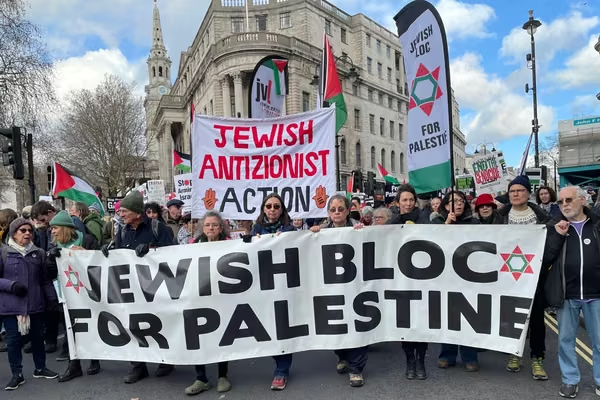
But over the last decades and especially since the genocide in Gaza we have seen the hold of Zionism crumbling, and this is exemplified by the results of the US mid-terms, the worldwide pro-Palestine movement that has Jewish supporters, and the Green Party resolution calling Zionism racist over here. The radical Jewish tradition is not dead, and indeed seems to be returning in force.
Bibliography
*Donny Gluckstein and Janey Stone, The Radical Jewish Tradition, Revolutionaries, resistance fighters and firebrands, Bookmarks, London 2024.
No comments on this post so far.