
The Jewish Radical – and revolutionary – Tradition for Today
JVL Introduction
This is the second of three pieces by the three presenters at the Radical Jewish Tradition workshop at the November 2026 Historial Materialism, Conference and reflects what they said at the session. This is by Rob Ferguson who introduces his paper in this way:
“I would argue that the Jewish left faces two specific challenges. First, the ideological assault on anti-Zionism and state attacks on the mass solidarity movement. Secondly, the rise of the far right, now on a global scale. These challenges take place in the context of a wider crisis of the world order, and importantly, significant revolts and resistance.”
Rob’s paper touches on the weaponisation of antisemitism, the rise of the far right, Jewish resistance, the proud record – and limitation – of the Bund, the importance of discussion and much more. One of several improtant areas he addresses is the Establishment’s defence of Israel and of Zionism where he stresses that the onslaught from the powerful “…has to be understood not simply as a defence of Zionism and Israel but as a defence of the imperialist order, and a world system in crisis, facing revolt from below.”
The uprisings in many countries from France to India are an indication of that revolt. As Jewish socialists we have a role to play but necessarily, as in our history, alongside the mass movement of a politicised working class.
Weaponising Antisemitism
For the last decade the weaponising of the charge of antisemitism has become a permanent feature of the political landscape in Britain.
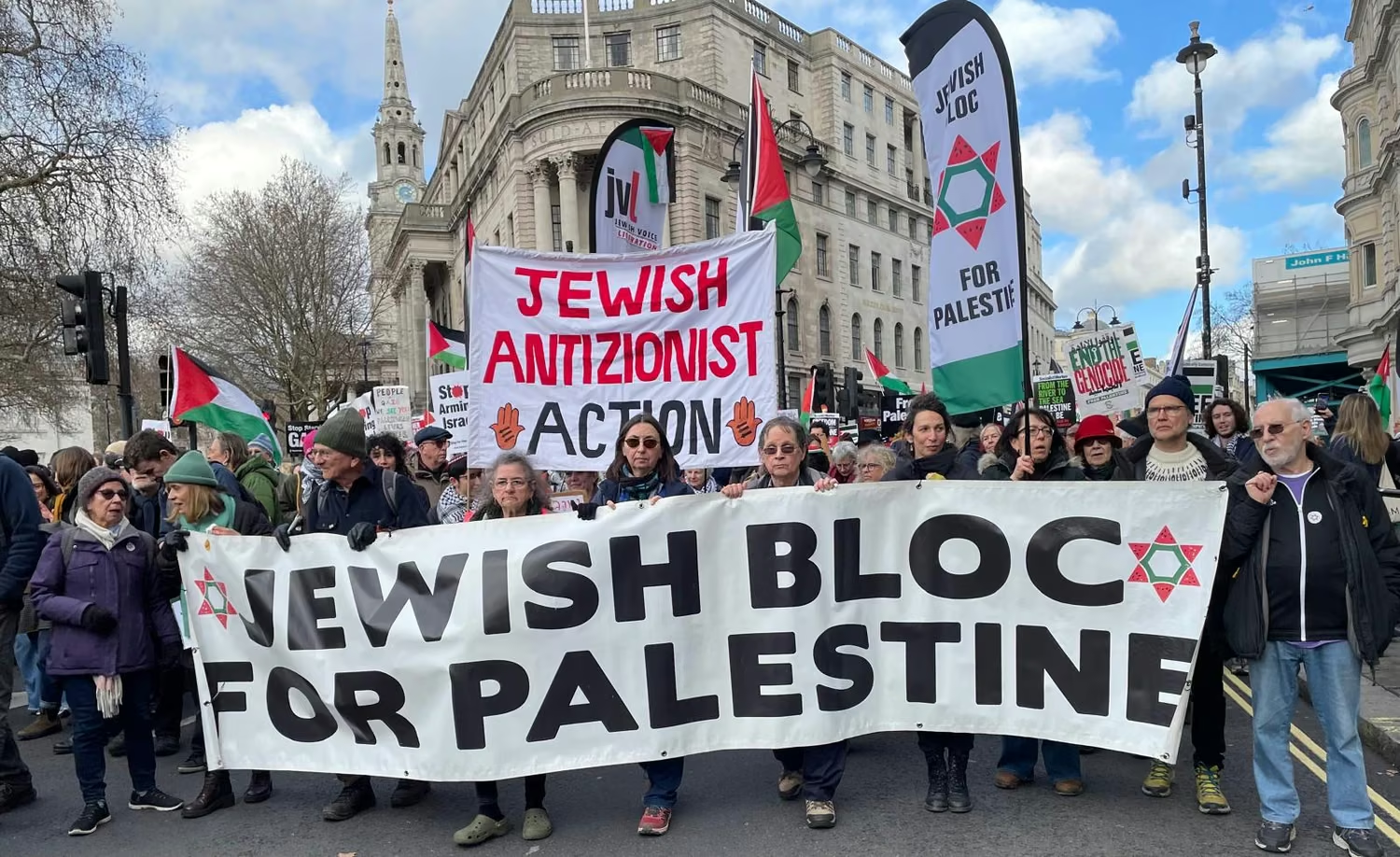
A central focus of the Jewish left has been to contest the conflation of anti-Zionism with antisemitism, and especially since 2023, to join with the Palestinian mass movement. This is important.
But charges of antisemitism are not solely about Zionism or Israel. It is impossible to explain the scale of the ideological offensive across Europe, North America and beyond and their use to underpin state repression, as purely motivated by a defence of Israel. We should therefore avoid descending into endless battles over identity with Zionism.
Defence of Zionism, 1950s-60s
Although the argument that anti-Zionism constitutes a new form of antisemitism is not new, it was not the central argument for the half century after the nakba.
The cultivated image was of a pioneer people who had made the desert bloom; a small, lone democracy, surrounded by hostile Arab states, and a Jewish state representing Jewish survival and a guarantee against persecution and extermination.
During the 1950s and 1960s, the key themes were “defence” of Israel against the Arab regimes, attacks on the Soviet bloc, a defence of Zionism’s historical legitimacy, and denial of any responsibility for the ethnic cleansing of Palestine.
These were, for example, the dominant themes of Arnold Forster and Benjamin Epstein’s 1956 book, Cross-Currents and subsequent literature.
A Breakpoint – Attacks on the Anti-imperialist Left and Black Power
The 1967 and 1973 Arab Israeli wars and their aftermath mark one breakpoint. On one hand US imperialism turns to Israel as its garrison in the Middle East. On the other, we see the eruption of the anti-Vietnam war movement, the civil rights movement, black power, May 68, student and worker revolt, the women’s and gay liberation movements and the rise of the New Left.
In 1969 Martin Seymour Lipset publishes “The Socialism of Fools: the Left, the Jews and Israel”; in 1970 the ADL identifies the black radical movements and the extreme left as sources of antisemitism in American society; in 1974 the ADL publishes The New Antisemitism by Forster and Epstein. In 1972, Israeli foreign minister, Abba Eban addresses the annual American Jewish Congress declaring, “The new left is the author and progenitor of the new antisemitism: anti-Zionism is neo-antisemitism.” After the 1975 UN resolution identifying Zionism as racism, equating anti-Zionism with antisemitism becomes a conspicuous element of mainstream political debate.
However, the defence of Israel also became a dividing line within the ranks of the left. Figures such as Irving Howe, Baynard Rustin, A Randolph, mounted sustained attacks on the new left and black radicals, explicitly on the grounds that their anti-Zionism reflected a deeper threat to American liberal democracy itself.
The “new antisemitism” then became the ideological scalpel that cut the line between those in the civil rights and anti-war movements who insisted on a liberal defence of American democracy and its place in the world, and those who had moved to anti-imperialist and revolutionary conclusions.
The 2000s – the deluge
Although the foundations of a new antisemitism narrative were laid in the late 1960s and 1970s, Zionists continued to chiefly rely on their traditional arguments in defence of Israel. However, by the 2000s these lines of defence were losing their traction. The narrative now shifts from a defence of Israel’s legitimacy to a sustained assault on any articulation of opposition to Israel and Zionism.
It is difficult to convey the flood of books, journal articles, newspaper and online commentary on “the new antisemitism” from 2003. Originators span Cold War ideologues, historians, pro-war liberals, Labour MPs, French “nouveaux philosophes,” Zionists, prominent feminists and innumerable commentators and columnists.
The central thrust was of an unholy alliance of the “extreme left” and Islamic fundamentalism. French philosopher Pierre-André Taguieff, published La Nouvelle Judeophobie in 2002, translated into English as Rising from the Muck: The New Antisemitism in Europe. Taguieff is an exemplar. He argued that Islamism was a global peril in which the Palestinians had become the standard-bearers for the enemies of democracy and the west. He identified Muslim communities as a primary source of antisemitism in Europe.
This ideological offensive did not take place in a vacuum. The 2000s opened with the second intifada; the rise of the anti-capitalist movement; then came 9/11, Afghanistan, the Iraq War, the global anti-war movement. And in 2006, the shock election victory of Hamas.
It is at this point, that the first discussions and forums begin to formulate what became the IHRA definition of antisemitism. From here on in, the new antisemitism narrative not only takes on unprecedented scale but becomes increasingly instrumentalised in the form of quasi-legal, institutional, and state repression.
This offensive has to be understood not simply as a defence of Zionism and Israel but as a defence of the imperialist order, and a world system in crisis, facing revolt from below.
I would argue that this then has implications for the Jewish left. To see these attacks as driven simply by Zionism and Israel is far too narrow an analysis, that can lead to mistaken strategies and distort our view of the role of Jewish socialists in the movement.
The rise of the far right
My description of the rise the far right will be brief but not because it is less important. The new antisemitism narrative and the rise of the far right are connected. They are both features of a world system in crisis.
Whilst not a charge anyone on this panel is guilty of, some on the Jewish left overlook the threat through an over narrow focus on attacks from the Zionist camp. But the far right and fascism, as in the past, are an existential threat. Potentially, with a greater power to extinguish revolt and resistance in the imperialist core than Zionism could achieve.
So, I don’t think we should be complacent about recent setbacks for the far right. First of all, these are not universal: witness the recent state election victories of the AFD in Germany, now our party dominated by its neo-Nazi wing; and despite the magnificent revolt taking place in France, Le Pen is still in line to win the presidency. Most important though – the crisis of the system upon which fascism grows is deepening.
Antisemitism runs through the far right’s political spine. Islamophobia and anti-migrant racism form the key vehicles of the far-right rise. But antisemitism is an indispensable ideological component of the far-right world view. It has a unique explanatory power and serves to mobilise the far right and fascist hard-core.
We need a clear sighted anti-racist and anti-fascist politics; on one hand, Tommy Robinson and other fascists, parade support for Israel and attack the Palestine movement. On the other, the likes of Tucker Carlson, uses his platform to provide space for white supremacy, fascists, and Holocaust deniers; Carlson portrays Israel as a centre of global Jewish power, upon which he heaves the crimes of US imperialism.
The systematic degrading of the meaning of antisemitism and the threat that it poses, has opened the door. Conflating Zionism with Jewish identity, has given a hand-up both to the Tommy Robinsons, and to Tucker Carlson and the white nationalists.
Antisemitism is not fake or an also ran. It is a sword of reaction at our throats, and the Jewish left has to see building a united mass anti-racist and anti-fascist movement as an urgent necessity.
The Radical Jewish Tradition and its Relevance Today
Donnie Gluckstein’s and Janey Stone’s book, The Radical Jewish Tradition, published by Verso, has provided the focus for this panel at Historical Materialism. The book examines the different strands of the radical Jewish tradition up to 1948, through anti-fascism, anti-war, workers’ struggles and internationalism. We need to recover that tradition for the conditions we face today.
The radical Jewish tradition embraced different elements and political currents. In a necessarily brief conclusion, it is only possible here to signpost some current debates.
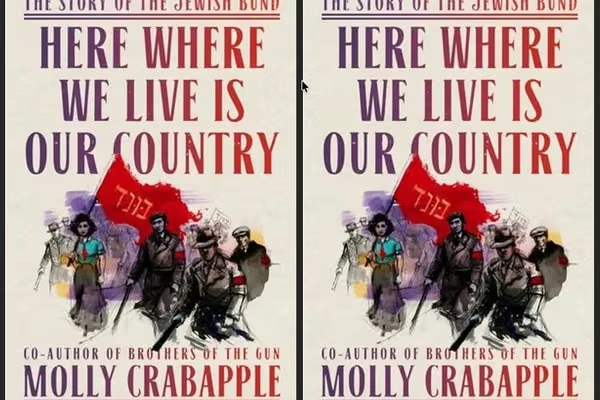
First, it is very heartening to see the enthusiastic and popular reception for Molly Crabapple’s book on the Bund. The book is welcome. I can’t do it justice here, but it is refreshing to see a recovery of the Jewish tradition of anti-Zionism, internationalism and unity against fascism for a new generation; especially at this moment.
Yet I am sceptical of what might be referred to as “neo-Bundism”. The Bund was a phenomenon specific to eastern Europe and was not able to root itself amongst Jews in France for example, or central and Western Europe. In the US, although large, the Bund was an entirely émigré organisation. When a new generation of Jewish radicals emerged in the 1960s, it was not to the Bund tradition they looked to, or to separate organisation or cultural movements, but to the New Left and the anti-imperialist movements.
In an article in International Socialism Journal, Sai Englert notes that the Bund was marked by contradictions. It created many of the pillars of revolutionary organisation, from agitational newspapers to full-time revolutionaries. The Bund organised trade unions and fought for better wages and conditions. Self-organisation was an advance in the conditions facing Jewish workers in Tsarist Russia and eastern Europe.
However, the Bund came up against its own limits. It was limited geographically and structurally by its base. Crucially, the Bund fell victim to the ebbs and flows of the class struggle throughout its existence. World War I and the October Revolution proved a severe test. Opposition to the October Revolution divided Russian and Polish Bundists, with the latter lending its support to the war and the second international. The Polish Bund turned to community organising and electioneering, and into decline during the harsh conditions of the 1920s.
That however was not the end of the story. The Bund is rightly remembered for its resurgence in the fight against antisemitism and pogroms in the 1930s and alliances with Polish socialists, and above all for its role in the Warsaw Ghetto Uprising.
Are there differences and even divides in the Radical Jewish Tradition? Yes. I place myself in the revolutionary socialist tradition and that of the October Revolution.
Is there common ground? Yes. Most clearly in our anti-Zionism, the fight against the far right and fascism, and anti-imperialism. Such common ground and unity is of crucial importance in the current moment. In our united struggles we can debate differences and put politics and strategies to the test.
The vital lesson of the Jewish radical tradition, in all its currents, is that at the sharpest points of struggle—both in victory and in danger — Jewish radicals and the Jewish left have an important role to play; yet the outcome of our battle, will rest on the mass working class movement and the political direction of that movement.
Look at France. The direction of the movement in France will shape the battle across Europe and beyond: against the far right and racism, over Palestine, against attacks on the left. Above all, these revolts – in France, Spain, India, amongst German youth – hold out hope, and a vision of revolution, and a society free of exploitation and oppression.
Rob Ferguson is a member of the editorial board of International Socialism Journal, Secretary of Dorset Palestine Solidarity Campaign and anti-racist activist.

‘Be radical, have principles, be absolute, be that which the bourgeoisie calls an extremist: give yourself without counting or calculating, don’t accept what they call ‘the reality of life’ and act in such a way that you won’t be accepted by that kind of ‘life’, never abandon the principle of struggle.” J Evola