
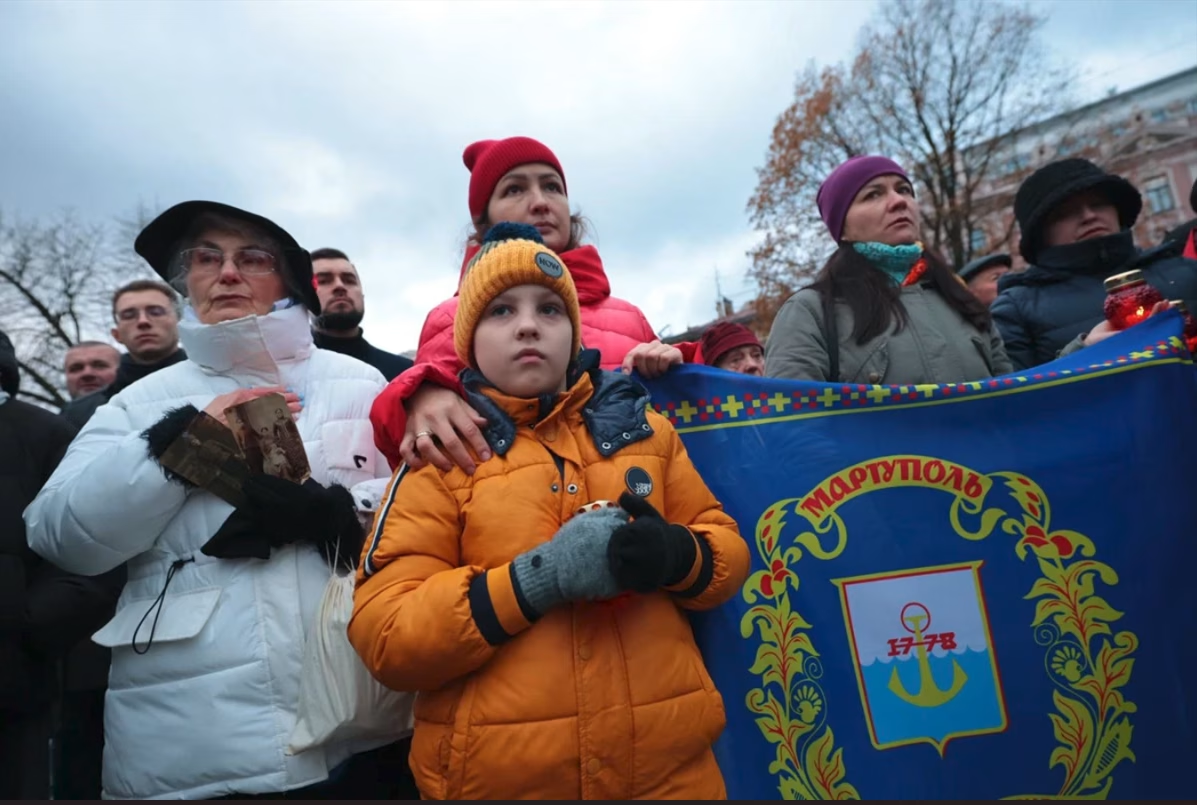
How we remember the Holodomor matters for today
JVL Introduction
Simon Pirani, who has researched and written extensively about Ukraine read Phil Colley’s piece on the starvation in Ukraine with interest, some agreement and some consternation. There are some things that he believes need correcting and he has provided a great deal of information with numerous useful links that will help people come to their own conclusions.
Both Phil Colley and Simon Pirani took the trouble to write because understanding the past matters today. Colley has a particular perspective relating to his own great Uncle, Gareth Jones who reported on the famine in Ukraine and elsewhere in the Soviet Union, Pirani has studied Ukraine’s history for many years. Both agree, for example that Rhea Clyman, a Jewish Canadian journalist who reported on the famine 3 months before Jones should also be celebrated; both Colley and Pirani are more than troubled by the veneration of far right characters such as Bandera but for Pirani there are several things that Colley has got wrong or for which he has the wrong emphasis.
Memorialisation is important; how we remember matters as well as who we remember. It is importangt to understand different takes on this man made famine as on other important issues. As Simon Pirani concludes: “The least that we in Britain can do, being fortunate enough to be far from the battlefields, is to find ways to discuss our differences over history, no matter how deep, in a constructive way.” We appreciate that both have contributed here.
In our age of livestreamed mass murder and microsecond attention spans, remembering the Canadian Jewish journalist Rhea Clyman is indeed a noble endeavour.
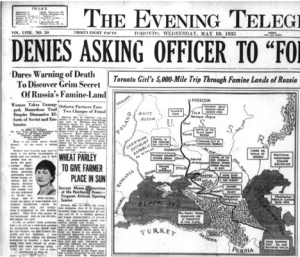
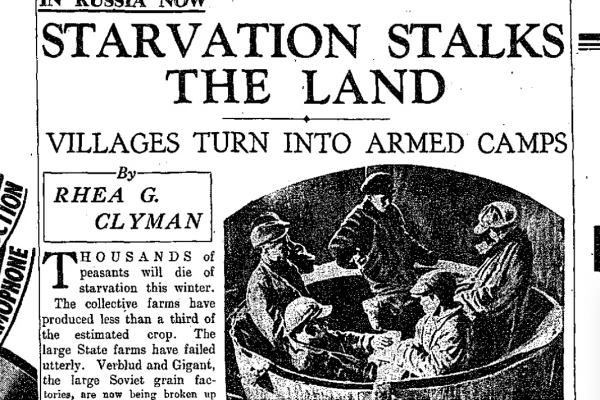
In 1932, Clyman raised the alarm about the famine sweeping through the villages of Ukraine, southern Russia and the north Caucasus, which is now also referred to as the holodomor. She wrote about the complicity of the authorities in the Soviet Union, of which all those places were part.
Clyman’s reports of the famine, which claimed 4 million lives, are thought to be the first to appear in English-language newspapers, at a time when news travelled by telex and the printing press. Speaking the truth mattered: inside the Soviet Union, all mention of this tragedy was suppressed until 1987.
So I agree with Philip Colley’s call, on this website on 29 October, for Clyman to be celebrated. But his attack on the Welsh parliament and Kyiv city council for supposedly “erasing” her memory is misplaced, damaging, and wrong on the facts.
Colley gives four reasons for his criticism of Welsh and Ukrainian politicians. I will deal with these in turn, and add a fifth point about the importance of this conversation for socialists in other European countries.
- The journalists who told the truth
Philip Colley’s first reason for claiming that politicians “usurped” Clyman’s role in a “particularly egregious” way is tricky to follow, and I ask readers to bear with me.
The Welsh Senedd (parliament) agreed with Kyiv city council to erect a memorial to Gareth Jones, another pioneering journalist who reported on the famine. Colley writes that a mock-up plinth displayed at the Senedd described Jones as “the first” to write in the western press about the famine, whereas Clyman did so three months earlier.
But the monument actually being prepared in Kyiv describes Jones as the “Welsh journalist who told the world of the Holodomor”. Not “the first”.
If anyone thought of calling him “the first”, they changed their minds. I discovered this by checking with the Friends of Ukraine (Wales), Phillip could have done that too.
Some enemies of the truth may want to silence memories of a Jewish woman questioning a violent dictatorship – but neither the Senedd, nor Kyiv city council, nor anyone else engaged in rescuing famine victims’ memory, is among them. And, although Philip does not mention them, efforts have begun to highlight Clyman’s heroism. (See note 1 below.)
By now, you, the reader, may be asking why a misunderstanding about a memorial has blown up into a public row. Good question. The answer is that Colley, a great-nephew of Jones, has broader, political objections to the Welsh-Ukrainian memory project, covered in the next three points.
- How to talk about the holodomor
Colley’s second complaint about the Welsh-Ukrainian monument is that it uses the word “holodomor” to describe the famine. This, he says, is a “clear political misuse of history”, because “Jones presented the famine as an attack on the entire Soviet peasantry as a class”.
I do not agree. The famine indeed wreaked havoc in the Volga region, southern Russia and, most ruinously, in Kazakhstan. But there is nothing in the common usage of the word holodomor that implies otherwise. Moreover, there is no doubt that most famine victims were Ukrainian – not only in Ukraine but in the Kuban region of Russia, whose population was at that time mostly Ukrainian.
The famine overlapped with a brutal reversal of Soviet nationalities policy, which until 1932-3, in Ukraine more than anywhere else, had overseen a revival of national language, culture and education that had been suppressed in the tsarist empire. Historians argue about the relationship between this assault on Ukrainians as a nation, and the mass murder of Ukrainian peasants in the holodomor – but the fact that these two things happened, and were intertwined, is incontestable. (See note 2 below.)
In Ukrainian, “holodomor” is a combination of “holod” (hunger) and “mor” (extermination, or plague). Its use was associated with the assertion of Ukrainian national identity in the late Soviet period, and during and after the achievement of independence in 1991 as the Soviet Union was breaking up.
“Holodomor” is widely used throughout society, by people who until 1987 had to speak about their murdered and tortured relatives, deserted villages and nightmare memories in hushed tones.
It ill becomes Philip Colley, or any of us, to instruct Ukrainians on how they should grapple with this collective trauma.
The use of “holodomor” is as legitimate as the use by Palestinians of the Arabic word “nakba” and the use by European Jews of the Hebrew word “shoah”. Opposition to it comes mainly from the Kremlin, in line with its campaign to rehabilitate the Stalinist leaders who were responsible for the famine.
Philip Colley says that, by emphasising the famine’s impact in Ukraine, Ukrainians are contradicting Gareth Jones’s view that the famine as pan-Soviet, and not Ukrainian. But this is not so simple. Jones clearly saw connections between the famine and the Soviet government’s onslaught on Ukrainian nationality.
In March 1933 Jones noted in his diary the impact of “Russification”: Ukrainian officials had been replaced by Muscovites, and Russian language mandated in schools. Jones had thought that the famine might provoke a nationalist revolt in Ukraine, his biographer Ray Gamache pointed out. (See ‘Tell them we are starving’: the 1933 diaries of Gareth Jones (2015) pages vii-xiii.)
Rhea Clyman made no direct connection between the famine and the assault on Ukrainian nationality in her reporting, but was also alert to the “chauvinism” of Stalin’s regime, as the historian Jars Balan showed. The Soviet elite “see in [Stalin] another Genghis Khan, and believe that this attempt at economic conquest [the grain expropriations that exacerbated the famine] is only a prelude to a military one”, Clyman wrote in the Daily Express (30 November 1932).
Political complication has been piled on to historical debate by the campaign, spearheaded by the Ukrainian government, to have the holodomor recognised internationally as a genocide.
Philip Colley says the wording of the Gareth Jones memorial “associates Jones’s reporting with a specifically Ukrainian interpretation of the famine as genocide” but this is wrong. Neither the wording he mistakenly believed was to be used, nor the actual wording being used, make any such association. My view is that the political discussion about whether the holodomor should be defined as genocide is best considered separately from the (related, but distinct) historical discussion about what happened and why.
- War and the weaponisation of memory
Philip Colley’s third concern is that the Gareth Jones memorial is being erected at the same time as memorials to Ukrainian nationalist figures who, during the second world war, sided with Nazi-ruled Germany against the Soviet forces and committed war crimes, including massacres of Polish and Jewish civilians.
I, too, think these memorials are odious, and the myth-building around them dangerous. But this is just the latest chapter in four decades of struggle over historical memory. Presenting a one-sided picture, as Colley does, will not help. There is no room here to tell the whole story, but the contours are important:
In the late 1980s and 1990s, Ukrainians could learn, many for the first time, about their history, free of censorship – not only the holodomor, but also the 1917 revolution and the fate of the Ukrainian republic that was folded into the Soviet Union; the flowering of Ukrainian art, literature and education in the 1920s and its subsequent suppression; the horrors of the second world war; and the disciplining of the expanding labour force in the post-war Soviet Union. (There was an uprising by industrial workers in Kamianske (then Dneprodzerzhinsk) in 1972; it took more than a quarter of a century before a journalist friend of mine could publish the very first account of it in a local newspaper.)
In post-Soviet Ukraine, it was no longer forbidden to honour victims of the holodomor. In 1998 an annual remembrance day (the fourth Saturday of November) was established; in 2008 a museum opened in Kyiv; memorials went up across Ukraine.
The battles over memory inevitably became politicised. Russia, with statist, nationalist president Putin at the helm, began to bully its former colonies again, Ukraine in the first place – and, with that, to revive the memory of its imperialist heroes. Not only Iosif Stalin, but also those of the tsarist past, again became positive figures. Ukraine’s right-wing politicians reached for their own heroes in response: in 2010, president Viktor Yushchenko reached a low point by honouring the wartime nationalist Stepan Bandera. And they joined the “decommunisation” drive launched in eastern Europe.
Russia’s invasion of Ukraine in 2014 turbocharged these conflicts. In the Russian-supported tinpot dictatorships in Luhansk and Donetsk, memorials to the holodomor victims were taken down, along with those remembering Vasil’ Stus, a Ukrainian poet who emerged in the 1950s “thaw” and died in a Soviet prison camp in 1985. Posters of Stalin went up. After Russia’s full-scale invasion in 2022, the destruction of monuments to the victims of the holodomor and Stalinist repression intensified: they were designated “disinformation”.
After Russia illegally annexed the territories it occupied, in September 2022, its local puppets took down monuments to “the victims of the holodomor and of political repressions”. It is nauseating to read the pro-Russian “experts”’ justifications: the memorials were “put up on the Ukrainian nationalists’ initiative”; they “in fact accuse Moscow of genocide” (note that that word was not used); “Russian memorials, and not politicised Ukrainian memorials accusing Russians of these crimes” are needed.
I invite Philip Colley to revisit his concerns about the word “holodomor”, and join me in denouncing these acts of vandalism by an imperialist occupation force.
The response in Ukraine has not been uniform. While right-wing politicians have indeed tried to memorialise the nationalists of the 1940s, there has also been a surge of interest in nineteenth-century anti-tsarist Ukrainian rebels, and in the victims of the holodomor, the Stalinist repressions that followed it, and the holocaust. And all of these have been subsumed into grieving for the hundreds of thousands killed and injured, and care for the millions displaced, by Putin’s deadly, imperialist assault on Ukraine that continues to this day.
- Jews and fascists
Philip Colley’s fourth argument is that memorials to 1940s nationalists are going up while those to victims of the holocaust are removed. This is a distorted picture, supported by two examples but omitting many more.
Philip claims that the Senedd and the Kyiv City Council, by remembering Gareth Jones, are “denying” Rhea Clyman’s achievement, “misrepresenting Jones’s testimony” and “obscuring” the involvement of right-wing Ukrainian nationalists in wartime massacres. Obviously, he is attributing to the monument powers of argument that it does not have, and attributing to its supporters views they do not hold.
Philip’s grim picture of Ukrainian antisemitism jars with my own experience of visiting Kyiv throughout the 2010s. Not only were Soviet-era monuments to Jewish victims well maintained, but the synagogue in the city centre was open and unguarded.
While writing this blog post, I contacted a Ukrainian friend, an anthropologist with anarchist political leanings, and asked him for an update. He replied:
I would say both trends – monuments to Ukrainian fascists and to Jews – are not even alternating, but growing simultaneously. As you know, Soviet memory politics tended to sweep the Holocaust under the carpet, rather talking about “mass murders of Soviet citizens” than about Jews. So maybe most of the Jewry-related memorial landscape in Kyiv, as in the rest of Ukraine, appeared in the post-Soviet period. And if, since 2014, there has been a surge in the cult of Bandera and others, there has simultaneously been a growing Jewish presence. Remember the term “zhydobanderivets” [yid-Bandera-ite] that some people still like to apply to themselves. Each year, city authorities install huge Hanukkah menoras in the streets. There are of course antisemitic incidents around them, but they are relatively rare, and certainly you can not say that they are tolerated by the authorities. Same goes for the synagogue.
The best way to remember Rhea Clyman, Gareth Jones and others is to think about the real dynamics between the histories of Stalinism and fascism, and the horrors of today’s wars in Ukraine, Palestine and elsewhere, rather than to invent stereotypical dichotomies.
- How this looks to socialists in western Europe
There are deep divisions in the labour movement and among socialists in Britain and other western European countries about the war in Ukraine, as readers are probably aware.
In our faces is government hypocrisy: it supplies Ukraine with weapons to defy a colonialist occupation, while arming Israel and facilitating its genocidal blockade of Gaza; it welcomes Ukrainian refugees, while witch-hunting many others.
The “stop the war” coalition and others condemn Russia’s imperialist onslaught on Ukraine in words, but oppose arms supplies and have had no interest in practical support and solidarity. For others, including me, Ukrainians have no less right to defend themselves, arms in hand, than Palestinians or other victims of imperialist aggression.
Our discussions are complicated and even poisoned by modern media. Across Europe, the Kremlin’s fictional talking points – that Ukraine is overrun by Nazis, that the Russian language is banned and Russian speakers in danger, that the war was started by NATO – are echoed not only by right-wing and fascist organisations but also by some on the “left”.
The best known British example is George Galloway, leader of the Workers Party of Britain and friend of Nigel Farage and Tucker Carlson. Galloway, who lives in Moscow, calls Russia’s war on Ukraine “a NATO war against the Russian federation” and claimed that the well-documented massacre of civilians at Bucha, a Kyiv suburb, was a false flag operation. Galloway last month praised Putin for showing “great restraint” and being “moderate”, and called for Ukraine’s government to be “dismantled” and replaced with a set-up similar to the one in Belarus.
Philip Colley, who stood for the Workers Party of Britain in the election in 2024, has, to my knowledge, never spoken out against Galloway’s deceitful pro-Kremlin propaganda. So when he writes, against the Senedd and Kyiv city council, that their “commemorative choices may also raise questions about motive”, I would say the same thing to him.
The Workers Party is clearly opposed to Ukrainian self-determination. Does this colour Philip’s attitude to Ukrainian history, and help explain his opposition to using the word “holodomor”?
Fights over historical memory can not easily be separated from the war being fought now. Russian occupation forces take down memorials to victims of the holodomor and the Stalinist purges; Ukrainians put them up. The least that we in Britain can do, being fortunate enough to be far from the battlefields, is to find ways to discuss our differences over history, no matter how deep, in a constructive way.
Note 1. The life of Rhea Clayman has been researched by the Holodomor Research and Education Consortium and highlighted by Ukrainian, Ukrainian-Jewish and other media outlets.
Note 2. Debates on the holodomor have raged among historians for as long as they have been writing about it. There has never been serious doubt that the mass murder of peasants, and an assault on Ukrainian and other non-Russian languages, cultures and politics happened contemporaneously in 1932-33: opinions remain divided on the way these two things related to each other.
A forceful case that famine was inflicted on Ukrainians for ethnic reasons was made in 1986 by Robert Conquest in Harvest of Sorrow: collectivisation and the terror-famine. The economic historians R.W. Davies and Stephen Wheatcroft made a contrasting argument, in The Years of Hunger: Soviet Agriculture 1931-1933 (2004), that the effects of disastrous harvests in 1931 and 1932 had been compounded by mismanagement.
Among western historians, The Affirmative Action Empire (2001) by Terry Martin was seen as ground-breaking. A chapter on the famine reflects on the wave of violent peasant revolts against collectivisation in 1930, especially but not only in Ukraine, and Soviet officials’ fear of such revolts, and increasing identification of them with nationalism, in 1931-32.
With the archives open, historians could learn more about the mood of officials who commanded grain requisitioning from starving villages and how it connected with the reversal in 1932-33 of the state policy of Ukrainisation, introduced in the 1920s. A decree of November 1932 that blamed nationalist sentiment among peasants and Ukrainian communists for the shortage of grain was pivotal.
Terry Martin sees the anti-national policy as effect rather than cause; other historians see the Communist party’s frenzied attack on “kulaks” (rich peasants) and “Petlyurists” (supporters of the Ukrainian nationalist leader Semyon Petlyura) – which led to 16,000 arrests by late 1932 – as causal.
In the 1990s and 2000s, Ukrainian historians who before then had been forbidden by state policy to research the holodomor poured out works based on archival research; memoirs of the famine were also published in Ukraine for the first time. Heroes and Villains: creating national history in contemporary Ukraine by David Marples (2007) is an overview of this historiography (i.e. a history of historians’ work); Contextualising the holodomor: the impact of thirty years of Ukranian famine studies (2015), edited by Andrij Makuch and Frank Sysyn, is a collection of articles from a range of viewpoints, one of the outcomes of Ukrainian and western historians working together.
In 2010, the Ukraine List, an English-language circular for researchers, featured a discussion about the memorialisation of the holodomor, and the nationalists of the 1940s. It was a clear introduction to the arguments, and I have re-posted that issue on line here.
David Marples, in the journal article “Debate: Ethnic Issues in the Famine of 1932-1933 in Ukraine” (Europe-Asia Studies, May 2009) argued that future studies of the holodomor could not ignore the national question: “indeed it should be the starting point, along with the question of whether Soviet anxiety about the situation in Ukraine resulted in a drastic solution (the elimination of Ukrainians) or merely ham-handed repression that was indiscriminate rather than targeted”. It is “no longer sufficient to examine the famine solely from the perspective of Moscow or agricultural statistics either, because the national question was a pre-eminent issue as early as 1933 in Ukraine”.
Since the all-out invasion of Ukraine in 2022, the politics of memory has itself become a subject of research, for example by Yury Latysh in the article “The holodomor of 1932-1933 in memory politics” (Genocidas ir rezistencija, 2024).
Simon Pirani is honorary professor at the University of Durham and the author of books and articles on Russia and Ukraine. He blogs at peoplenature.org.


These blogs I wrote are also pertinent to the article by Simon Pirani
Why the Rise of Fascism is Again the Issue
The Lies of Imperialism Feed the Rise of Fascism
By John Pilger
https://azvsas.blogspot.com/2015/03/why-rise-of-fascism-is-again-issue.html
Why is Hate Not Hope Turning a Blind Eye to anti-Semitism and the Integration of neo-Nazis into the Ukrainian State?
During the Corbyn Era Hate not Hope saw anti-Semitism everywhere but today they ignore it repeating NATO Propaganda About Zelensky Being Jewish
https://azvsas.blogspot.com/search?q=odessa&updated-max=2023-09-26T05:06:00%2B01:00&max-results=20&start=4&by-date=false
Sharon Graham & Gary Smith – Zionists and Imperialists Stand in Solidarity with Ukraine’s Neo-Nazis As the Slaughter Continues
https://azvsas.blogspot.com/search?q=odessa&updated-max=2022-02-24T08:04:00Z&max-results=20&start=2&by-date=false