
Gareth Jones, ‘Holodomor’ and the erasure of Rhea Clyman
JVL Introduction
Philip Colley is a great-nephew of Gareth Jones who has been recognised for reporting on the Ukrainian famine or “Holodomor” while the country was ruled as part of the Soviet Union. However, along with four other great-nephews and great-nieces he is keen to set the record straight, ideally before a monument with an inaccurate inscription is unveiled in Kyiv. As Colley writes here, the planned inscription – and much that has gone before – is wrong on two counts; firstly, Jones did not only write about starvation in Ukraine but across the Soviet Union and secondly, he was not the first to report on the Soviet famine. That accolade belongs to Canadian Jewish journalist, Rhea Clyman, who deserves recognition along with his great uncle.
Here we can learn a bit more of the truth and also get a brief introduction to Rhea Clyman. History matters and accuracy matters. Colley raises concerns about how this dreadful period is being commemorated and whose memory is being elevated at a time of war. He points to the recognition in Ukraine of some figures who collaborated with the Nazis and the renaming of streets commemorating others who vigorously opposed them.
Colley states in a letter co-written with relatives and sent to the Welsh Parliament: ‘In a eulogy delivered after Gareth’s death, he was remembered as an ‘apostle of international understanding’ and ‘an interpreter of nations to one another’. He was a pacifist and universalist who warned of the dangers of nationalism. His legacy should therefore promote truth, peace and reconciliation—not be appropriated in ways that deepen national divisions at a time of war.’
LL
My great-uncle reported a pan-Soviet famine, not a ‘Holodomor’. Nor was he the first to report the famine. Why is the work of Canadian Jewish journalist Rhea Clyman being ignored?
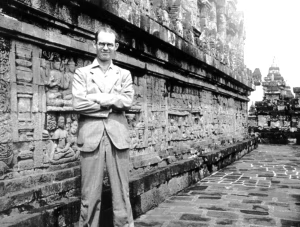
Gareth Jones was a Welsh investigative journalist whose work helping to expose the Great Soviet Famine inspired the controversial film Mr Jones (2019), starring James Norton. When the film was released, I criticised it in a Sunday Times article for misrepresenting his testimony. Now a proposed memorial plinth to Jones in Kyiv, funded by Welsh taxpayers and expected to be unveiled this November, has sparked further controversy. Five of his six surviving great-nephews and nieces have appealed in a joint letter to the Welsh Parliament for its wording to be changed. The Senedd has ignored our pleas.
As reported in Labour Hub, a mock-up of the plinth displayed at the Senedd in March carried the proposed inscription: “Gareth Jones – Welsh journalist who was the first to state in the Western press, under his own name, that the Holodomor occurred in Ukraine in 1932–1933.”
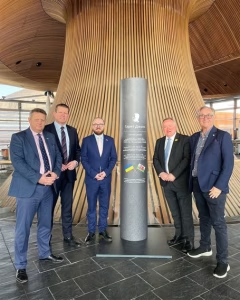
This wording is problematic in two important ways. Firstly, it wrongly describes Jones as the first to report the famine in the Western press under his own name, overlooking the earlier reporting of the Canadian Jewish journalist Rhea Clyman. Secondly, it associates Jones’s reporting with a specifically Ukrainian interpretation of the famine as genocide, something the evidence of his testimony does not sustain.
Contrary to the Senedd’s wording, Jones was not the first to break the news under his own name. Clyman’s reporting preceded his.
Clyman was a courageous, self-taught journalist from a poor Jewish family who had emigrated to Toronto from Poland in 1906, when she was just two years old. At the age of six, she lost her leg after being hit by a tram, and soon after lost her father too. From the age of 11, she supported her family by working in a factory during the day and studying at night. Her heart set on journalism, she travelled to the USSR, learnt Russian and at the age of 24 secured a job as Moscow correspondent for the Daily Express.
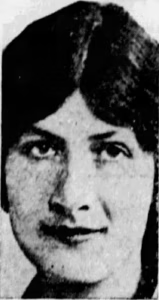
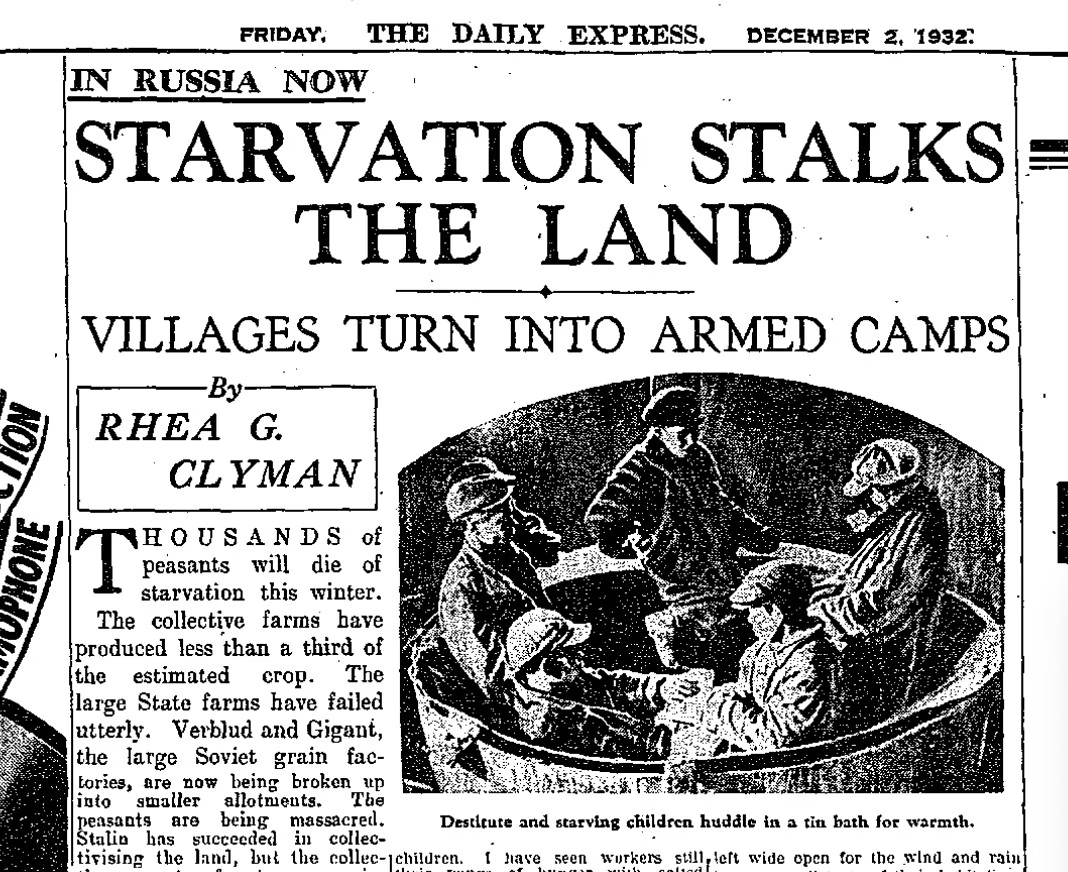
Six months before Jones’s March 1933 disclosure, she had travelled by car from Moscow to Georgia via Ukraine and witnessed terrible scenes of famine along the route. Following a series of reports about the famine by Clyman in the Toronto Evening Telegram in September 1932, a further article, “Russia Now: Starvation Stalks the Land”, appeared in the Daily Express on 2 December. It described deserted villages in both Russia and Ukraine, famine along the Volga and reports of cannibalism in southern Russia. “The bread famine is not due to any failure of crops” she wrote. “It is because the peasants, fleeced of the fruit of their labour, refused to plant and reap their fields.”
Like Jones, Clyman portrayed the famine as a disaster extending across the Soviet Union and, also like Jones, was subsequently barred from returning. Her next assignment took her to Nazi Germany, where she reported for the Daily Telegraph for five years. In November 1938, days after Kristallnacht, she fled Berlin on a flight carrying Jewish refugees. The aircraft crashed soon after take-off from Schiphol Airport, leaving her severely injured as one of the few survivors.
By wrongly describing Jones as “the first”, the mock-up plinth displayed at the Senedd usurps Clyman’s pioneering role in exposing the famine. This inaccuracy is particularly egregious given that she was a female Jewish journalist who took considerable risks to report what she witnessed.
The second problem concerns what Jones actually reported. The question here is not whether later historians have in fact substantiated a genocide interpretation, but whether such an interpretation can credibly be attributed to Jones.
Jones consistently presented what he witnessed as a Bolshevik attack on the peasantry as a class, not a specific attack on Ukrainians as an ethnicity, as the Holodomor label attached to him on the plinth implies. When he publicly exposed the famine in Berlin on 29 March 1933, the first published report of his disclosure in the New York Evening Post quoted him as saying:
“Everywhere was the cry, ‘There is no bread. We are dying.’ This cry came from every part of Russia, from the Volga, Siberia, White Russia, the North Caucasus and Central Asia.”
Although Clyman had reported earlier on famine in other regions, including in Soviet Ukraine, Jones appears to have been the first journalist to report on the catastrophe in Kazakhstan. Whilst describing a “general famine” across the USSR, he implied that the Central Asian republic was proportionally the worst-affected region, saying that “a million out of five million ha[d] died of hunger”, an estimate equivalent to one-fifth of its population.
Jones also took risks in undertaking his assignment. In March 1933, he disembarked from a train to Kharkiv and crossed the border from Soviet Russia into Soviet Ukraine on foot. On a clandestine walk of about 35km, he spent one night, and roughly equal time, on each side of the border. Although subsequently reframed as the Holodomor’s chief witness, he spent relatively little time in the Ukrainian countryside. After walking for a few hours across the border, he met and stayed the night with a Ukrainian peasant whose testimony became central to his reports of one huge famine afflicting not any particular ethnic group, but the peasantry as a whole across the USSR.
Jones later wrote that of the “hundreds of Russian peasants [he had met] none represented so admirably the views of their class as this Ukrainian… he showed the characteristic hospitality of the Russian peasant, a hospitality which I had often enjoyed in several parts of Russia. In his hatred for the collective farm… he was the mouthpiece of millions of peasants whose lives have been turned upside down by the collectivist policy carried out by the Soviet Government since the Five Year Plan”. Far from emphasising his Ukrainian identity, or suggesting that it was somehow connected to the famine, Jones described the man as expressing the hopes of “almost one hundred and twenty million peasants out of the total population of one hundred and sixty million in the Union of Soviet Socialist Republics.”
Jones presented the famine as an attack on the entire Soviet peasantry as a class. To carve his name in stone as having reported a ‘Holodomor’, a specifically Ukrainian genocide, is a clear political misuse of history.
Kyiv City Council, which has organised the renaming of the streets after controversial nationalist figures, has also been cooperating with Senedd members over the proposed plinth for Gareth Jones Street. The omission of Clyman’s achievement is particularly troubling at a time when Ukraine is commemorating nationalist figures implicated in helping the Nazis carry out the Holocaust, while removing memorials to those who fought to defeat Hitler and bring the Holocaust to an end. In recent years the country has been dismantling all reminders of its Soviet past in a programme it calls decommunisation. However, erasing a Jewish journalist’s pioneering work whilst rehabilitating those implicated in the 1941–44 erasure of Ukrainian Jewry is, at best, insensitive and arguably brings the programme itself into disrepute.
In May and August 2026 respectively, Andriy Melnyk, a leader of the Organisation of Ukrainian Nationalists (OUN), and its founder, Yevhen Konovalets, were reinterred at the National Military Memorial Cemetery near Kyiv with military honours. President Volodymyr Zelensky attended both ceremonies. Stepan Bandera, leader of the OUN-B, and Roman Shukhevych, commander of the Ukrainian Insurgent Army, are commemorated in prominent Kyiv street names. All, apart from Konovalets, who died in 1938, are heavily implicated in mass murder and the Holocaust.
The four were leading figures in the OUN, a fascist, antisemitic, ethno-nationalist movement that emerged in interwar Galicia, a region in today’s western Ukraine but then part of Poland. OUN leaders and members have been documented by Holocaust scholars as having engaged in significant collaboration with Nazi authorities and participated in anti-Jewish persecution and violence.
Such associations are often overlooked in today’s Ukraine, particularly in its current state of war. Outside of Kyiv statues of the infamous Stepan Bandera are now increasingly common, much to the outrage of Jewish groups and Ukraine’s neighbours, particularly Poland.
In Kyiv, General Vatutin Avenue, named after a Soviet commander whose forces fought Nazi Germany, was renamed Roman Shukhevych Avenue in 2017. Shukhevych led the Nachtigall Battalion, which accompanied the Wehrmacht on its 1941 invasion of the Soviet Union, and whose troops were implicated in the Lviv pogrom, one of the first acts of the Holocaust. This opened a broader wave of OUN-B massacres, including the slaughter of over 3,000 Jews in nearby Zolochiv.
Gareth Jones Street, where the plinth is to be installed, similarly replaced a street commemorating the Khokhlov family, who were associated with the Soviet struggle against Nazi occupation. Commemorating Jones is not equivalent to honouring Shukhevych. Nevertheless, such changes require careful scrutiny, especially when memorials to the millions of Ukrainians in the Red Army who helped bring an end to the Holocaust are being replaced by commemorations of a relatively small number of Ukrainians who helped carry it out.
Whilst it is understandable that an independent Ukraine would seek to forge a new identity separate from its Soviet past, historical memory must be handled with sensitivity and tact. It is morally inconsistent for a state to build part of its historical identity around exposing what it has deemed Stalin’s “Holodomor-genocide” while simultaneously honouring figures who actively collaborated with the Nazis. The failure of the Senedd to take these complexities into account in the wording of the plinth represents a serious lapse in historical due diligence.
Clyman’s omission alone does not establish antisemitic intent. But denying her pioneering achievement, misrepresenting Jones’s testimony and obscuring nationalist figures’ involvement in the exterminatory attack on Ukraine’s pre-war Jewish population seriously distort historical memory. These commemorative choices may also raise questions about motive.
On Holocaust Memorial Day earlier this year, the Senedd pledged “to ensure that the darkness of the Holocaust and the lessons it holds for all of us are never forgotten”. To honour that pledge, the Senedd should examine not only the wording of the Jones memorial but also the wider commemorative policy in which its partnership with Kyiv City Council is situated.
Gareth Jones himself deserves commemoration, but not through the appropriation of another journalist’s achievement nor by the recasting of his own testimony for political purposes. In their letter to the Senedd, Jones’s relatives suggested as a more historically defensible epitaph the words:
‘Gareth Jones, Welsh journalist who, in 1933, helped expose the mass starvation afflicting Soviet Ukraine and other regions of the Soviet Union.’
They advised that this would recognise the full breadth of the suffering Jones documented, not least in Soviet Ukraine, while remaining faithful to the actual geographical scope of his testimony. Our pleas have met with silence from the Senedd. It should now answer the family and correct the wording.

Absolutely. The ‘Holodomor’ is being used by Ukrainian nationalists and Nazis to boost their cause.
Yes, but the Holomodor did happen, and in part explains Ukrainian nationalism.