Terrorism: “the fire is inside the house”
JVL Introduction
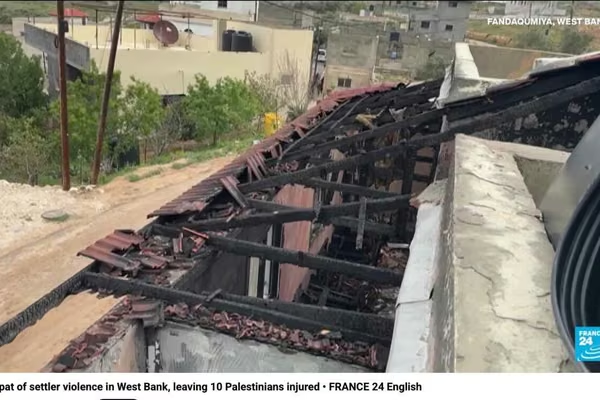
The Israeli government continues to treat violent settlers with leniency (to put it mildly) and for many, even if there is some recognition that settler violence might be going “too far”, most consider it justified revenge for October 7th 2023 as well as a way to ethnically cleanse the West Bank – and East Jerusalem.
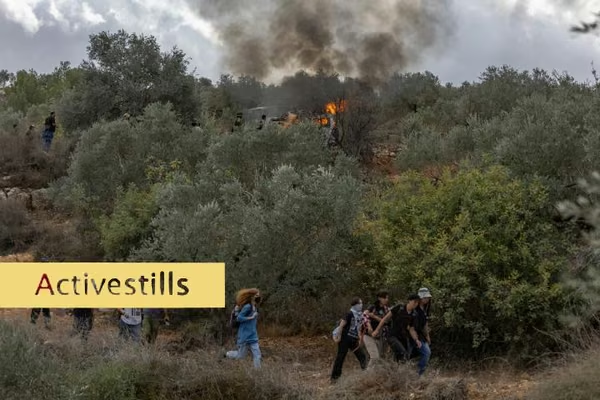
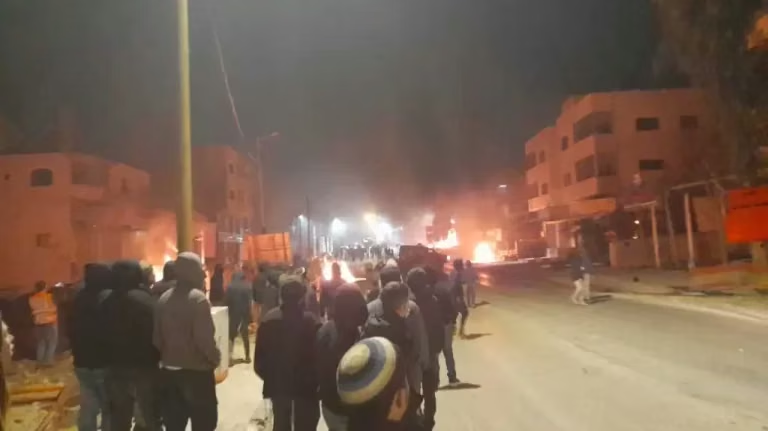
Huwara in the north West Bank has come under attack again and again. One such attack took place in February this year after which, “Israel’s far-right Finance Minister Bezalel Smotrich called for Huwara to be “wiped out.”
A further attack took place at the end of May and on Israel’s Channel 12 breakfast show a pundit echoed this saying: “Huwara should have been wiped out a long time ago … it should face the same fate as Jenin’s refugee camp, Beit Hanoun [in Gaza] and Bint Jbeil [in southern Lebanon].”
This article was originally published by Ha'aretz on Sun 7 Jun 2026. Read the original here.
From Hamas to Huwara: What's the Difference Between Jewish and Palestinian Terror?
When the image of a group of black-clad settlers driving into the West Bank town of Huwara to attack Palestinians circulated over the weekend, many Israelis saw a visual parallel to the Hamas attack of October 7. Was the resemblance intentional? Are there different tiers of terror?
A white Toyota pickup truck full of black-clad balaclava-wearing militants.
That was one of the grimly iconic images seared into Israelis’ memories from October 7, 2023. The footage came from the southern Israeli city of Sderot and showed Hamas terrorists driving around, ISIS-style, while conducting a massacre, killing 37 civilians, 11 police officers, two firefighters and three IDF soldiers.
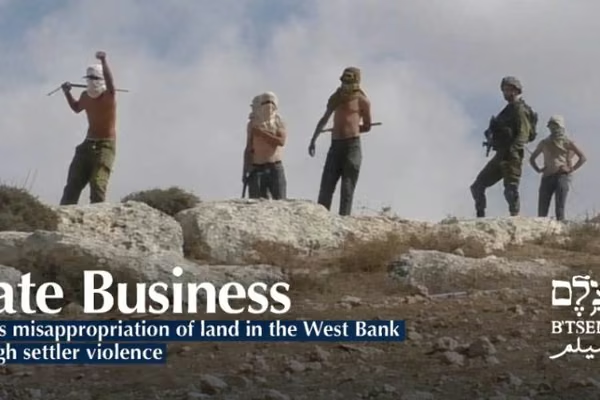
This weekend, the same image returned – but this time, it was a white Toyota pickup full of black-clad, balaclava-wearing Jewish terrorists entering the West Bank town of Huwara.
They wounded at least eight Palestinians; the settlers and a uniformed Israeli soldier were filmed beating two men with clubs.
The only visual clues to differentiate the two images? The October 7 militants toted Kalashnikovs and wore green headbands with the white lettering of the Shehada, the Islamic declaration of faith – the insignia of Hamas’ armed wing. The June 6 militants wore tzitzit, the ritual fringes worn by Orthodox Jews.
Settlers in Huwara, Saturday.
For award-winning graphic artist Yossi Lemel, an expert in political art, the visual mirroring was a deliberate choice. The violent settlers wanted to create their own “appalling icon” by reframing their actions as “revenge” for October 7 – taking back ownership of Toyota terror, as it were.
It’s part of a deliberate manipulation, characteristic of provocateurs, he says, and it has undoubted visual power. But although violent settler WhatsApp groups celebrated the comparison for its intimidation value, many Israelis simply equated them with Hamas, with frequent comments on social media to “Jewish Nukhbas,” referencing Hamas’ elite forces.

Every day there is another pogrom against Palestinians in the West Bank. It’s become an appalling routine; Shabbat is a favored day for concerted attacks. But Huwara has another set of resonances with October 7.
It was the site of a rampage in late February 2023 which broke through the mainstream apathy about settler violence. The proximate trigger was the murder of two brothers from the Har Bracha settlement; as “revenge,” hundreds of settlers hurled rocks, threw Molotov cocktails into Palestinian homes, shot dead a 37-year-old man and injured around 100 others. For the first time, Israeli headlines used the term “pogrom” to describe the violence.
Huwara became a flashpoint of successive terror attacks and settler vigilantism, to the extent that, shortly before October 7, the IDF was forced to redeploy units to the area from the Gaza border.
After the February pogrom, Israel’s far-right Finance Minister Bezalel Smotrich called for Huwara to be “wiped out.” On Sunday morning, after the latest attack, a pundit on Israel’s Channel 12 breakfast show reiterated the call: “Huwara should have been wiped out a long time ago … it should face the same fate as Jenin’s refugee camp, Beit Hanoun [in Gaza] and Bint Jbeil [in southern Lebanon].”
For Eliaz Cohen, the founder of a group of settlers who protest Jewish violence, the pride that the Huwara attackers take in their propaganda is “unbelievable.” But he thinks they overstepped: “It’s an own goal” in their war of narratives, he says. Cohen himself firmly rejects the comparison between Hamas and hilltop vigilantes, calling it “immoral,” but he considers the failure to confront violent settlers – whose actions have grown to “monstrous” proportions – to be a “complete military, moral and governmental failure.”

Cohen doesn’t expect much from the police force, which long ago surrendered to far-right National Security Minister Itamar Ben-Gvir. The Shin Bet, whose Jewish division used to act against settler terror, has been defanged. But he does expect more from the IDF, whose regional commander used the expression “Jewish terror” last month.
Cohen has a radical suggestion: The same IDF open-fire regulations used against Palestinian terror attacks, from stone-throwing to shootings, should be used against Jewish terrorists. “If there is no equal treatment, the message is: This isn’t actually terror and we can’t, or won’t, deal with it. That leads to anarchy, and it also just encourages more Jewish violence,” he says.
‘Attacks were happening well before October 7’
Abdullah Rade, a Palestinian farmer and activist in Al-Lubban Al-Gharbi, 35 kilometers (21 miles) east of Huwara, who is facing intensified pressure from settlers and the IDF, rejects both the efforts to isolate violent settlers as a dangerous but fringe phenomenon, and to characterizing the current tsunami of anti-Palestinian violence as a “reaction” to October 7.
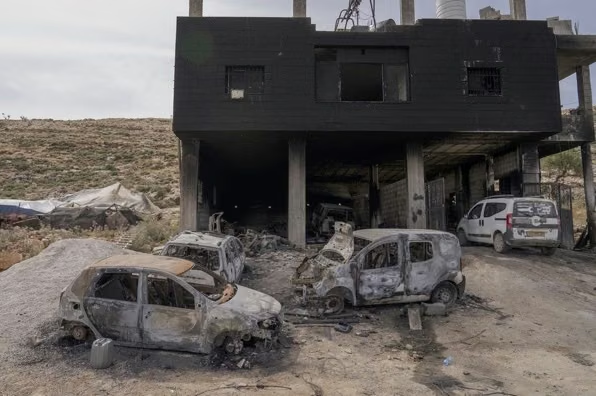
“The settler attacks were happening well before October 7. In recent years, they have increased dramatically and in their ferocity,” he says. “They burn our trees and farms, restrict our movement, steal our livestock, demolish businesses, workplaces and farms, confiscate our land, and cut off and steal our water supply; they kill, torture and abuse young people, children, women and the elderly.”
For Rade, it is clear that the settlers are enacting state policy: “These are systematic terrorist attacks sponsored by the state to further displacement and ethnic cleansing.”
Indeed, Palestinians are not only dying at the hands of settlers. On Friday, a 7-month-old baby, Sam Fahed Abu Haykal, was shot by an Israeli soldier in Hebron. And it’s hard to avoid Abdullah’s contention that there is a concerted effort by different arms of the state supporting settler violence. In another depressing routine, the IDF said they had not yet opened an investigation into baby Sam’s death, nor had they yet managed to identify the soldier beating up a Palestinian in Huwara.
By Sunday lunchtime, another grotesque terror attack, this time committed by an Arab citizen of Israel, had taken over the headlines. The 35-year-old carried out a series of shootings near the central town of Kochav Yair that left Haim Kalomiti, 55, dead and five others wounded.
Arab MKs denounced the Kochav Yair attacker. “Terror attacks and violence are not our way…Life is the supreme value. We unequivocally condemn the terror attack,” wrote Ahmad Tibi on X; Ayman Odeh wrote that “Harming innocent people is absolutely forbidden, and this principle applies to every person, Israeli and Palestinian alike.”
That is in stark contrast to settler leaders and their ministerial allies, who call to rain down destruction after Palestinian terror attacks and choose silence or justification after Jewish terror attacks. Prime Minister Benjamin Netanyahu himself has not commented on the Huwara attack. And Arab parliamentarians are well aware that right-wing voice calling to wipe out towns in the West Bank, Gaza and Lebanon are only a trigger-finger away from suggesting the same course of action for the Arab-Israeli town of Taibe, where the attacker lived.
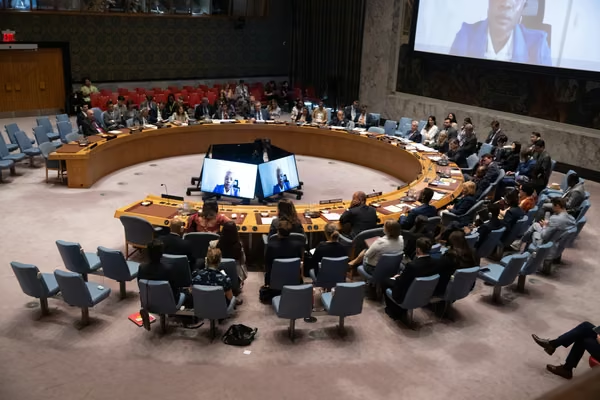
There has been and will be international condemnation for surging settler violence. That is helpful, even if largely performative, because it keeps the issue on the international agenda and reminds the Netanyahu government that they’re not invisible to the world.
But the fire is inside the house. As long as Israel’s government easily finds the words to condemn violence by Palestinians but loses its capacity to speak when violence is committed by Jews, Israel will continue to incubate a Jewish terror movement fueled by a theocratic ideology and territorial maximalism, backed by institutional capture, that will, justified or not, invite comparisons to the perpetrators of October 7.
No comments on this post so far.