
Germany’s Jewish Problem: Genocides Past and Present
JVL Introduction
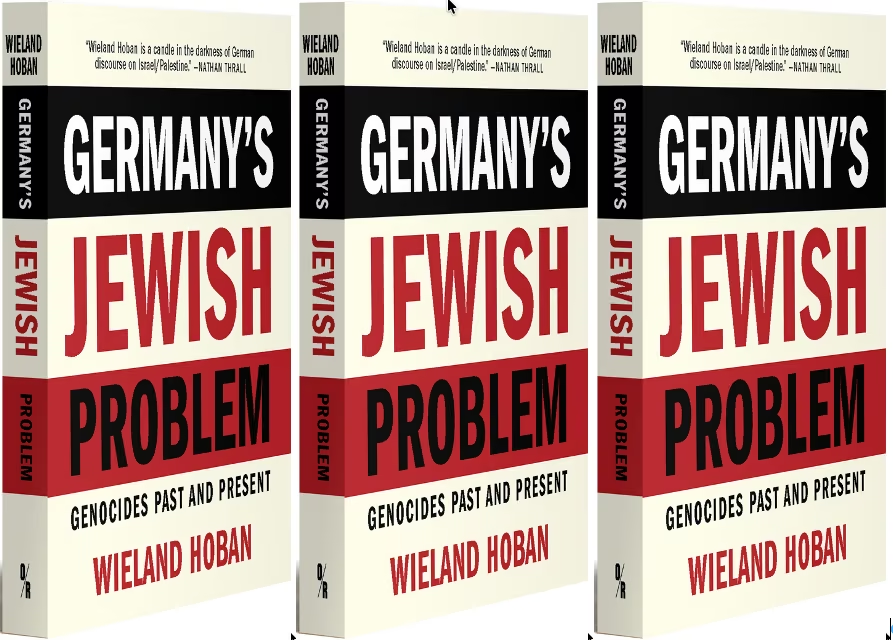
Wieland Hoban’s new collection of essays and interviews Germany’s Jewish Problem: Genocides Past and Present, recently published by OR Books, is reviewed here by Leah Levane.
“Wieland Hoban is a candle in the darkness of German discourse on Israel/Palestine.”
—Nathan Thrall, winner of the Pulitzer Prize
Note: there will be a London Book launch on 21st April with Wieland Hoban speaking. Do email us if you want more information nearer the time.
You can order the book directly from the publishers here.
RK
Wieland Hoban is the Chair of the German anti-Zionist organisation Jewish Voice for a Just Peace in the Middle East. This collection of 26 pieces, written over a four-year period is an important read and takes us from October 2020 to the first anniversary of the commencement of the genocide in Gaza. Much of the writing is about what is happening in Palestine rather than in Germany, highlighting what Germany is trying to ignore – not least by its weaponisation of antisemitism and its designation as terrorist of any act of resistance from Palestinians. So far so familiar, but there is a particular edge when the attacks on anti-Zionist Jews and the racism displayed towards the Palestinian people are from a German perspective. These essays contain criticisms of the left and far right as well as “mainstream” Germany politics and society at large.
As we have noted on many occasions (e.g. here, here and here), Germany is learning all the wrong lessons from the horrors of the Nazi era and the Holocaust of six million European Jews and many million others. Germany has decided that it has worked out how to deal with antisemitism – by making support for Israel its “Staatsräson” (i.e. its fundamental, non-negotiable commitment for Germany’s survival as a nation). Essays in this collection describes some of the impact of that decision. There is a lot to learn here and to be warned about this extreme reaction against those standing for the rights of Palestinians in many countries, including anti-Zionist Jews in the UK.
Germany will claim its support for Israel as “the Jewish State” is a way of shunning antisemitism which (rightly) is taken very seriously but it totally conflates Jews and Israel. Almost every German State and many other organisations have antisemitism leads (or Czars) who, armed with the IHRA so-called “definition” of antisemitism treated as holy writ as well as knowledge of their own heinous history, are – despite most of them not being Jewish –emboldened to tell anti-Zionist Jews that they do not know how to be proper Jews. Even the extreme right populist Alternative für Deutschland has one! (A friend told me that when she visited Buchenwald recently, there were AfD posters on every tree on the street leading to the site of the camp so the question of what has been learned is an open one)
Through these essays, Hoban paints a graphic picture of a Germany that wants to reject its antisemitic and brutal past but has not prevented the rise of far-right ideas, or of militarism, not least when it comes to its unquestioning support for Israel and its actions.
Germany is the extreme exemplar of weaponising antisemitism to divert attention from Israel’s human rights violations on the ground and failing to address anti-Palestinian racism and, indeed, Islamophobia, which is very real and ugly in Germany.
Some of the pieces are interviews and make for fascinating reading. Hoban’s interview with Ramsis Kilani (a Palestinian from Gaza whose father and other family members were killed during Operation Protective Edge) touches on the way the Central Council of Jews (similar to the Board of Deputies of British Jews) defines what is acceptable for Jews and what can be said.
Kilani noted:
“In a kind of perversion, they build a bridge via Holocaust guilt and the unfinished processing of that guilt, As a result, today’s Germans have learned from history and are cleansed of antisemitism. These people then tell Jews, even descendants of Holocaust survivors, that they’re actually the antisemites of today and that they’re comparable to the Nazi regime. That’s a real twisting of reality, and almost created a positive connection to the Holocaust because it’s purified you.”
Kilani and Hoban note that the left in Germany is also tainted with this perspective and while claiming to stand against racism does not want to include the question of Palestinian rights or be critical of Israel. Of course, this is all too familiar to Jews opposing Israel’s occupation, ethnic cleansing, siege and genocide, especially anti-Zionist Jews in many countries, not least the UK. But there is a particular edge to non-Jewish Germans telling Jews how they should think.
There are still fairly few Jews in Germany and many who are there are Israelis who have rejected Israel’s regime of Jewish Supremacy. The collection includes interviews with two members of Jewish Israeli Dissent (JID) who find that their experience also counts for nothing. The Israelis in Hoban’s organisation are clear that they are Israeli Jews against the occupation, not against their own people or parents. However, Israeli immigrants find themselves “sympathised with a little too much, as though they were victims with no role in the crisis”. There is still something considered “exotic” about being a Jew in Germany (as Iris Hefetz writes in her introduction). There is work to be done for it to be normal to be a Jew in Germany without it evoking a dangerous philosemitism but of course this only applies if you are “the right sort of Jew”, i.e. one who is Zionist and identifies with Israel – and perhaps also with Israel as the “victim” in the Middle East.
A compilation of essays and interviews written for different purposes means that there is some repetition but such a collection also means a whole essay with its key points can be absorbed over a cup of coffee. There is much to commend here, much to learn and appreciate and we recommend it wholeheartedly.






In addition to buying this book, you may be interested in this blog post by Martin Gax https://zeteo.com/p/germany-no-land-for-jews-still-israel-gaza?utm_source=share&utm_medium=android&r=j3i2o&triedRedirect=true