
Jewish Journeys from Zionism (11) Young Man
JVL Introduction
This. the eleventh in our series “Jewish Journeys from Zionism” describes the experiences and feelings of a young Jewish man, a strong socialist and active in Na’amod. Like all the stories it is unique but still with the clear thread not only of questioning what is handed down to us but also the determination to stand for justice for everyone, not only Jews.
We published this in July 2024 and are republishing to make small corrections.
Index of all the personal stories
LL
Anon young man 2
Interviewed in London, April 30th 2024
I am 25 years old. I grew up in an upper-middle-class family in north-west London. My father is Jewish by birth: his parents were born in South Africa, the children of Lithuanian and Latvian refugees, and they came to England in the 1950s. My mother converted to Judaism, as it was important to my dad to have Jewish children. She chose Reform, which takes only a year, I think, compared to the three or four-year Orthodox conversion programme.
We were part of a Reform Synagogue. I went to cheder every Sunday, until my bar mitzvah. I didn’t always want to go, but my Dad made sure I did. He often said, “Our ancestors died so that we could continue this religion, continue being Jewish”, so from an early age I had the idea of the duty of being Jewish because people had tried to kill us. I remember thinking, ‘All those people died so that I had to go to cheder on a Sunday? That doesn’t make sense to me.’ After my bar mitzvah, I was encouraged to take Jewish Studies GCSE as well, with classes taught by my rabbi.
My school was not Jewish, but I was among a lot of Jews, in what is known as the north-west London Jewish bubble. I didn’t always fit too well in this bubble. Early experiences of it made me not want to identify with being Jewish. When people said, “You don’t look Jewish”, I would say “Thank you!” I was more drawn to the Englishness I had from my mother’s ancestry, and felt that was something to be more proud of. I was always questioning – and it was only later that I realised that this questioning was actually a very Jewish thing in itself. I questioned religion: I remember calling myself an atheist at eleven years old, and arguing with my rabbi.
I clashed quite a lot with my father. It was never a religious argument; God was never invoked. It was sometimes about what it meant to be Jewish, especially in relation to the fact that people hate us: we have to be proud, and we have to continue this long tradition. But our clashes were mainly political: I identified as a socialist or communist or Marxist or whatever at the age of fifteen. I think I got there through my atheism: I remember learning about Feuerbach[1] and how God did not create man, man created God, and that fed into Marx and “Religion is the Opium of the masses.”[2] I became known as the champagne socialist of my school.
Palestine and Israel was something I pushed to the side because it was an argument I could never have with my dad. Within two minutes it would lead to shouting. My earliest memory of our arguments about this was simply that no criticism would be tolerated: any criticism of the state of Israel was essentially treasonous. “We can only rely on ourselves to defend ourselves.” He didn’t want to hear a smidgeon of anything pro-Palestinian. I knew that there were issues, and I recall having arguments with him about the illegality of settlements, and the killing of civilians. He always invoked the Human Shield argument, and said “The UN are antisemitic; all these organisations are antisemitic and cannot be trusted.” It was too emotive, so at that age I decided to focus on other politics that were less inflammatory. Besides, at that point my socialism was less decolonial: I thought, ‘There is a working class in Israel, and a working class in Palestine,’ and it seemed like a contrived religious conflict that I couldn’t understand, so I didn’t want to engage.
Haunted by the Holocaust
Although my great-grandfather escaped to South Africa in the early 20th century, there were still members of my family in Lithuania who died in the Holocaust. My father went in 2000 on a family research trip. He was accompanied by the late Chaim Bargman[3] – an expert on Jewish heritage in Lithuania. They went to Krakes, a village just north of Kaunas, the second largest city – Kovne would by the Yiddish name. He asked to be taken to the oldest person in the village, and they found a 90-something-year-old woman and he asked her, “Do you remember my family?” She said, “I do remember, they lived there,” and she recounted the day they were taken out to the forest to be shot. My dad told me it was Lithuanians, alongside the Nazis, who led them there. I grew up around not only hatred of the Germans – my dad didn’t want me to learn German at school – but also a degree of resentment of Lithuanians and other former neighbours in Eastern Europe, the people who my father saw as having turned the Jews in.
First view of Israel
When I was sixteen I went on Tour. I had never been to any youth camps, though some of my friends had, but in my mind Tour was a matter of spending a month with a load of young people. I was at a boys’ school so the idea that there would be girls there was a revelation.
I went with Reform Synagogue Youth (RSY). The Tour was really pushing the idea that Israel was the homeland that would always be here for us. I remember being moved by Mount Herzl cemetery[4]; and I remember Yad Vashem, snaking through the exhibition and coming out onto the great balcony overlooking the land of Israel – the narrative is very clear. But mostly I felt it wasn’t my homeland at all, because of its very militarist masculine culture. Seeing the golden muscled bodies on the beach, I thought ‘This isn’t me!’ A few Israelis joined our group as guards. When a Palestinian citizen of Israel was invited to speak to us about his experiences, one of the Israelis with us, who I really got on with, was angered by his talk. I remember her saying, “All this complaining, and yet he sits there with an iPhone!”
I’d visited America the year before and hated it, because of identifying as a socialist and having learnt about the Cold War. But on Tour, despite my curiosity in all other affairs and my being very political, I didn’t seek to learn more about the kibbutzim we visited. I think there was still a voice in my head that was defensive about Jewish people, a part of me that implicitly accepted the need for a Jewish homeland. At that time you wouldn’t have asked someone, “Are you a Zionist?” It was, “Are you pro-Israel?” If you grew up as I did, you are Zionist by default, it’s a given. But at the end of the Tour I came back to London with no desire to ever return to Israel.
Experiencing the antisemitism crisis in the Labour Party
My first experience of party politics was campaigning against Keir Starmer for the Greens in the 2015 general election. I supported Corbyn from the day he announced his Labour leadership campaign, specifically because of my socialism: I was concerned with issues like homelessness, poverty, housing, education. I joined the Labour Party in 2017, and immediately joined the Momentum group.
I was always very alert to antisemitism. My time in the Labour Party was one of the most difficult times politically, with the emotions around being Jewish in the Labour Party at that time. It was also the height of tension between me and my father: I don’t know if he used the term self-hating Jew, but he insinuated that I was antisemitic myself.
One of the members of Momentum at that time was obsessively posting and commenting on videos of the Jewish Labour Movement. Despite my political disagreements with the JLM I felt uncomfortable, and I frequently challenged her and argued in the group chat. She was extreme, and had only a small number of sympathisers; to me, she was obviously antisemitic. It became a scandal when one of the local councillors, who was on the right of the party and Jewish, shared a lot of the images she had posted. I remember sitting in a coffee shop with two other activists, going through every single image and explaining to them why each was antisemitic. They were saying, “This is just anti-Israel”. But I can tell the difference between anti-Zionism and antisemitism. There was Holocaust denial in there; she was friends on Facebook with Alison Chabloz[5], and with Gilad Atzmon[6], who has published some horrific stuff. She was kicked out, but remained in the mailing group. I continued to challenge her and ask why she was still in the group – with a lot of people supporting me.
I was frustrated that there wasn’t more of a will in the Labour Party to deal with this. It was hard to fight against people who were accusing the party of antisemitism when at times I felt that there actually was antisemitism. I often felt, ‘If this isn’t antisemitic, I don’t know what is; don’t you believe it exists?’ I wanted to educate people. To be honest, I wasn’t happy with JVL when they defended Chris Williamson: he is someone I instinctively felt uneasy about[7]. It was all very tiring.
I think the crucial difference comes in one’s analysis of power. People say the US acts the way it does because it is in the thrall of the Israel lobby, rather than seeing a symbiotic relationship between two powers, one of which – Israel – is almost a client state, acting as a bastion of Western interests in the Middle East. If you say, “American politicians act the way they do because they are bound up by Israeli money”, to me that has antisemitic undertones: you are implying that at the top of the hierarchy there is a group of Jews, Jewish money. I think it’s a flawed understanding of how the world works, and it’s not a basis for good activism.
Now that I am getting into the pro-Palestinian movement, I find antisemitism is nowhere near as endemic as I thought it was. The marches are almost as much about the complicity of western powers – the UK, Germany, the US – as they are about Israel itself. That shows an understanding of the global nature of politics; none of these states act in isolation. There’s an understanding of how Israel is part of a wider network of interests, in which we in Britain are implicated. Maybe that’s just the echo chambers I live in.
I think also that I have become less sensitive about the presence within the movement of things that I would consider antisemitic, because I understand that the basis of it is most often ignorance. It comes down to a conspiratorial analysis of the world, an elitist analysis, which is a key issue in antisemitism on the left and indeed the right: it holds that power is worked by an elite group of people whose decisions affect the rest of the world. I have a more structural understanding of power. I see it as impersonal: one group of people could replace another as a ruling elite but the same operations of power would exist. You see that in post-colonial states everywhere. I think that fighting antisemitism on the left is part and parcel of developing a stronger basis for understanding how power operates, and being better activists. I look back with regret at that era when I was in the Labour Party, that I didn’t take a more active stance in educating. I tended to shut down when I heard something I didn’t like; I wish I had fought more.
I’ve come to understand that there are many types of prejudice existing around the world – it’s in the media we consume, in how we grow up. Part of being a revolutionary is fighting those ideas, and having humility: you may have prejudices yourself that you need to be alert to. Now I have less goodwill towards the people who are weaponising antisemitism. I knew at the time that this crisis was being – not concocted, but stirred, weaponised – by people who didn’t care about the party, but wanted to weaken it.
I left the Labour Party very soon after Starmer was elected, specifically because of his position on Black Lives Matter[8]. I thought, ‘I can’t stand this, I can’t give my money to this.’ The left-wing group was devastated, there wasn’t much left, we were just contesting delegates to meetings and so on. After I left, I was ready to put political aspirations behind me. I thought, ‘We are not going to achieve socialism in my lifetime, so I might as well make the most of my life.’
Developing understanding of what it is to be Jewish
As I said, in my early teens I’d rebelled to some extent against the pressure to identify as Jewish. But in 2018, during my undergraduate studies in History and Politics, I was awarded a grant to visit Lithuania and Poland for a research trip on conflicting memories of genocide. I was interested in “Defending History”, a group of activists in Lithuania fighting against Holocaust revisionism, or what they called “obfuscation”. This revisionism has a lot to do with the geopolitical situation of eastern Europe in relation to Russia and NATO. Around the time of my visit, Poland had outlawed the term “Polish Death Camps”[9], and in Lithuania they were celebrating figures like Jonas Noreika[10], hailing him as an anti-Soviet freedom fighter, though in fact he signed off mass executions of Jews during WW2. 95% of Lithuanian Jews were killed, one of the highest rates. The oppression of Jews had led many to be communists, and many were killed not only as Jews but also as communists. Lithuania was unusual in that most Jews weren’t killed in camps but by mass executions, in 1941-42. They call it the “Holocaust of bullets”. Jews were taken to forests and shot.
Now there’s a lot of whitewashing of collaboration. For instance, the Ninth Fort in Kaunas was one of the mass killing sites[11], but now its museum had a room called “Lithuanians, saviours of the Jews.” A few people did take Jews in, but considering YIVO[12] has written that the Ninth Fort was the only killing site in Europe that was almost wholly administered by local people, I felt that it was very dangerous to be using this sort of language as the title of a room. I interviewed the deputy director of the Fort and challenged him on that, but he evaded the question. Remember, I was only nineteen.
I went into this trip wanting to investigate how public institutions – historical institutions, museums, sites of memory – dealt with this battle over victimhood. From the Jewish perspective, local communities collaborated in the genocide of Jews; whereas the Lithuanian perspective argues that the Soviet occupation should be considered a form of genocide, that the gulags were as bad as concentration camps. I meant to prove that Lithuanians and Poles were unable to deal with their guilt. I had a sense of righteousness: we as Jews have been wronged here, and we deserve our history to be acknowledged as it should be. I’ve got all the notes but I didn’t ever write it up. My scope was so broad – I went to Vilnius, Kaunas, Warsaw, Gdansk – and when the trip was over, I didn’t have answers.
A couple of years later, I did an MA in Music Studies – and the course changed my whole perspective on the world. It was at the University of Amsterdam, as it was the last year before fees went up after Brexit, but I did it from home because of Covid. I took a module called Cultural Musicology, which had a huge amount of post-colonial studies: I started to understand and be able to articulate concepts like Whiteness, and decolonised my own politics. Studying and reading about empire, racial capitalism, and colonialism, that was a big shift, and it led me to be a lot bolder in my stance on Palestine. I started to see the importance of moving beyond victimhood as a basis for political claims.
I also did a Jewish Studies module (and became Kosher again, to the extent I had been as a child). I read a lot, and learned about the different histories of Judaism that existed, the Yiddish tradition, the history of Bundism and Jewish socialism, the Frankfurt School[13] and the great Jewish thinkers who were at the vanguard. Recently I’ve been reading an amazing book by Tom Segev, called The Seventh Million[14]. It made me aware of the effort Zionists had to make to create the state of Israel, how forced it was as a political project. I hadn’t been aware of the lengths they went to.
Jewish values and anti-Zionism
A moment of rupture for me, when my everyday experience of Judaism came into conflict with my politics, was in May 2018, after Na’amod held Kaddish for people who’d been killed in Gaza[15]. Rabbi Schochet[16] wrote a piece in which he described the Na’amod members as Kapos[17]. I can’t articulate how I felt – when a rabbi who you know uses such a term. I’d kind of known already what he was like: he’d been the rabbi who oversaw my grandfather’s funeral. He’d made the funeral a lot about Israel, about how my grandfather had fought in the 1948 war and was a devoted supporter of Israel, which was not the grandfather I remembered.
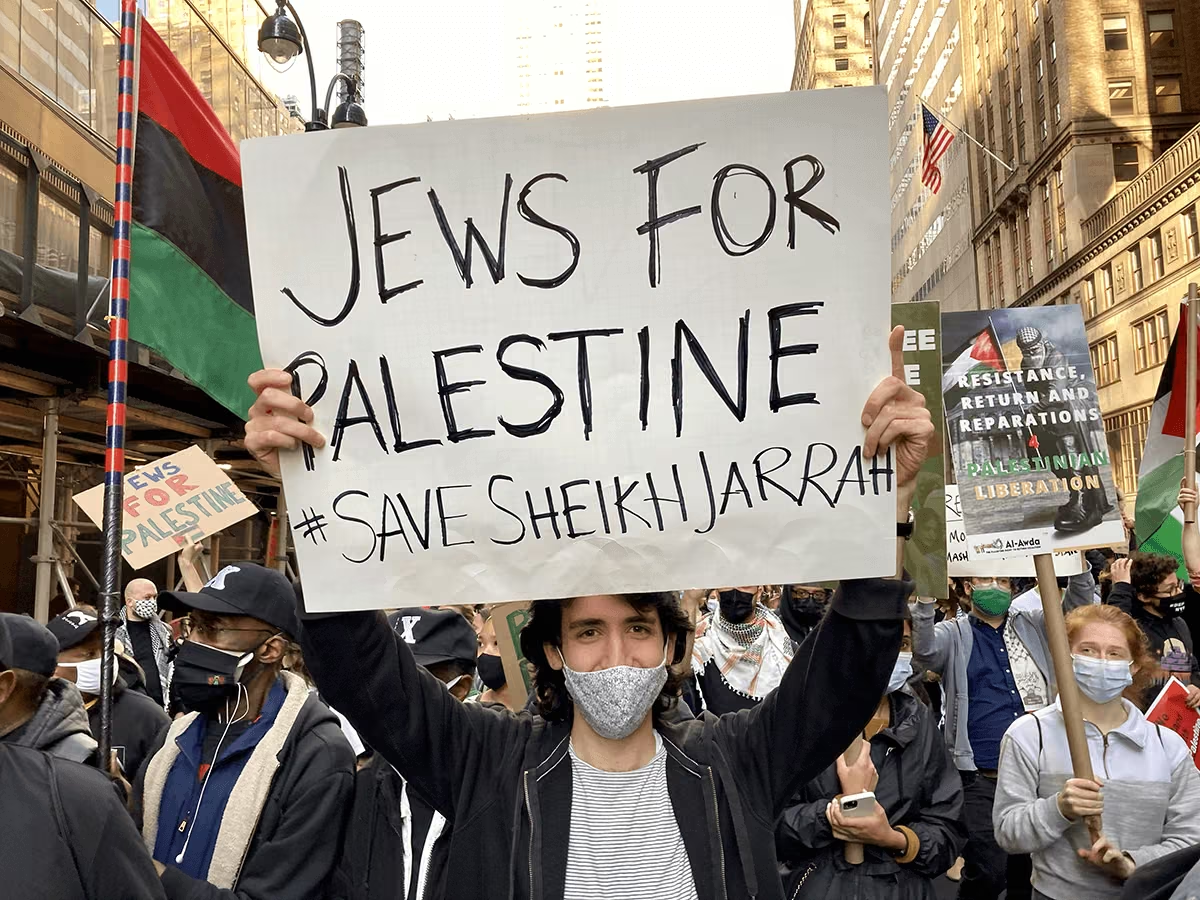
The first pro-Palestine protest I went on was against the Sheikh Jarrah evictions, outside Downing Street in 2021[18]. I had seen videos of teargas being thrown into Al Aqsa mosque, and I was thinking, “This is incredibly wrong, and I want to do something”. I went with a friend who was a member of Na’amod[19].
In the week after October 7th, like many others, I changed from being a non-Zionist to being an anti-Zionist. What specifically mobilised me was the weaponisation of Holocaust language by Israeli officials. The headlines were, “The worst massacre of Jews since the Holocaust”, and then they started calling Hamas Nazis. I’ve studied the Holocaust. It was clear to me that the October 7th attack, the way it occurred and the conditions behind it, could not be compared with the Nazi extermination of Jews in Europe, what was done and the conditions in which it was done. The way this Holocaust language was being used felt like a disgusting manipulation of the memory.
My position had once been, “I don’t think it’s right to say to a Jew, because you’re Jewish you need to take an active stance on Israel and Palestine.” I went from that position, to: “I do have an opinion on it, but I don’t think it should take up more space than other issues around the world.” Now I’ve moved to, “My name is being used to justify horrific genocidal acts. What am I going to do about it?”
I went to visit friends in Amsterdam in late October 2023, and went to a teach-in at the university that one of them had helped organise. I heard some incredible speakers, and was very impressed by how people there recognised the complexity of the situation, but also had a clear understanding of the moral and political approach we should be taking. I was really inspired by some of the activists I met.
Since then I’ve been on several marches in London, to an amazing Shabbat for Palestine organised by the Jewish bloc, and with my sister to Na’amod’s Seder. Recently I marched for the first time with the Jewish bloc. It’s important on these marches to be visibly Jewish. I made a sign saying, “My Jewish values brought me here”. Part of my Jewish education was the concept of “Tikkun Olam”, repairing the world, and I love the phrase in Isaiah, “The light among the nations.” And part of what makes me Jewish is the radical Jewish tradition of questioning power, always being critical, never accepting the world as it is given. Even my Dad, extreme as he may be, would question things.
People on the marches really appreciate my sign. They are very emotional when they see it, they say “Thank you so much”, they often want to hug me. In this emotion there’s an understanding of how difficult it is for us as Jews to be there; it’s a caring recognition, caring about you as a Jew. People are coming from a place of love, and it’s a beautiful thing.
[1] Ludwig Feuerbach, 1804-1872, a German philosopher and anthropologist. His best-known book was “The Essence of Christianity”, in which he developed the idea that God is a creation of Man.
[2] This slogan is derived from the Introduction to Marx’s “Critique of Hegel’s Philosophy of Right”.
[3] Chaim Bargman or Bergman: Lithuanian ethnologist and historian, especially of the Jewish heritage in Lithuania and events around World War 2, which are very contentious in Lithuania.
[4] Mount Herzl, on the edge of Jerusalem, is Israel’s national cemetery and has other memorial and educational facilities.
[5] Alison Chabloz, a British right-wing blogger and musician, was imprisoned in 2021 for broadcasting antisemitic songs which denied the Holocaust.
[6] Gilad Atzmon is an Israeli-born Jazz musician and writer, a controversial anti-zionist and known for challenging Holocaust-denial legislation. The Community Security Trust described his book, The Wandering Who? A Study of Jewish Identity Politics (2011) as “quite probably the most antisemitic book published in [the UK] in recent years”.
[7] Chris Williamson, Labour MP for Derby North 2010-15 and 2017-19, was suspended from the Labour Party in 2019 for critical comments about how the party was responding to allegations of antisemitism. He thought antisemitism was being weaponised. He resigned from the party and joined the Workers’ Party. He hosts a programme, Palestine Declassified, on Press TV, a TV channel owned by the Iranian government. The investigation into antisemitism in the Labour Party by the Equality and Human Rights Commission in 2020 did not find him guilty of “harassment in relation to Jewish ethnicity”.
[8] In July 2020, Sir Keir Starmer referred to Black Lives Matter as a “movement, or moment if you like”. He was widely accused of belittling the movement and the issue of racism, though he denied that that was his meaning.
[9] Official efforts to rewrite the WW2 past, attributing all atrocities to Nazi or Soviet occupiers and minimising the roles of local people, creating an image of a glorious and heroic past, have become more common in Eastern and Central Europe since the rise to power of nationalist populist parties such as Poland’s Law and Justice party (2015). The “Polish death camp law” (2018) was an amendment to existing law making it a crime to accuse Poland of participating in Nazi or communist offences. “Polish death camps” refers to Nazi camps that were located on Polish soil, including Auschwitz.
[10] Jonas Noreika 1910-1947, an anti-soviet partisan and Nazi collaborator. He was responsible for the murder of 1800 Jews in the Plungé massacre, and for confining other Jewish communities into ghettos. Plaques and other memorials celebrating his memory have been controversial.
[11] During the Nazi occupation, 1941-44, 45-50,000 Jews, mostly from Kaunas and its ghetto, were murdered by Nazis and Lithuanian collaborators in the Ninth Fort in Kaunas, “the Fort of Death”.
[12] YIVO Institute for Jewish Research, established in Wilno, Poland (now Vilnius, Lithuania) in 1925, moved to New York and Buenos Aires before World War 2.
[13] The Frankfurt School of critical social theory was one of the most influential philosophies of the 20th century. Founded in 1930, most of its early members were Jewish.
[14] The Seventh Million: The Israelis and the Holocaust (1993). Tom Segev is one of Israel’s “new historians”, challenging the country’s official and traditional narratives.
[15] Na’amod members held Kaddish in Parliament Square, London, 16 May 2018, for 62 Palestinian demonstrators killed in Gaza since March in the largely peaceful “Great March of Return” demonstrations. The Kaddish event caused outrage among some in the UK Jewish community.
[16] Rabbi Yitzchak Schochet came to the UK from Canada via New York in 1991, and at the age of 28, in 1993, became the rabbi of Mill Hill synagogue in London. He is a sought-after speaker and prolific writer.
[17] A “Kapo” was a prisoner in a Nazi camp assigned to supervise forced labour or carry out administrative tasks. The term is sometimes used now as an insult, meaning a Jew who betrays fellow Jews by work for their oppressors.
[18] Sheikh Jarrah is a district of East Jerusalem, from which some Jewish property-owners had been moved in 1948 as part of the ceasefire agreement dividing the city into Israeli West Jerusalem and Arab East Jerusalem. From 1987 some Jewish Israelis began making claims to repossess properties from the Palestinians who had been legally living in them since 1948. Long-running legal disputes ensued, and from 2001 settlers began moving in and evicting the Palestinian occupants. In 2021 an Israeli High Court ruling was expected in favour of the settlers, which triggered demonstrations and violent protests across Palestine leading to the storming of Al Aqsa by Israeli police and eleven days of fighting, including rockets from Gaza and retaliatory airstrikes, in which 256 Palestinians and 13 Israelis were killed.
[19] Na’amod, founded in 2018, is a movement of Jews in the UK seeking to end the community’s support for apartheid and occupation, and to mobilise it in the struggle for dignity, freedom and democracy for all Palestinians and Israelis. The name means ‘We will stand’ in Hebrew.
Really interesting ( not just because my partner’s family also came from a village outside Kovne ,and thence some of them to South Africa)! The evolution of this young man’s ethical position is very clearly and honestly described. Like many in the younger generation his religion is important. Like all of us of whatever age, family pressures also mean a lot to negotiate.
I’m particularly interested in this sequence:
‘My position had once been, “I don’t think it’s right to say to a Jew, because you’re Jewish you need to take an active stance on Israel and Palestine.” [The Baddiel position, often encountered].
I went from that position, to: “I do have an opinion on it, but I don’t think it should take up more space than other issues around the world.” [ Again, a position often encountered, this time among anti-Netanyahu but pro-Israel supporters]. Now I’ve moved to, “My name is being used to justify horrific genocidal acts. What am I going to do about it?”
This is wonderful because it is so open-ended, part of a long development that hasn’t hardened. Perhaps one day we will know this person’s name, it will be an honour!
I have nothing but respect for your position and how you arrived at it.
Brilliant.