
Jewish Journeys from Zionism (17) Tony Lerman
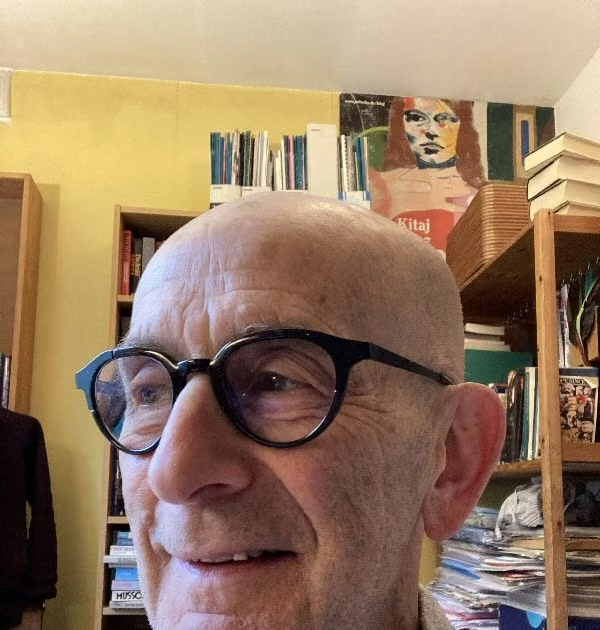
JVL Introduction
This is the 17th in the Jewish Journeys from Zionism series and, like the others, makes for fascinating reading. Tony Lerman held several positions in Jewish organisations and has written about his own journey from Zionism and also about the weaponisation of antisemitism. He writes about his enthusiasm for socialism nurtured, in part, by the Habonim movement and the initial attraction – and then disillusion with – the kibbutz movement. This is another fascinating story of personal history, political awakenings and growing awareness of the reality of Zionism on the ground.
Once again our huge thanks to Kitty Warnock who took on the task of creating this “Jewish Journeys” series as a volunteer early in 2024.
Antony Lerman[1]
My name is Antony Lerman, but I’m usually called Tony. I was born in 1946.
My mother’s family came from Poland in the 1880s. Her father, Myer Miller, was a tailor who, by the early 1950s, had three shops in London: at the Angel, Elephant and Castle, and the main one in Old Street, at the heart of the East End. He was brought up in Bethnal Green, but moved out to Golders Green when he married my grandmother Rose. My mother Ray and her twin sister Leah, born in 1919, grew up in comfortable circumstances. Myer was a pillar of the United Synagogue community, being among the founders of the Dunstan Road shul.
In contrast, my father Abraham’s parents, Samuel and Rosa, arrived in the UK penniless in 1901, from a shtetl in the Zhitomer region in what is now Ukraine. They settled in the East End, near Mile End. Samuel, from a strictly orthodox background, had no training and worked as an odd-job man (though he was formally known as a cabinet maker). After Rosa died in 1912, Samuel married again in 1913 and his wife Sarah gave birth to my father in 1918.
With five children to bring up, the family was very poor. My father left school when he was thirteen, mainly because he didn’t have boots to wear to get there. I know little about his teenage years, but I believe he had friends involved in communist politics, and in later life when we were very comfortably off, he would, perhaps slightly tongue-in-cheek, describe himself as a communist.
My parents met when my father got a job sweeping the floors in the Old Street shop. He started to learn the tailoring business, and he and my mother were more or less engaged when the war came and he was conscripted to serve in the Royal Berkshire infantry. He saw action in 1940 as part of the rearguard attempting to stem the advance of the Germans while the Dunkirk evacuation was underway. But he’d been less than two days in the field when a mortar exploded above him, leaving him unconscious and wounded in a ditch near Ypres. He came to in a German field hospital and spent nearly four years in German prisoner-of-war camps in Germany and Poland.
He was repatriated in a prisoner exchange in late 1943 organised by the Red Cross. His father lived just long enough to see his return. The mortar had left him with only partial use of his right hand, but he learnt the tailor and cutter trade, married the boss’s daughter in 1944 and went to work in the family business. My grandparents Myer and Rose helped them buy a small house off the Hendon Way, and that’s where I grew up. Several aunts and uncles lived nearby, so it was a close-knit milieu, of largely observant Orthodox Jews. We went to synagogue on Friday night and Saturday – often morning and evening – and from the age of four I was attending cheder four times a week. But the family was also assimilating, so by dress we were indistinguishable from the middle-class population of the area. I went to an ordinary state primary school, Wessex Gardens, though with a very high percentage of Jewish pupils. I was not a conscientious student, and only just scraped through the 11-plus to get into a grammar school.
I don’t remember hearing much mention of Israel in the synagogue or the cheder beyond the reciting of the prayer for the state. But Israel was symbolically present in the form of the Jewish National Fund (JNF) collecting tins on a classroom windowsill and at home. People knew a bit about the mass murder of Jews in the war but it didn’t figure prominently in services, cheder or at home (and the word Holocaust didn’t come into general use until the 1970s).
Although I have fond memories of the rituals of Jewish life, especially when festivals and Holy days came around, I was often bored in shul, and in the cheder class I would often gaze out of the window wishing I was with the non-Jewish boys playing football in the park. It was no surprise when I failed my bar mitzvah test the first time round, much to the disappointment of my parents. I scraped a pass the second time.
I came into contact with Zionism, though I wouldn’t have known the word then, at the age of eight, when my older brother Steve and I went on a 10-day Habonim[2] camp in Capel, Surrey. (Strictly speaking, I was a year too young but it was allowed as I had Steve to keep an eye out for me). My mother must have had nice memories of going to one of the earliest Habonim groups[3], and I think my parents were concerned that assimilation would take us too far away from Judaism. They were looking for something we could do which was Jewish but a bit more fun. And it was: to this day I remember it well. I only realised much later that some of the ‘fun’ games were playing at soldiers fighting Arabs, with sticks for rifles.
When I was thirteen and my brother fourteen, we started going to regular Habonim activities in the Finchley Road youth centre. I enjoyed the scouting element, singing Israeli songs, mixing with girls and playing group games. I was a diffident child, with a slight stammer, and this youth group provided me with a socialisation pathway. And the youth centre had a table-tennis table – the one sport I was good at.
By the time I was fifteen, Habonim was a very important part of my life. I was going to summer, winter and weekend camps, and to the youth centre often twice a week. At school I was beginning to take an interest in left-wing politics, being drawn to radical movements – especially the French and Russian revolutions – taught by an engaging history teacher. By then I was fully aware that Habonim was a socialist Zionist youth movement, and that its aim was to send young Jews to live on a kibbutz. It was the socialism, rather than the Zionism, that was of most interest to me. I took the legitimacy and necessity of Zionism for granted. We spent endless time discussing different kinds of socialism, how the kibbutz would realise it, whether this or that socialist or socialist-Zionist thinker – Marx, Ber Borochov[4], A. D. Gordon[5] for example – held the key to making real the socialist Zionist revolution.
That ‘Arabs’ lived in Israel and were a ‘problem’, and that they surrounded the state and threatened its existence, was taken for granted. Israeli Arabs loomed large in our discussions about whether kibbutzim should hire Arab workers, or should use only Jewish labour in order to achieve ‘pure’ kibbutz socialism. This dehumanisation seems hardly credible now, but you must remember that we never referred to Arabs as ‘Palestinians’. If I ever heard the word ‘Palestinian’, it was in reference to Jews who had immigrated before 1948. When ‘Arabs’ were spoken of, it was in connection with incursions by Arab ‘mechablim’ (terrorists), and the word conjured up a scary image of an enemy who didn’t want us there. It was drummed into us that the Arabs living in the Jewish homeland had left their homes of their own accord in 1948 because their leaders told them the Arab armies were advancing and would drive the Jews out. I remember in the late 1960s being given “factsheets” about this, prepared by whom I do not know, and being frightened that the Arabs were saying, “This is Arab land, and we’re going to come and take it back.”
By sixteen I was thinking Israel might be the place for me. I was not doing well at school, and had almost left at fifteen. I was particularly weak in maths, a handicap which I felt acutely because my older brother excelled at it. (He became a professor of the philosophy of maths education).
I feared that I would not get beyond O levels. But this fear seemed to act like a wake-up call, and with encouragement from my history and English teachers, the range and depth of my reading increased. The latter lent me classical music records and opened to me the world of poetry and good fiction. But the person who most influenced my intellectual development was Simon Schama[6] – which seems odd now, given how differently we think today. A year or so older than me, he went to the same synagogue and was a member of Habonim. He was already known as a brilliant student and he sort of took me under his wing. He lent me essays that he’d written, for example on Shakespeare or modern history, and gave me book lists covering philosophy, political theory, literary criticism and much more. I began writing – bad poetry mainly, but I also tried my hand at fiction and wrote about issues connected to the youth movement and socialist Zionism. The writing bug never left me, but it was only years later that I began to see my writing in print.
Being a Habonim youth leader
I progressed academically and got good enough A level grades to secure places at LSE and Manchester University to study sociology. At the same time I was so committed to the youth movement that I was determined to go on the one-year leadership training course in Israel that all Zionist youth movements could send their future leaders to, all expenses paid. My parents had refused to let my brother do this but I was stubborn and they gave in.
I enjoyed being away from home, but it was tough at times. There was no time for wallowing in starry-eyed idealism. Israel in 1964 was quite a primitive place, and Jerusalem, where I spent the first five months, was a backwater: divided, dusty and mostly quiet.
We were more than 100 from 15 or more northern hemisphere countries, reflecting a range of Zionist youth movements from the French Marxist-inclined Hashomer Hatzair to the apolitical north American Bnai Brith Youth Organization (BBYO). We studied Jewish and Zionist history and Hebrew, and the skills needed to bring young Jews to imbibe Israeli culture. I knew classical Hebrew, and picked up the modern language quite quickly. One of my talents was so-called Israeli folk dancing – ‘so-called’ because of course (as I realised later) there was no such thing. It was an appropriated mix of Polish, Russian, central European and also Arab/Palestinian dancing. Steeped as we were in all-embracing Zionist ideology, it was easy to swallow such fictions.
After completing the six-month educational component of the course in Jerusalem, those of us belonging to kibbutz-oriented movements went to a large kibbutz for two and a half months to get our first taste of manual labour, mostly picking fruit and planting new orchards. Our UK Habonim contingent spent the final two and a half months at Kibbutz Amiad in the Galil[7], where members of our movement had been settling from the early days of the state. A new influx of Habonim members ‘making aliya’[8] was underway, and it was expected that some of us would join them.
Irrespective of any such plans we had, it was expected that in exchange for the all-expenses-paid course, we would commit much of our free time to leadership work in the movement, and perhaps take up full-time posts.
After the fairly sheltered life I had lived until then, that year in Israel gave me so many new experiences, relationships, trips covering the entire country – so much to assimilate: the physical reality of the Zionist and Jewish story.
While I had not wavered in my desire to make Israel my home, I was acutely aware of the tedious nature of the work on the kibbutz. I was assigned to the banana plantation, which was swelteringly hot, tough and, to me, boring. I struggled with that, because the ideology of Jewish Labour that we learned reading Borochov and A D Gordon took no account of any such doubts. I understood the concept of the ‘dignity of labour’, but when it came to doing the work….I didn’t question the idea but I felt inferior; I couldn’t meet those standards.
As for any questioning of the legitimacy of the Zionist idea or of the status of Arab Israelis – there was none.
Back in the UK, I took up my deferred place at Manchester University to study sociology. At first it was a relief to be feeding my brain rather than testing my muscles, and I was soon playing my part as a Habonim youth leader. Nevertheless, it wasn’t long before I became deeply unsettled and unhappy, living in tiny digs and studying a lot of maths-based economics, which I wasn’t good at. The year in Israel had left me very disoriented. I came back to London, much to the consternation of my parents. But I still wanted to get a degree, and in the autumn of 1966 took up a place studying sociology at what was then Regent Street Polytechnic.[9] In the meantime I got a job shifting lino in Whiteleys department store, and threw myself into youth movement work. I found the sociology course relevant and rewarding, and as my first academic year ended in June 1967 I felt confident that a degree was in my grasp. But the outbreak of war in the Middle East that very month changed everything.
In the movement, like practically everywhere else in the Jewish world, we saw an existential threat to the Jewish state. Many senior movement members – and I was one – wanted to go out to Israel as volunteers, defending the state and especially the kibbutz we intended to make our home. A feverish atmosphere of dread and naïve heroic excitement prevailed. But the war was over in six days, and fear of annihilation gave way to talk of a miracle.
For me, it suddenly seemed obvious that I should put my studies on hold and take up a full-time role in the movement – filling a gap left by more senior full-time workers moving to Israel earlier than they had planned to.
I was sent to Glasgow to run the Habonim centre there, even though I had very little experience beyond running groups in Manchester and then London as a volunteer. But I survived, and the higher-ups judged me suitable to take on the post of Mazkir (General Secretary) when it became vacant. So at the age of only 22, I was given responsibility for running a national organisation with four youth centres, a training farm in Sussex, and around 20 employees. I edited the movement magazine, chaired meetings of the national committee and set the agenda for debate in the movement about the implementation of our socialist Zionism. I struggled, but I learnt on the job and my two-year stint was no disaster.
However, the movement was facing an ideological challenge which constituted for me the first disruption in my settled sense of what Zionism was all about. The 1967 victory sparked discussions about whether socialist Zionist kibbutz building should change its focus to establishing new settlements in the newly occupied territories beyond the Green Line. The emissaries from Israel working with the movement encouraged us to support the “new pioneering” as it was called. But we were a socialist youth movement; we did not see the land as holy. Moreover, this was 1968, and we had many student members – some at the LSE – who were new left radicals, prominent in student protest against the US war in Vietnam. They strongly resisted this new direction on ethical, political and legal grounds. I don’t remember the debate being framed in terms of Palestinian land – shameful now when you think of it, but that was the Zionist culture in which we were steeped.
I had to manage the debate, but it was also a challenge for me personally, because I knew I would be going out to live in Israel after I had finished my stint as General Secretary. I was very ambivalent. For a while I attached myself to a group that did want to go and settle beyond the Green Line, on the Golan Heights. But I separated myself from them and when I went to live in Israel in 1970, having got married that summer, we were heading for Kibbutz Amiad.
Living in Israel – first doubts
I had dropped out of university twice, but I was still determined to get a degree, so we decided that instead of going straight to the kibbutz we would go first to Jerusalem where I could complete a history degree. As immigrants already registered as citizens we were assigned a little flat in a new suburb of Jerusalem situated on land only accessible since the 6- Day war. But it was tough. My Hebrew was pretty good but could not cope with an introductory course in Roman history. It was also tough socially. I had friends there, but my wife didn’t, and she was very unhappy, especially after she became pregnant. So for the sake of our marriage I left university yet again, and we went to the kibbutz, where there would be support for her and we would live the communal life we had chosen. Our son was born there in 1971.
While in Jerusalem I went to join the Labour Party. I still held to the idea we had espoused in the youth movement that Israel should be one big kibbutz, and I naively believed that joining Labor would be a personal act furthering that goal. The kibbutz movement was still in its heyday, but my idealism was soon challenged. At the local branch office I was faced with an official who didn’t seem at all interested in having this Brit singing the praises of the kibbutz movement and offering to be a Party member. I spouted ideology, he talked delivering leaflets and door-to-door campaigning. I felt very alienated.
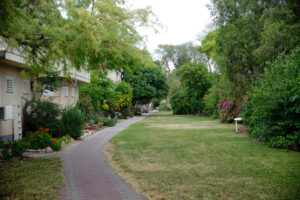
Arriving in the kibbutz, where my brother was already living, brought some relief from the unsettling and confusing experience of living and working in Jerusalem. I was again assigned to the banana plantation and soon felt the advantages of the security the kibbutz provided and the presence of friends from the youth movement and my training course. It was not long before my monotonous work could not be made any more bearable just because it was said to be serving a higher purpose. But not all kibbutz work was boring, and some of us newcomers began to propose a more relaxed approach to choice of work and study. We had hopes of a sympathetic hearing through democratic discussions at the weekly members’ meetings – but when the older kibbutz leaders became aware of what was afoot, the backlash was severe. Even discussion was out of the question.
There was also negativity towards expressions of concern about the status of women. In the kibbutz, children slept in separate accommodation, away from their parents. This was touted as being in the interests of women’s liberty, but some of the younger women from the UK still felt that they were pigeonholed as child-rearers. The jobs they were given were mostly looking after children, or working in the gardens, kitchens or laundry. Few worked in agriculture, and very few held leadership positions. Moreover, some, especially of the younger generation, increasingly resented being separated from their babies and young children at night.
I began to wonder whether I would ever be given the opportunity to return to full-time studying. Meanwhile, looming over my future was compulsory military service. In early 1971 I went off to do my basic training – only three months, not six, because I was married and we had a child. I was mentally prepared for it on one level – this was my Zionist duty. But Israeli army training was supposed to be tough, and it brought me one step closer to the real possibility of being involved in armed conflict.
My training took place at Gush Etzion[10], in the occupied West Bank, not far from Hebron. I discovered later that this little enclave was the centre of the nascent settler movement: Gush Emunim.[11] Its leaders and followers saw the capture of the West Bank and Gaza in the Six-Day War as the fulfilment of God’s promise that the entire Land of Israel was for the Jews.
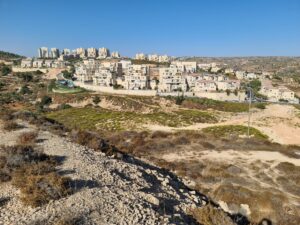
I don’t think my commitment to Zionism, to Israel, got any higher than in those three months. I was in the Engineering Corps, mostly learning how to lay mines. I was determined to do my duty as a soldier as well as I could. And indeed for my efforts, at the end of the course I was awarded the appellation of “Outstanding Soldier” of our 250-person cohort.
But before the course ended two things happened that made me begin to see things in a different light. A conscientious objector was with us for a few days before returning to army prison, and he seemed a gentle and thoughtful soul. His existence posed a question for me: could he be also objecting to Zionism?
The second experience was more stark. I was increasingly conscious that we were living among Palestinians, and for the first time I was asking myself, “Who are these people?” Shortly before the end of the course, we were going to a training area near Hebron for live fire manoeuvres. The Colonel addressed us before we left, using language about Palestinian Arabs I had never heard before. It was unambiguously racist, and it shocked me. I began to realise that perhaps the story of Zionism and the nature of the Jewish state were not so morally and politically without blemish as we had been led to believe. In retrospect I see this as the turning point in my journey away from Zionism.
But three months is not long, and I went back to the kibbutz, happy to be reunited with my family. As before, I found the work in the banana plantation boring and soul destroying. I was running the irrigation systems, going around on my own a lot of the time switching taps on and off. And once more I was brought face to face with the Palestinian question sparked by the Colonel. The plantations were guarded and serviced by a Palestinian with a large family. His home consisted of two huts with carpets on the ground inside. I can picture him now, though I no longer remember his name. My few daily contacts with him were polite, respectful, but I came to realise that there was really no relationship between us. It made me wonder who really belonged here.
Back in the UK – deeper questions
In late summer 1972 we left the kibbutz and Israel, and returned to Britain. Our marriage was faltering; I felt I had failed as a kibbutznik; and I still had no higher education qualification. We told ourselves we would return to Israel soon, but it was one of the lowest points of my life. To say that I was given the cold-shoulder when I left is a major understatement. I was beginning to question what I was – an Israeli, a Jew, a Zionist?
I applied to read history at Sussex University and was accepted to start in autumn 1973. I had many doubts about our future and my ambitions during the year of waiting, and there were times when I despaired of ever taking up the place. But once the academic year began, within a couple of weeks I knew it suited me down to the ground, and things went well academically. But there was pain too. After a year in couples therapy our marriage broke down and we separated.
I concentrated on modern European and British history, but the course included much contextual work on literature, philosophy, social analysis, critical thinking and more. I was also beginning seriously to think about how I had got to the point of being so deeply involved in the Zionism that I was now questioning. For instance, having become aware of Palestinian dispossession I realised that I had never asked how Kibbutz Amiad acquired its land. A friend in Israel supplied the answer: the village of Jubb Yusuf was ethnically cleansed in 1948 as part of General Yigal Allon’s Operation Broom which forced the Palestinians and Bedouin from the entire region.
Sussex University was a radical place, and there was a pro-Palestinian voice, though still small. In discussions about Zionism I understood some of the arguments people were putting forward about Israel’s unjust treatment of the Palestinians, and I couldn’t ignore them. I still saw myself as a Zionist and argued in favour of its legitimacy, but I was already uncomfortably between positions.
One of the Habonim emissaries, an old friend of mine, was looking for someone to write the history of the movement. I’d been thinking about this myself, and I got involved – hoping it would help me make sense of what I had been through. I was commissioned to write the book and worked on it in my spare time for five years. This project had a major influence on my life. I learnt that socialist Zionism meant socialism only for Jews, and Zionism meant colonisation to dispossess the Palestinians.
I never finished the book[12]. Besides having to put it aside to concentrate on getting my degree, I faced a dilemma: the people who were financing it wanted a book of happy, funny stories and pretty pictures. They were not pleased when they understood that I was writing a critical, objective study.
Having suffered so many failures, I was elated to get a first-class degree and then start work on a doctorate in Economic History at the LSE. But the questions about my Jewish identity and past were looming so large in my life – What is Zionism to me? How did I get here? – that within a year I was finding my PhD studies boring and irrelevant. In 1979 I was also very shaken by the sudden death of my mother, aged only 59. It spurred me on to look for another field of study, one more relevant to my existential concerns. I had put my doctorate on hold and was lecturing part-time at Brighton Polytechnic[13] when I saw an advertisement for a job as a research officer at the Institute of Jewish Affairs[14].
All I knew about the IJA was that it was the research arm of the World Jewish Congress, but I could see that the kind of things it was researching – current antisemitism, the state of Jewish communities throughout the world, the ‘Arab-Israel’ conflict, international affairs – might help me answer my questions. So I applied, and got the job.
From the Institute of Jewish Affairs to the Institute for Jewish Policy Research
One of my roles was editing a series of research papers, and for the first time I engaged systematically with the situation of the Palestinians and the PLO. It was a significant time, as the Palestinian National Council were talking about coming to some kind of accommodation with Israel[15], and we had commissioned a paper about their latest meetings from a PhD student at SOAS. His name was Ilan Pappé![16] It was my task to edit it. I was on a steep learning curve about the subject, but I could see that the paper was brilliantly written – and twice as long as we had requested. I tried to shorten it sympathetically, wondering, ‘How will this go down with my director, Stephen Roth?’ He was a leading figure in the Zionist Federation and the Board of Deputies of British Jews. To his credit, he didn’t reject it. Many years later I reminded Ilan of this and he told me, “That was a very important paper for me: it was the first piece I ever got published.”
Not surprisingly, most of the IJA’s work was governed by assumptions from Zionist thinking. One of my tasks was to monitor broadcasts from third world, Muslim and Arab countries which were translated by the BBC monitoring service at Caversham. I had to look for things being said about Israel and Jews – especially to see if they were antisemitic. My academic training led me to analyse the recordings objectively, and it became clear to me that much of the discourse was not antisemitism but political or ideological anti-Zionism. I cautiously reflected this in my first research papers, but I was still very green about British and world Jewish politics, and had little understanding of how controversial my analysis would be. Nevertheless, my writing came to the attention of the international politics editor of the Jewish Chronicle, who began commissioning regular comment pieces from me.
I learnt so much in those first five years at the IJA about Middle East politics, international institutions, antisemitism globally and the debates on the relationship between antisemitism and anti-Zionism and criticism of Israel. I also developed expertise as an editor, and was appointed assistant editor of one of the IJA’s academic journals, Patterns of Prejudice, which focused on antisemitism in the context of racism in general.
My journey away from Zionism advanced significantly when I was roped in to help preserve the Jewish Quarterly (JQ),[17]a left-leaning literary, political and cultural magazine, founded and edited by the single-minded and wonderfully stubborn Jacob Sonntag. Many prominent writers wrote for it, like Arnold Wesker[18], George Steiner[19], the Litvinoff brothers[20]. By 1984 Sonntag was very ill, and I led a support group to help him. We produced one edition before he died. After that I was appointed editor, a role I thought I could fulfil in my spare time.
My second editorial, in 1985, was titled ‘The Politics of Antisemitism’. I was already of the view that much of the fuss being made about antisemitism was in fact about Israel, and I felt that the organised Jewish community, the Board of Deputies and its defence department, were using antisemitism as a political football, to stamp their control and their place as the most important body in the UK Jewish community. My editorial pulled no punches.
I was totally naïve: I thought I could separate my thinking on this from my IJA work, and I was unprepared, psychologically or in any other way, for the huge furore that engulfed me. My boss at the IJA came under a lot of pressure from the Jewish establishment to shut me up or sack me. It was either IJA or salary-less JQ. I had remarried and we had two children, so I had no choice but to resign from the JQ. However, the furore continued. Many thought I was being forced out. Correspondence for and against me went on for seven weeks in the Jewish Chronicle, with well-known figures weighing in. Sir Alfred Sherman, a Thatcher guru, said ‘Lerman combines Jewish self-hate and loony leftism’; while playwright and novelist Bernard Kops wrote: ‘Lerman has fallen foul of a power-mad cabal’.
That was my first clash with the Jewish establishment, and it hurt. I hadn’t courted controversy deliberately and I didn’t realise at the time how much it affected me. It was only at the turn of the decade that I felt it was behind me.
Meanwhile the IJA was facing a very uncertain future. In 1990 our funders, the WJC, run from New York by two aggressive political operators, Israel Singer and Elan Steinberg, decided to cut our funding by half, and brought in the right-wing Zionist Anti-Defamation League[21], (ADL) as joint funder with overall control. The ADL was already taking a leading role in pursuing the antizionism=antisemitism agenda.
At the same time Stephen Roth was retiring, and an internal battle over his successor dragged on for more than a year. I was eventually appointed director, in 1991. My candidacy was supported by the IJA lay Chair, William Frankel, who was a critically inclined Zionist establishment figure in the Jewish community, but of liberal views. He edited the Jewish Chronicle for nineteen years. He was able to help us get a big grant from the Rothschild Foundation. The ADL had mercifully withdrawn in 1991. But in 1994, with the WJC secretly planning to close us down, we confidentially forged a 5-year partnership with the American Jewish Committee (AJC), which at the time seemed a more compatible body. When we informed them of this the WJC was furious and immediately ceased our funding, but we had expected this and made provision for it.
These connections gave me cover for the agenda I had for the IJA: strengthening European Jewish communities emerging after the collapse of the Soviet Union, by focusing on secular Jewish culture and civil society initiatives; and developing accurate assessments of antisemitism in light of its revival in former communist countries.
It was during the 1990s that my still gradual journey away from Zionism gathered pace. In this period the Israeli government formally decided to spearhead worldwide monitoring and combating of antisemitism. But it was clear that for them it was not so much about antisemitism as about protecting Israel and using fear of antisemitism to further Zionist objectives. For nine years I battled with the Israeli authorities – principally the Mossad, who were tasked with implementing the government’s decision – over their approach. I insisted that we deal with antisemitism on its own, and not link it with Zionism or anti-Zionism. Mossad treated me and the IJA as pariahs, refusing to cooperate with us, and tried using dirty tricks to discredit me.
I founded the Antisemitism World Report in 1992 as an objective and balanced annual survey. Each year in the introduction we would mention Zionism, and reiterate our view that any criticism of Israel that strayed into antisemitic language could be dealt with using existing definitions. There was no need for a new one. But by the end of the decade I knew we were losing the battle. An institute at Tel Aviv University, initially funded by the Mossad, went into competition with us in producing an annual Report; most Jewish defence organisations followed Israel’s lead; and much Jewish academic opinion was coalescing around equating anti-Zionism with antisemitism. Even our new partners, the AJC, were embracing this narrative, and they expected us to follow suit. We refused to comply, and we were hardly on speaking terms by the time the partnership ended in 1999. The Zionist imperative in the outlook and policies of major Jewish organisations, not just in the USA, now reigned supreme.
In 1996 I implemented a plan to refound the Institute as a policy think tank, with a new name – the Institute for Jewish Policy Research (JPR) – and a stronger focus on social research relevant for the development of Jewish communities. An early survey revealed a growing disconnect between young Jews and Israel – a finding that didn’t go down well with the Zionist organisations. All the time the question of how Zionism related to Jewish life was looming larger for me. I was desperate to open up a debate about Zionism, and the possibility of someone who was not a Zionist – where I now stood – being able to work within Jewish organisations. But I realised that forcing the issue would spell the end of my career.
The Rothschild Foundation Europe
By 2000 I’d been with IJA and JPR for almost 20 years, and I thought it best to move on. The opportunity arose to establish a new grant-making foundation for the Lord Rothschild side of the family, focusing on reviving Jewish life in Europe, especially in the former communist countries. The Rothschilds are an important Zionist family. It was a former Lord Rothschild to whom the Balfour Declaration was addressed. The foundation devoted to supporting projects in Israel – Yad Hanadiv – then had a capital value close to $2 billion.
Given my direction of travel, was my move not incongruous? It could have been. But I knew Jacob Rothschild well enough from the role he played as President of JPR to be confident that I would be judged on my European foundation programme building work, not on my political views.
In my private life I began to meet with like-minded non-Zionist and anti-Zionist Jews, and to strategise on Jewish promotion of human rights and self-determination for the Palestinians. By 2005 my views had advanced to such an extent that I more or less saw no future for a two-state solution and was advocating considering one state with equal rights for all in Palestine-Israel.
If anyone wanted to know, I was still calling myself non-Zionist rather than anti-. My reasoning was that since the establishment of the state of Israel, Zionism was a done deal, not an active ideology, so why did I, as an individual Jew, need to make any kind of declaration about it? But I was not comfortable in that position for long, partly because of the reality of Israel’s actions on the ground in Gaza, and partly because of the licence being given to extreme Zionist, messianic settlers in the West Bank to seize land and destroy Palestinian property. At the same time official government Zionist rhetoric was being used to justify this growing repression. I began to feel my position could not be sustained.
I was beginning to speak out more in public, and with a group of friends, some more radical than me, set up an organisation called the Jewish Forum for Justice and Human Rights (JFJHR) in 2003. On a March 2005 panel discussion titled ‘Israel-Palestine uncensored: what future for the two peoples?’ I advocated the creation of a single democratic state for all as possibly the most just way forward, perhaps in some kind of federal configuration
Back at JPR – briefly
After six years with the Rothschild Foundation my views had changed so much that I wanted to get back into think-tank work. As it happened, my successor at JPR was moving on, and the chair asked me if I would come back. I thought I might have a freer hand now to do what I wanted to do, to open up dialogue in the UK and across Europe on these vexed issues – so I accepted.
After my appointment was announced the Jewish Chronicle revealed that three members of the JPR board had objected so strongly that they had walked out of the meeting at which the decision was taken. The paper seized on the story and published a vicious op-ed by Isi Liebler, leader of Australian Jewry and vice-president of the WJC, demanding that I be sacked, having advocated a one-state solution at the JFJHR panel in March 2005. And so began three years of concerted efforts by the Jewish and Zionist establishments to get the JPR board to sack me.
JPR had become a very important think-tank, yet it became increasingly difficult to get cooperation from mainstream groups when we wanted to have dialogues on the issues we were tackling. In the end these obstacles and the dirty tricks to oust me proved so upsetting and insurmountable that, at the end of 2008, when I realised that I was even beginning to lose the support of my board, I resigned.
A few days earlier the Israeli ambassador had withdrawn from a lecture we had organised that very week, at which a large crowd was expected. This was clearly an act of sabotage, a snub to us, and I saw that it was overshadowing the important work we were doing, holding dialogues among Jewish and non-Jewish civil society groups across Europe.
By that time I wasn’t exactly hiding my views about Israel, the Palestinians and Zionism. I had been involved in secret discussions between JFJHR and a group called Jewish Writers for Palestine, in which Jacqueline Rose[22] was one of the key figures, to launch Independent Jewish Voices (IJV) in protest against atrocities Israel was perpetrating in Gaza. It was launched in February 2007, with many major artists and writers among 139 signatories to a full-page advert in The Times. (I had to absent myself from the list or I would have faced being sacked.) It got huge publicity and was viciously attacked by the usual suspects. For instance, Melanie Phillips[23] wrote about it in the Jewish Chronicle under the heading “Jews for Genocide”.
Owning my anti-Zionism
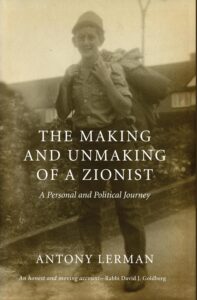
Stepping down as JPR Director was a great liberation for me. I began to write regularly for the Guardian in their pioneering online ‘Comment is free’ section, and occasionally in the print edition. Other periodicals also commissioned me to write for them, mostly on antisemitism, Palestine/Israel, multiculturalism and Holocaust issues. And in 2012 my memoir The Making and Unmaking of a Zionist: A Personal and Political Journey was published by Pluto Press.
I was soon invited by the Kreisky Forum for International Dialogue[24] in Vienna to participate in discussions about minorities and belonging in Europe. Subsequently I joined their Arab-Jewish engagements group, which gave me the wonderful opportunity to get to know some leading Palestinian academics, writers and political activists. I will for ever be grateful to the Kreisky forum for bringing me into contact with so many Palestinians, from the diaspora and from Palestine itself. Until then, my work within the mainstream Jewish community just hadn’t brought me into contact with Palestinians. One of my great regrets is that through all those years I didn’t do more to reach out to them. One of the people I met through this project was the Lebanese novelist Elias Khoury.[25] He is a brilliant writer, so deep and sensitive. Hearing him talking about the Nakba, explaining it was not just a single event, but something ongoing, was a light-bulb moment for me. It made so much sense in terms of things I had observed in Israel. I am still a senior fellow (visiting) of the Forum.[26]
I moved to the radical position that Zionism had to be dismantled, at some point in the mid 2010s. I realised that my previous idea that Zionism was no longer a living project was all wrong. In the only form that has any agency today – messianic, ultra-orthodox, fascist – Zionism remains a live and brutal genocidal project: the ground on which Israeli apartheid stands.
Some still assert that they are Liberal Zionists, and repeat the two-state mantra as the ‘day after October 7th’ solution. But Liberal Zionism is empty rhetoric and the two-state solution is dead. A very significant development of the last 5-10 years is that today’s Zionism has been completely adopted by the mainstream Orthodox Jewish denominations in the UK and elsewhere. The United Synagogue’s Chief Rabbi Ephraim Mirvis says Zionism has existed for 2,000 years, and Judaism and Zionism are one and the same. This is rubbish. Yet he speaks of Israeli soldiers committing war crimes as ‘our boys’.
The aftermath of 7/10 has given new impetus to Jewish resistance to Zionism, genocide, ethnic cleansing and the demonisation of Palestinians. But the outlook is bleak, and I am still rather pessimistic. Israel still has a strong geopolitical position with significant high-tech and arms exports, its closeness to America and various governments in Europe. And in the so-called War on Terror, or war on Islam to put it more plainly, I think there is still a strong feeling of a “West” that needs to stand up against Islamism, and that Israel must be part of that. I found the pager episode[27] sickening: in the media coverage there was so much of, “Aren’t they clever! Amazing what they did, so high-tech!” Such little concern for all those babies, children, women, shopkeepers, stall-holders placed in such jeopardy. And we’re moving into a more authoritarian age, in which many countries’ leaders are not at all out of sympathy with Israel’s political and ideological project. They look to Israel’s ethnic cleansing as a model of what they would like to do in their own countries.
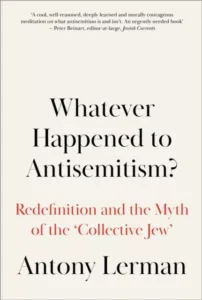
My journey continues. My most recent book, Whatever Happened to Antisemitism? Redefinition and the Myth of the ‘Collective Jew’ (2022), will be published in Polish and French next year. Discourse on antisemitism remains a mess. Perhaps I will find another way to open peoples’ eyes to the danger this represents.
I am very encouraged by the scaling up of what is now called Global Jews for Palestine (GJP),[28] a coalition of Zionism-rejecting groups around the world endeavouring to become more effective. I was pleased to be involved in helping it come into being.
How do I see my Jewish identity now? Even as a child I was pretty rebellious about organised religion. “Cultural Judaism” wasn’t a recognised identity at the time, but later, when I was working with Jewish communities in Europe, I felt that was where I belonged. However, in recent years I have become more sceptical about such a thing. I found Shlomo Sand’s short book, How I stopped being a Jew,[29] very persuasive. I think he goes too far in some respects, but the fundamental premise of cultural Judaism, that it can be transmitted, doesn’t stand up to scrutiny. Cultural Judaism is often turned into an ersatz religion, but I doubt that it has a future. And by itself, it has nothing to offer in the struggle to dismantle Zionism and bring full equality to all who live in Palestine/Israel. I will keep fighting for that as long as I can.
[1] Tony Lerman has written in much more depth about his journey from Zionism in The Making and Unmaking of a Zionist, Pluto 2012. Also relevant to the following account is Whatever happened to Antisemitism: Redefinition and the myth of the ‘Collective Jew’, Pluto 2022
[2] Habonim (“The Builders”) is a Jewish Zionist Socialist youth movement, founded in the UK in 1929, in part modelled on the Boy Scout movement. In 1982 it merged with Dror, a Polish-founded youth movement, and today it is active in 17 countries.
[3] There were 21 Habonim groups in London by 1932.
[4] Dov Ber Borochov, 1881-1917, Russian Marxist Zionist, a founder of the Labour Zionist movement.
[5] Aaron David Gordon, 1856-1922, Labour Zionist thinker and spiritual leader, who lived in Palestine mainly working as an agricultural labourer from 1904. He declared, “The Land of Israel is acquired through labour, not through fire and not through blood.”
[6] Sir Simon Schama, b 1945, well-known and prolific British historian and TV presenter. His special areas of interest include art history and Jewish history.
[7] Kibbutz Amiad, an agricultural and industrial kibbutz in Upper Galilee, established in 1946. Among its founders were many graduates from British Habonim.
[8] ‘Make Aliya’ means literally to ‘go up’ to the homeland.
[9] Regent Street Polytechnic was the first polytechnic in London, established in central London in 1838. In 1992 it became the University of Westminster.
[10] Gush Etzion is a cluster of settlements in the Judaean Hills in the southern West Bank.
[11] Gush Emunim (“Bloc of the Faithful”) was an ultranationalist religious Zionist activist movement committed to establishing settlements in the occupied territories. It emerged after the 1967 war, and was formally established in 1974.
[12] The manuscript is lodged at Southampton University.
[13] Brighton Polytechnic was formed in 1970 from the merging of Brighton School of Art and Brighton College of Technology, later joined by two other HE colleges. In 1992 the Polytechnic became the University of Brighton.
[14] The Institute of Jewish Affairs was established in New York in 1941, under the auspices of the World Jewish Congress and the American Jewish Congress, to carry out policy-related research into the situation of Jewish life in the contemporary world. The Institute moved to London in 1965.
[15] The Palestinian National Council is the legislative body of the PLO. Its 10-point programme, adopted in 1974, introduced the concept of a two-state solution and other interim steps towards full liberation.
[16] Professor Ilan Pappé (born Haifa 1954), historian, director of European Centre for Palestine Studies at the University of Exeter. Formerly a professor at the University of Haifa and a political candidate in Israel, he left the country in 2008.
[17] Jewish Quarterly, a journal founded in London by Jacob Sonntag in 1953, published until 2019. In 2021 it was relaunched by an Australian publisher, with a rather different content and perspective.
[18] Arnold Wesker, 1932 – 2016, British playwright and author, born in London’s East End
[19] George Steiner, 1929- 2020, Franco-American literary critic and philosopher
[20] Emanuel Litvinoff, 1915-2011, poet, novelist and campaigner for Soviet Jewry, born in London’s East End; Barnet Litvinoff, historian, especially of Jewish and Zionist history
[21] The Anti-Defamation League is major New York-based NGO, founded in 1913 to combat antisemitism and other forms of discrimination.
[22] Jacqueline Rose (b London 1949), feminist literary critic and leading voice in criticism of Israel.
[23] Melanie Phillips (b London 1951), prominent right-wing writer and broadcaster
[24] The Bruno Kreisky Forum for International Dialogue was in established in Vienna in 1991, in memory of Austrian Chancellor Bruno Kreisky
[25] Elias Khoury (1948-2024) novelist
[27] On 17 and 18 September 2024, Mossad’s Operation Grim Beeper detonated explosives hidden in thousands of pagers and walkie-talkies used by Hizbollah in Lebanon and Syria. 42 people died and between one and four thousand people, many civilians, were injured.
[28] Global Jews for Palestine is the recently renamed International Jewish Collective for Justice for Palestine. It is formed of anti-Zionist Jewish organisations in 17 countries. The scoping study into its possible expansion was carried out by Rebecca Vilkomerson, former director of Jewish Voice for Peace in the USA.
[29] Shlomo Sand (b Austria 1946), Israeli historian, professor of history at Tel Aviv university; also teaches in Berkeley and Paris. How I stopped being a Jew, 2023, Verso


What an utterly fascinating long personal journey. I get a strong impression though that the real spur didn’t dig in until 2005. This seems to indicate the all-embracing power of what was being questioned and, ultimately, rejected.
I too found this journey of Tony Lerman fascinating. Also the fact that he began his degree at Sussex University one year b4 I started at Brighton Polytechnic where Tony taught and where I became the union Vice-President 1977-9.
I also found fascinating the details of the debate within Habonim in respect of establishing kibbutzim in the West Bank/Golan, which in fact happened. It proves to me that ‘socialist Zionism’ is an oxymoron. there is no such thing though, like Tony, I was for a while fooled.
I remember well the battles to remove Tony from the IJPR. From memory one of the key individuals was the owner of Dixon, Stanley Kalms who doubled up as Tory Party treasurer.
What Tony proves is that Zionism, as a Nationalist (as opposed to a National) movement is inherently authoritarian and undemocratic. It refuses to debate any of its own assumptions about Palestinians or the Jewish ‘right to return’ because it knows that these don’t stand up.
Today there is no socialist Zionism. Yair Golan, of the combined Meretz/Labor Party advocated starving Gaza and invading Lebanon. It no longer has any purpose in existing. There is no human Zionism.
Not only is Zionism today openly genocidal but it is also authoritarian and undemocratic for Jews. I despair however that they will see that they are being used as imperialism’s moral alilbi because stupidity seems the main characteristic of the Jewish community today.
Like Tony I too had to unlearn all that I had learnt when I was young.
A very interesting and informative account
To shake off the past takes a long time and is uncomfortable and takes courage. This – like most of these stories – is inspirational. They should be published in book form.