
Yiddish anarchists’ break over Palestine (1929)
JVL Introduction
What goes around comes around, as debates about Zionism after the Hebron massacre in 1929, chronicled below, reveal.
Eyshe Beirich has done a great service in unearthing two responses to the murder of unarmed members of the Orthodox Jewish community of Hebron in August 1929.
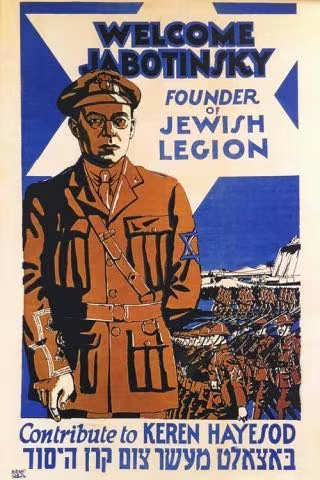
Shockingly, the most widely read anarchist Yiddish newspaper in the world, Di fraye arbeter shtime (Free Voice of Labor) went overnight from denouncing he “raw, physical violence” associated with Vladimir Jabotinsky’s revisionist Zionism as fascist, to seeing it as the only way to safeguard the Jewish community in Palestine. It was justified by racist imagery about the Palestinians as savages.
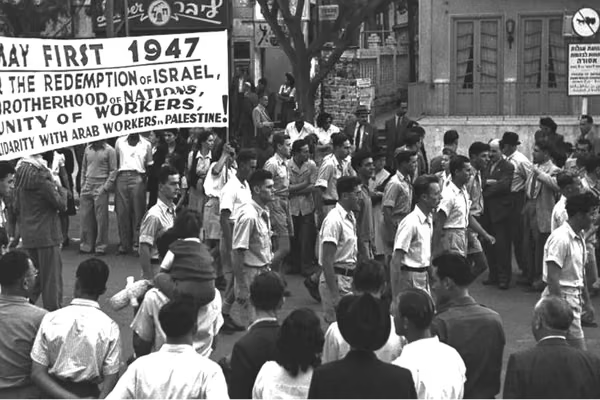
In response to this, a group of young Polish Jewish anarchists published their dissent. Refusing to reduce Palestinians to pogromists, the saw common cause between Jewish workers and Palestinian peasants, insisting on the latter’s right to remain on their land
They argued that the violence they had witnessed was no reason for people to lose their heads: “the greater and stronger the violence grows, the greater our responsibility and duty grows to find the correct cause and diagnosis”.
As Beirich puts it, they rejected “reactionary and exclusionary politics in favour of sober material analysis and solidarity” which can well serve as the watchword for us today.
RK
This article was originally published by Jewish Currents on Fri 10 May 2024. Read the original here.
Yiddish anarchists’ break over Palestine (1929)
An exchange in the anarchist newspaper Di fraye arbeter shtime after the 1929 Hebron massacre offers a case study in Jewish discourse and political reaction after immense violence.
Loading article text…


An outstandingly prescient piece of analysis from 1929; quite rightly, allocating significant blame for where we are, on English colonialism.
I do wonder how an Israeli zionist Jew, who has experienced a lifetime of propaganda would be able to assimilate any of this, though.
How correct were the Polish Anarchists? There is a film, directed by an refugee Arab woman, Mai Masri, in 2002, which can be screened from Sands Films Cinema Club, called, ‘Frontiers of Dreams and Fears’, which is a wonderful and wonderfully moving story of the lives of Arab refugees in their ‘camps’ in Lebanon and Bethlehem, which has led to the hideous, genocidal outcome on our screens daily as a result of that original and ongoing ‘love of the Jewish coin’.
What strikes me is the honesty of the analysis and the plain truthfulness of the language. The British habitually try to position themselves as the honest brokers between the two warring parties, whether in Northern Ireland, Cyprus or historic Palestine; the Mercutio position in Romeo and Juliet – “A plague on both your houses” – is clearly an attractive one, but Mercutio was dying when he said it and the Imperial powers usually ensured that someone else was doing the dying.
The Zionists have been quick to catch on: instead of one largely European regime taking over from another that had favoured and trained them, we get “Independence Day” and a crude dismissal of the indigenous savages that the Arabists in the Foreign Office would not have allowed.
I wonder what Trotsky had to say about this.