
Why are people so prone to accepting fantastical beliefs?
JVL Introduction
Jonathan Cook looks at popular willingness to countenance off-the-wall conspiracy theories. He argues it is because the lies our governments and media have got used to peddling have so eroded pubic trust.
He looks at waystations on the path to the consolidation of this distrust and the collusion of mainstream media in the process.
“[T]hrough their reflexive dismissal of doubt, of all critical thinking on anything that has not been pre-approved by our governments and by the state-corporate media, they have helped to disfigure the only yardsticks we have for measuring truth or falsehood.”
To hold our leaders genuinely to account requires a transformation of our relationship to information and debate, a new model of independent, pluralistic, responsive, questioning media – one that truly holds politicians to account and celebrates scientists for their contributions to collective knowledge, not their usefulness to corporate enrichment…
“Sounds like a fantastical, improbable system of government? It has a name: democracy. Maybe it is time for us finally to give it a go.”
This article was originally published by jonathan-cook.net on Tue 28 Apr 2020. Read the original here.
Welcome to the era of the Great Disillusionment
Loading article text…

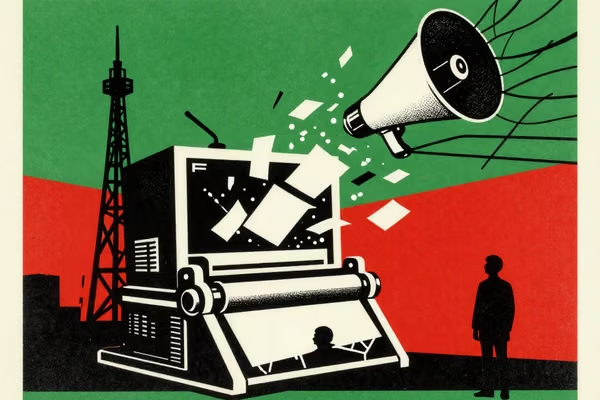
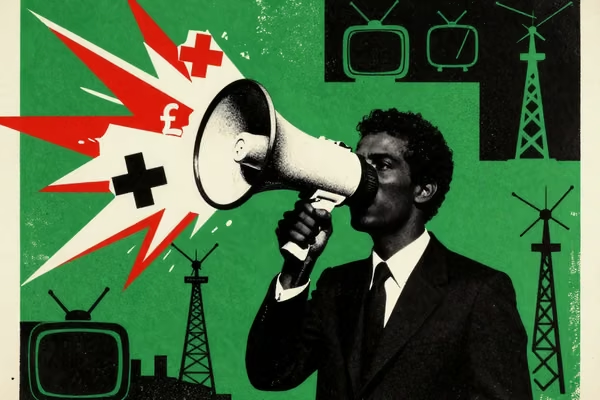
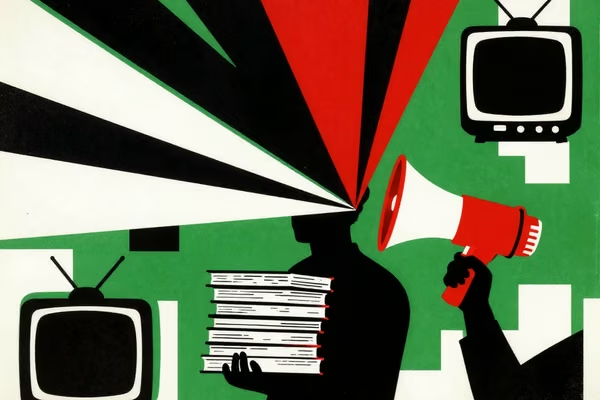

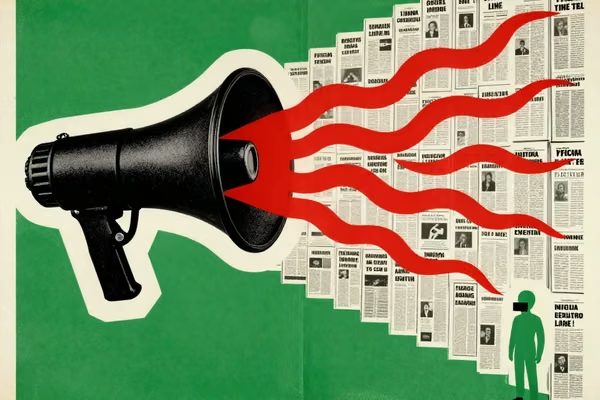
Is not any form of religion a fantastical belief?
Jonathan Cook is, as usual, raising seminal issues about society, the media and information.
In doing so, he inadvertently demonstrates (in his list of Great Lies) illustrates the way in which accepted narratives weave themselves into taken-for-granted collective consciousness :
“… and now the criminal failures of our governments to prepare for, and respond properly to, the Covid-19 pandemic, despite many years of warnings.”
Leave aside the competence/incompetence of governments – but there is behind this exemplar an acceptance that this is indeed an unprecedented pandemic in terms of its lethality.
In fact, what we have is a phenomenon around which there has been massive uncertainty in terms of data, its consequences and the appropriateness of measures taken. However, as information has accumulated, the one clear feature that has emerged is a *lessening* of the justification for the ‘Panic’ headlines that typify the media coverage.
Jonathan says ” I am not a scientist” – but this is not necessarily true. We all have the choice to be ‘scientists’ in the root sense of the word. And it is that root sense that makes the term the only defence against constructed mythologies.
This doesn’t mean that we all can grasp the multitude of specific scientific techniques that are appropriate to various fields of analysis. Of course we can’t. But we can all acquire a general questioning ‘scientific’ reasoning to the available information, some of which will have emerged from those detailed processes.
It is evidence-based ‘scientific’ argument that has supported (against the tide) the hypothesis that ‘institutional antisemitism’ in the Labour Party is a confection. Without such processes, argument deteriorates into the assertion of contrary assumptions, the inhabiting of ghettos, and the rule of confirmation bias (to which we all are immensely susceptible).
The Question Mark ‘?’ is the basis of this sort of ‘science’, degrees of uncertainty the outcome – rather than the assertion of an absolute ‘truth’ (which it has a nasty tendency to undermine). It’s that lack of certainty in a world of probabilities that tends to generate a preference for myths as an alternative mode of thought.
So no cop-out : ‘I’m not a scientist’. Of course you can be : it’s your only (uncertain) guard.. And for anybody who’s not so far been paying attention except to recent front pages and daily ‘briefings’ : go and have a look at the wider information and analysis, armed with a ‘?’ You won’t be ‘certian’ at the end of it, but neither will you be in a state of paralysis.
There are many interesting ideas in this article, but I do not think the opening argument is at all convincing. I don’t think it is wrong, especially for socialists, to expect a minimum of scientific knowledge or intelligence from most people and that they do not succumb to off-the-wall conspiracy theories. Is it really so hard, for example, to dismiss the idea that very low intensity and low energy electromagnetic radiation can somehow create a global pandemic, especially when the actual, real vector has been isolated and characterised?
Trump has over 100 million supporters and even amongst them only a few hundred drank disinfectant.
I also want to defend climate scientists. The obstruction has come from governments and corporations, not scientists’ conservatism. When Teller was speaking (and he was by no means the first) the potential for fossil fuel burning to give rise to global heating was well understood by climate scientists. The problem was to get political action on this. I don’t think they failed to speak up. We might not think that the methods they used (a presidential commission in 1965, or James Hansen addressing congress in 1988) were sufficiently revolutionary, but I do not think that you can lay at their door responsibility for government inaction or a public “distrust of science”. There’s also the issue of what science is: to me it is (roughly) a body of knowledge acquired by the pursuit of the scientific method. It is not technology, which is often, but not always, a product of the application of scientific knowledge. Distrust of science is usually irrational.
Absolutely superb, the best article that I have read in a long, long time!