
The unbearable heaviness of being
JVL Introduction
Keith Kahn-Harris a a liberal Jewish commentator known for his willingness to explore uncomfortable questions so anything he writes is ordinarily of great interest.
Here Deborah Maccoby provides a not altogether tongue-in-cheek review of a not entirely tongue-in-cheek new book by Keith Kahn-Harris about the ordinariness of being Jewish.
Or at least pretending that Jews are “less interesting than they really are” in a search for genuine examples of Jewish banality and mediocrity.
Kahn-Harris does find one amusing example of Jews actually being very good at something: setting up organisations, ones which he notes – and celebrates – are riddled with “rivalry, grudges, competition, the narcissism of minor differences and endemic inefficiency,” pointing out that “if a global Jewish conspiracy existed, a rival global Jewish conspiracy would undoubtedly be set up.”
Maccoby finds much to enjoy but questions Kahn-Harris’s essential rejection of Jewish universalism to the extent of calling into question his very understanding of Judaism.
And she worries about his priorities in looking for a solution to Jewish anguish and despair during Israel’s genocidal onslaught on Gaza.
Surely other concerns should be more central!
RK
PS: you can see Kahn-Harrris’s own reflections on his book here: What the world isn’t waiting for: Thoughts on a publication day.
.
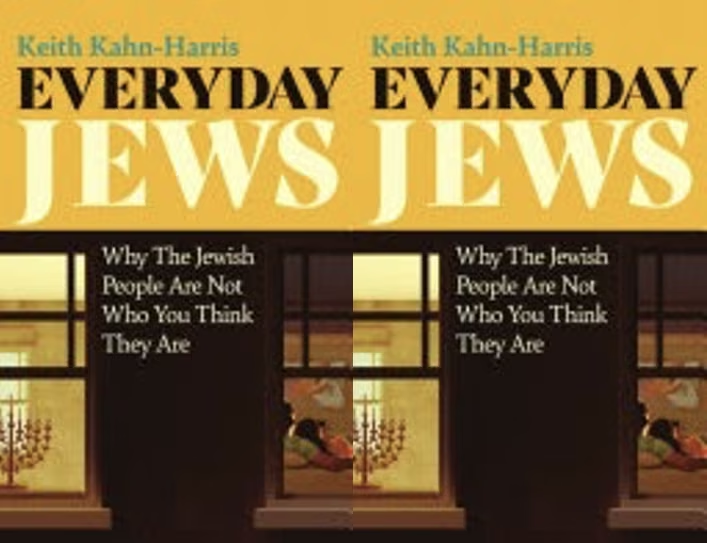
Everyday Jews: Why The Jewish People Are Not Who You Think They Are
Keith Kahn-Harris, Icon Books, 2025. 218 pp.
Reviewed by Deborah Maccoby
To adapt the title of Milan Kundera’s famous novel The Unbearable Lightness of Being: I suggest as an alternative subtitle for Keith Kahn-Harris’s new book Everyday Jews: “The Unbearable Heaviness of Being Jewish”. Kahn-Harris laments: “To be Jewish today is a heavy, heavy thing” (p. 70). Jews are burdened with the ancient Biblical mission to be a “nation of priests” and “a light unto the nations”; Kahn-Harris, a Senior Lecturer at Leo Baeck College, points out, in relation to the Biblical concept of “chosenness” that “what can sound like Jewish supremacy is in fact a burden” (p. 10). Jews are in the spotlight because of all their Nobel Prize winners. Jews are weighed down by the memory of centuries of persecution in Christian Europe, culminating in the Holocaust. Jews have had to deal for many decades with the Israel/Palestine conflict. And above all, Jews are now burdened by the catastrophes of October 7 and the subsequent destruction of Gaza by Israel, involving the massacres of tens of thousands of Gazans (Kahn-Harris never uses the word “genocide” but is clearly horrified by Israel’s onslaught against Gaza.)
Kahn-Harris wants out — not of Jewishness in itself, but of the weight of meaning involved in being Jewish. Instead of Jewish “being”, he advocates for Jewish “doing”: i.e., the boring, mundane nitty-gritty of communal service and religious ritual, without any meaning or purpose behind it. The aim of the book (in so far as a book that tries to abolish meaning and purpose can be said to have an aim) is summed up on page 214:
this book experiments with the conceit of treating Jews as less interesting than they actually are. I wanted to see what it would be like to base Jewish life on nothing more than everyday Jewish doing. I wanted to see what it would be like to treat my heritage as though it were nothing more than an arbitrary set of symbols, practices and actions.
As this book is an experimental “conceit”, it is clearly not intended entirely seriously. There is a tongue-in-cheek quality about the book’s advocacy for and celebration of Jewish insignificance. Kahn-Harris celebrates it because, even though his “conceit” involves pretending that Jews are “less interesting than they really are”, he also finds and applauds many genuine examples of Jewish banality and mediocrity.
In Chapter 1, Kahn-Harris is in Poland on a memorial tour for Jews to visit the land of their ancestors, connect with where they lived and mourn their deaths in the Holocaust. But “it all felt wrong from the start”: he never feels that his ancestral past comes to life for him, and he starts to resent “my new identity as ‘Holocaust-obsessed Jew coming back to the old country’”. Instead, he realizes that the real reason he is in Poland is “to find out about Polish baseball”. The experience becomes the trigger for this book.
The next two chapters map out what Kahn-Harris thinks is wrong with the Jewish self-image. In Chapter 2, Kahn-Harris criticises various Jewish celebrities for their public identities of “Jewish being”, contrasting these famous Jews unfavourably with the obscure Jews who get on with the humdrum, unrecognized communal tasks of “Jewish doing”. Chapter 3 is a critique of the Jewish humorous but narcissistic game of deciding whether all kinds of disparate things are “Jewish” or “goyish”.
The rest of the book is mainly a celebration of Jewish banality and mediocrity, with tongue-in-cheek chapter titles like “Frailty in numbers” and “Punching below our weight” (Chapters 4 and 5). In Chapter 6, however, Kahn-Harris praises something Jews are actually very good at: setting up organizations (but, good though they are at it, this shows that Jews are adept at doing rather than being). Even Jews who feel marginalized from the mainstream Jewish community, Kahn-Harris writes, will respond by setting up a new organization: “The Jewish anti-Zionist left has, in the last few years, developed a substantial network of organisations across the world” (p. 95). Yet even here Kahn-Harris notes and celebrates the fact that Jewish organizations are riddled with “rivalry, grudges, competition, the narcissism of minor differences and endemic inefficiency.” Kahn-Harris continues: “If a global Jewish conspiracy existed, a rival global Jewish conspiracy would undoubtedly be set up” (p. 97).
In Chapter 7, Kahn-Harris, at his most tongue-in-cheek, raises and answer the question: “What is the point of it all?” Why have Jews struggled for millennia, often in the face of terrible persecution, to stay Jews? “The answer”, he pronounces, “is supper quizzes” (p. 99) – specifically, UK synagogue supper quizzes (based on the UK pub quiz night, they are unknown outside the UK). However, despite the deliberate flippancy, this chapter does make a serious point about the nature of Judaism. Kahn-Harris writes:
Jewish tradition does not denigrate the surface level in which everyday life is led. Over millennia, Judaism has built up a system of law and practice that is all-encompassing, complex and demanding.
Kahn-Harris goes on to admit: “Ideally, adherence to that system should be suffused with purposeful attention to the divine” (pp. 102-103). Later in Chapter 7, he points out that the Talmud “is so full of detail and complexity and obscurity that … you can lose yourself in it and never come out” (p. 113). The everyday detail in the Talmud is irradiated and consecrated by the divine. Earlier in the book, in Chapter 3, Kahn-Harris writes: “Judaism is at once a form of universalism, concerned with ‘everything’; yet also radically particularist and inward-looking” (p. 31). Ideally (though, it is true, not usually in practice) there is a dialectic in Judaism between the universal and the particular, according to which neither is fully itself without the other. But Kahn-Harris spends this book throwing out “the divine” – i.e., the universal and transcendent.
This discarding of the universal is even more explicit in Chapter 8, entitled “The great Chanukah swindle”. Kahn-Harris points out that Chanukah, mainly because of its proximity to Christmas, has become the most public, outward-facing Jewish festival; but he argues that Chanukah is in fact completely particularist and inward-looking. For him, the Maccabees, who led the Jewish uprising against the Syrian-Greek Emperor Antiochus Epiphanes, who tried to convert the Jews to Hellenism by force, “stood for unapologetic Jewish particularism” (p.122). But the Chanukah story surely also carries a universalist message that resonates with every small nation’s struggle for national and religious freedom against foreign domination – including the Palestinian struggle? Kahn-Harris writes that, in contrast to the stubborn “particularism” of the Jews, “the Hellenised world could be for ‘everyone’, at least in theory. This universalism offered the tempting possibility for Jews and other peoples to become part of the expanding prestige culture of the day” (ibid). Kahn-Harris’s identification of “the expanding prestige culture of the day” with universalism raises, in my view, serious questions about his understanding of the meaning of universalism. He seems to me to be confusing it with success-worship of a dominant culture. He sneers at a Chanukah message from the UK branch of Chabad-Lubavitch, that claimed: “’The Menorah … has universal significance for all humanity. The battle of the Jews against the ancient Syrian-Greeks was a battle for belief in one G-d and for the universal moral values implicit in that belief’” (p. 123). But surely one does not have to be religious in order to appreciate the universal and eternal moral values implicit in the belief in One God, which implies one humanity? In my view, in this the ultra-Orthodox Lubavitch have a much clearer understanding of Judaism than the “Progressive” Kahn-Harris.
Kahn-Harris spends most of Chapter 9, entitled “The Israel Chapter”, reminiscing nostalgically about the wonderful banality and mediocrity of pre-1967 Israel. It seems to me that a major argument against the thesis of his book (if thesis it can be called) is that a central goal of the early Zionist movement was to “normalize” the Jewish people – a goal that has not exactly worked out. Kahn-Harris explains the ascendancy of the fascist religious right in Israel by pointing to the “vacuum” of meaning and purpose created when nation-building has been achieved, and people have to get on with the boring detail of everyday doing: “the vacuum that is left once nationalism succeeds can be filled by those who resist normality”. But it seems to me that the Zionist goal of casting off Jewish “chosenness”, in the Biblical sense of a burden of responsibility, created a “vacuum” of meaning and purpose that has been filled by the fascist, racist national-religious interpretation of “chosenness”.
The rest of the book is devoted to summing up Kahn-Harris’s denial of “essentialism” (p. 182), in the sense of any essential meaning or purpose in being Jewish. Yet there is a weird kind of mysticism in Kahn-Harris’s advocacy of meaningless – doing for the sake of doing. In Chapter 10, entitled “Sacred Smallness”, he mentions “the concept of tzimtzum, developed by the sixteenth-century kabbalist Isaac Luria” (p. 184), according to which God created life by contracting His infinite light to create a space without God in which life could emerge. Kahn-Harris claims to have taken the concept “out of the realm of mystic paradox” (ibid.), but something strangely mystical remains in his own throwing out of universalism. In Chapter 7, he calls to his support the theological ideas of Yeshayahu Leibowitz, who asserted that Judaism was a code of holiness without an ethical dimension. Yet Kahn-Harris himself writes that Leibowitz “is best known these days for his incendiary comments that the Israeli occupation forces acted as ‘Judaeo-Nazis” (p. 106). Kahn-Harris calls these comments “incendiary” and “self-righteous”; but they are remembered nowadays as prophetic warnings that went unheeded, whereas Leibowitz’s theological opinions are forgotten. Indeed, we could turn Kahn-Harris’s being/doing dichotomy on its head and argue that Leibowitz’s abstract theological ideas were “Jewish being”, whereas his prophetic activism (which refuted his theological views) was “Jewish doing”.[1]
To try to sum up: on the positive side, the book is often amusing in its tongue-in-cheek way. And, in asserting the human need for the everyday and for “small worlds” (p. 205), Kahn-Harris does seem to me to have a real point (especially in a world increasingly dominated by the internet and social media, which take us away from the world of actuality). But, as well as the contradiction of devoting a whole book to Jewish insignificance, there is something deeply troubling about a book that attempts to find a solution to Jewish anguish and despair over October 7 and Israel’s onslaught against Gaza, while the population of Gaza is faced with genocide. It is like a German writer during the Holocaust writing a book advocating a solution to German anguish and despair. And the proposed solution –Kahn Harris’s “experimental conceit” — seems to me to be a complete failure, because it denies the human need for unity and synthesis – aspects of the human mind that should surely be reactivated in the current time of crisis, rather than retreating into banality. But Kahn-Harris would probably argue that the very failure of his book is an indication of success.
[1] See the Independent’s obituary of Leibowitz (written by my father, Hyam Maccoby) : “His own life was the best refutation of his theology.”


Identity, of the kind Kahn-Harris discusses, is at best a mixed blessing. There is a very thoughtful discussion of idnity in one of David Bromwich’s essaysin his book Moral Imagination. He examines the way certsin kinds of collective identity, such as Quebecois, function to diminish the ability to see oneself as connected to a range of people. Rather than people seeing themselves as belonging to a nation or a group he suggests we should see ourselves, in terms of identity, as, for example, a lover of 19th century fiction concerned about animal welfare, a loving partner etc. As for group idenity, Bromich says ” the best thing you can do is keep it to yourself”.
The book actually advocates a reduction in Jewish identity – thus in the last chapter, Chapter 11, Kahn-Harris recommends treating Jewishness as a “hobby” (p. 189), like stamp-collecting or trainspotting. In the beginning of the Conclusion, Kahn-Harris quotes Gershom Scholem, who puts forward the typical Zionist advocacy of normalization, but adds: “We are always asked to be something exceptional, something supreme, something ultimate. Maybe that very expectation will come to fruition one day, and perhaps then even the enigma of being the chosen people, which is not so easily discarded, will be resolved.” Kahn-Harris comments on this quote from Scholem: “As one of Judaism’s greatest scholars and an authority of Judaism’s mystical tradition, it was perhaps too difficult to fully accept that it was all an arbitrary and pointless game” (p. 212). But surely Scholem was correct to say that “the enigma of being the chosen people … is not so easily discarded”. I argue in my review that the attempt to discard the “enigma” has led to the fascist and racist interpretation of “chosenness” that has now taken over Israel. Identities can’t be as easily shrugged off as Bromwich seems to be saying. I think he should try telling the people waving St George’s Cross flags in the streets of the UK today that they should just adopt the identities of “lovers of 19th century fiction, concerned about animal welfare, a loving partner etc.”, and see what reaction he gets. I haven’t read his book but to me it sounds like a superficial and ineffective way of dealing with the complex issue of identity.
If Kahn-Harris is really advocating a reduction in Jewish identity then he must be on a journey as previously he’s been very much in the liberal Zionism camp and firmly aligned with the anti-socialist Labour right.
My reading is he’s trying to resolve his inner struggle – the reality that sociology tells him (Jews are not an oppressed minority) with his defence of Zionism against the left and Jewish left and the absurd notion that we are all Jews together in a virtually non-existent anti-racist struggle never mind the politics.
See also:
https://jewishvoiceforliberation.org.uk/article/how-a-radical-new-form-of-anti-racism-can-save-labour
Kahn-Harris claims to be “neither Israel nor Palestine” (p. 164) and is critical of “people with Opinions” (p. 143) on either side. Archbishop Desmond Tutu wrote: “If you are neutral in a situation of oppression, you have chosen the side of the oppressor”. This is, of course, true. But Kahn-Harris seems to find it far too painful to face up to the genocide; he prefers the avoidance tactic of taking refuge in banality – not so much really as a solution as a kind of management strategy: “a place where the struggle becomes manageable” (p. 213). In a way, he universalizes this strategy by claiming it will also work for the despair and anguish caused by “climate change, the rise of authoritarianism” (ibid.) etc.
Just to add something about Kahn-Harris’s preoccupation with extreme metal music. See his own reflections on his book, linked to in the JVL intro, in which he points out approvingly an extreme metal slogan: “Functionless Art is Simply Tolerated Vandalism. We are the Vandals.” Kahn-Harris continues: ”It has only been in the last week or two, though, that I thought of applying these wise words to myself. What if my work had no purpose, function or value? And what if I was proud of that fact?” His preoccupation with extreme metal puzzled me at first; but it seems to me now, after reading his reflections (which I read after my review had been finished), that the connection is that Kahn-Harris is a kind of intellectual Vandal, attempting – albeit in an amusing, tongue-in-cheek way — to destroy the basic principles of rational thought: meaning, purpose, function, value. He writes in the book: “It may be an extraordinary thing for a confirmed intellectual to say; but Jews may need to start questioning what the life of the mind can do for us” (p. 71). So on the one hand, he advocates banality as a way of managing the apocalyptic reality of the Gaza catastrophe, climate change, the rise of authoritarianism etc. (a reality that is given expression by apocalyptic, doom-laden extreme metal music); but on the other hand, he himself is proud to be an intellectual Vandal. The book is so extremely weird that it becomes interesting – which is clearly not what Kahn-Harris intended.