
The story of Jewish-Muslim relations – a review
JVL Introduction
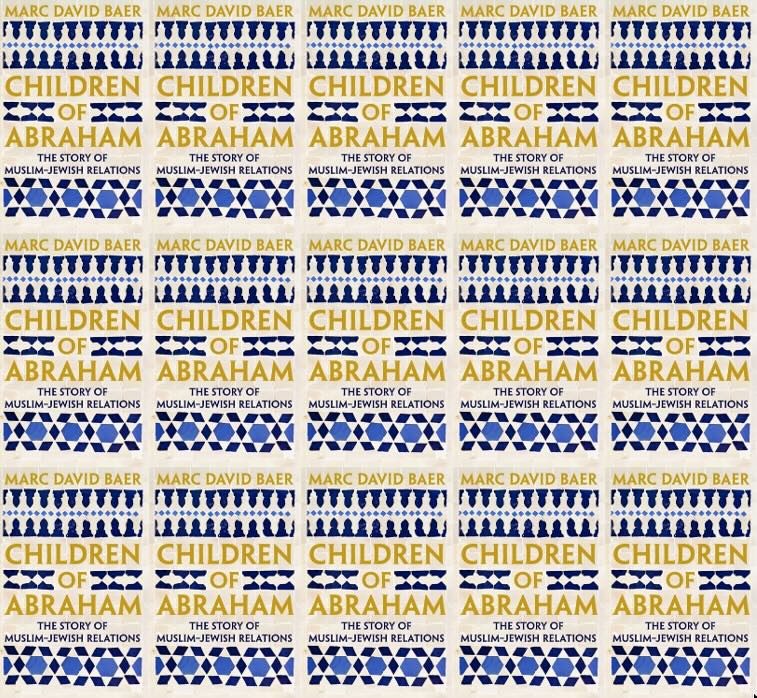
Deborah Maccoby offers us a thoughtful appraisal of an important new account of Jewish Muslim relations in the recently published Children of Abraham by Marc David Baer.
In it Baer provides a balanced appraisal of this relationship over the centuries, distancing his analysis from the extremes of some previous accounts: those which see Jewish life as an “interfaith utopia” under Muslim rule, and those which view it largely as one of subordination and disaster.
There is clearly much to be learnt from the “fascinating, informative stories and details” which are woven together in Baer’s Children of Abraham.
Children of Abraham: The Story of Jewish-Muslim Relations
Marc David Baer, Profile Books, 2026, 383pp.
Reviewed by Deborah Maccoby
Marc David Baer, professor of international history at the London School of Economics, sets out to correct two opposing myths about the historical relationship between Jews and Muslims.
One is of an “interfaith utopia”, in diametric contrast to the persecution of Jews in Christian Europe that culminated in the Holocaust. The other is of a blood-soaked history of Muslim antagonism to Jews that differed little from that experienced by Jews in Christian Europe.
Both myths are politicized by the Israel-Palestine conflict; the mainly anti or non-Zionist proponents of the “interfaith utopia” myth argue that Jewish-Muslim relations were always idyllic before the advent of the State of Israel; the mainly Zionist proponents of the “antagonistic” myth claim that Muslims had always hated and attacked Jews.
Summing up towards the end of the book his central thesis, Baer writes:
“We must not have to choose between writing the history of Jewish-Muslim relations in either red (blood) or gold ink. As this book has shown, Jews and Muslims have shared good times and bad, days of onion and days of honey, in the words of a Sephardic and Palestinian proverb” (pp. 372-372).
Children of Abraham steers a balanced course between the two extremes, presenting a complicated history held together by some key themes.
The concept of tolerance
One is the concept of tolerance in Islam. Baer argues that, in contrast to “Christianity’s primacy of religious exclusivity”, which meant that it sought, as “the new Israel”, to replace Judaism,
“Islam is depicted as restoring the pure monotheism of Abraham rather than being the divine fulfilment of Judaism…. They are fellow Children of Abraham, who accept their siblings’ claims to the same paternity” (pp. 33-34).
Baer also comments that “Mohammed died a natural death” and has never been regarded as divine (p. 33). On the contrary, like Judaism, Islam makes a complete separation between the human and the divine. Whereas Jews in Christian Europe were demonized as the killers of God, Baer writes, such a tradition did not exist in Islam: “Hostility to Jews where it emerged in Islam was non-theological” (ibid.).
Baer points out at the beginning of the book that Islam’s innate religious pluralism was apparent in the very first encounter between Jews and Muslims: Mohammed’s meeting with Arab Jewish tribes in Medina (to which he had fled from persecution in Mecca) in 622 CE. Baer stresses (p. 15) that the term “Arab” includes Jews as well as Muslims and Christians. Mohammed included these Arab Jewish tribes in a treaty of alliance called the Pact of Medina, which stated: “The Jews have their religion and the Muslims have theirs” (p. 21).
However, this alliance was short-lived. Mohammed later accused the Jewish tribes of violating the Pact of Medina and (after they had refused to accept him as God’s Prophet) conquered, expelled and massacred them, a process culminating in their defeat at the Battle of Khaybar in 628 CE (pp. 21-23). Baer writes (p. 25) that proponents of the “interfaith utopia” myth point to the Treaty of Medina; proponents of the “antagonistic” myth point to Mohammed’s expulsion of and the very real massacre of Jews (although the number of dead has probably been exaggerated).
Despite the expulsions and massacre of Jews, the Pact of Medina, Baer claims, was a “blueprint for a system of tolerance” in Islam that “includes the so-called Pact of Umar, named after the Muslim Caliph Umar I (r. 634-6444 CE)” (p. 30). The Pact of Umar was “a protégé pact … known as dhimma, those subject to it are the dhimmi, and the poll tax is the jizya” (ibid.). Jews and Christians under Muslim rule were granted toleration and protection in exchange for paying the jizya and accepting the status of dhimmi, i.e., second-class citizens subject to restrictions.
Baer emphasizes that tolerance “is not to be confused with equality or multiculturalism” (p.118). Nonetheless, he quotes approvingly Bernard Lewis’s conclusion that in Muslim-ruled countries “the restrictions on Jews were more often disregarded than strictly enforced” (p. 10). Baer also points out that
“Jews had a confirmed legal status as protected people, in the social hierarchy of Islamic society, as opposed to arbitrary special law and status in Christendom, as Christians marginalised, excluded and expelled them from society.”
Much later in the book, Baer tells the story of how, in Iraq in 1941, a pro-Nazi nationalist pogrom against Jews in Basra was stopped by Muslim notables and neighbours influenced by the age-old Islamic tradition of dhimma: “The dhimma pact, no longer valid in a secular state, whose constitution granted all citizens equality, compelled Muslims to stand up to modern nationalist violence” (p. 230).
The Jewish-Muslim Alliance
Another theme in the book that opposes the ”Muslim antagonism” myth is that of alliance between Jews and Muslims. In 638 CE (six years after the death of Mohammed), when conquering Arab Muslim soldiers besieged Byzantine Christian-ruled Hebron, “the Jews helped them conquer Hebron” (p. 11; see also p. 26 ), by showing them where they could make a gateway in the walls, in exchange for being allowed to build a synagogue, which the Christians had forbidden, at the entrance to the Cave of Machpelah (the burial-place, according to the Hebrew Bible, of the patriarchs and matriarchs Abraham, Isaac, Jacob, Sarah, Rebecca and Leah).
A central theme of Children of Abraham is “Judaeo-Islamic symbiosis” — a term coined by the German-Israeli scholar Shelomo Dov Goiten, who wrote that “’Muslim religion took form under Jewish impact’ and ‘traditional Judaism received its final shape under Muslim-Arab influence’” (pp. 36-37). Baer points out that “Jewish kabbalists and Muslim Sufis emerged and developed in tandem” (p. 44). Under the tolerant Muslim Abbasid dynasty (750 to1258 CE), Talmudic academies flourished in Baghdad (p. 50), which had become the centre of the new, highly sophisticated Islamic civilization. Baer points out that
“the main factor in the Judeao-Islamic symbiosis was the Jewish adoption of Arabic… Adopting Arabic names for themselves, they used it to translate and comment on the Torah and the law, producing philosophical as well as theological treatises in the language” (p. 51).
Baer also emphasizes what he calls “the secular symbiosis”. Under the Abbasid dynasty in Baghdad, Muslim and Jewish philosophers collaborated in the preservation of Greek philosophy and science:
“Their writings were translated from Arabic into Latin in Spain from the ninth to the twelfth centuries, and sparked the thirteenth and fourteenth-century Renaissance in Christian Europe” (p. 52).
Baer writes that Muslim Spain, known as Al-Andalus, was, under the tolerant Umayyad dynasty (756-1031 CE), in many respects a genuine “Golden Age” for Jews:
“The most perfect expression of Jewish-Muslim symbiosis occurred in cities such as Grenada and Cordoba. It was found not in the Arabic literature of the Jews but in the secular and religious Hebrew poetry and musical melodies created in medieval Muslim societies including Al-Andalus” (p. 77).
Famous medieval Spanish Jewish poets, such as Judah Halevi and Solomon ibn Gabirol, used the “metres, motifs and genres of Arabic poetry” (p. 78) to create in Hebrew beautiful poetry, both religious (these poems are still sung in synagogues all over the world) and secular.
But Baer also points out the dark side of Al-Andalus, in particular the murder of the Jewish Grand Vizier Joseph ibn Naghrela in 1066[1], followed by a massacre of the Jews of Grenada (p. 84). The rise and fall of the ibn Naghrelas (Joseph’s father, Samuel ibn Naghrela Ha-Nagid, was also a Grand Vizier but showed more humility than his son) demonstrates both the heights to which Jews could rise in Islamic societies but also the precariousness of their position. It was felt by the Muslim populace that Joseph ibn Naghrela had become so powerful and arrogant that he had violated the dhimma pact.
Similarly, writing about the Ottoman Empire, Baer counters the “myth of Turks as saviours of the Jews” (p. 118) that is put forward by “Jewish chroniclers and modern historians” (p. 122) by pointing out that
“when Ottoman Muslim historians from the fifteenth to the eighteenth centuries selected Jewish figures, they almost always … provided examples where Jews rose above their subordinate dhimmi status and caused harm to Muslims in some way and were ridiculed, humbled, converted or put to death for it” (ibid.).
Here we come back to the theme of Muslim tolerance: its benefits but also its limitations. Much later in the book, Baer describes the Turkish government’s betrayal of Turkish Jews in Germany and other parts of Europe during the Hitler era, many of whom were abandoned to their fate, even though the Turkish government was given the opportunity to repatriate them (pp. 240-246).
But to return to the theme of “secular symbiosis”: Baer traces this thread throughout the book, from medieval times to the alliance between left-wing anti-Zionist Jews and Muslims in the twentieth and twenty-first centuries: for instance, Iraqi Jewish Communists “who formed the League for Combatting Zionism” (p. 331); radical French Jews, both Sephardic and Ashkenazi, who supported Algerian independence, the Palestinian cause and the rights of immigrant Muslim workers (pp. 363-365); and even today’s Green Party in the UK. Baer writes:
“The leader of the Green Party of England and Wales is a Jew, Zack Polanski; and a deputy leader is a Muslim, Mothin Ali. It is the age-old secular symbiosis, the left-wing anti-Zionist alliance that we have seen in the Middle East and Europe” (p. 374).
Baer points out that European Zionist Jews “were there to create an exclusive Jewish state and looked down upon the local Jews and their good relations with Muslims” (p. 264). Taking up another of the book’s themes, Baer writes: “Throughout history, when there is a triangular relationship among Jews, Muslims and Christians, and Christians are on top, relations between Jews and Muslims worsen” (pp. 272-273); and he cites the Balfour Declaration as a prime example (p. 273).
Yet Baer also argues that “Zionism itself gave political independence to a persecuted people” and suggests that “the state of Israel missed a chance to resurrect the historical bond of the Jew as ally of the Muslim united in a Jewish-Muslim symbiosis” (ibid.). Many will disagree with Baer’s view that Israel might have achieved this symbiosis; but it seems to me that he has a case in arguing that the current catastrophe was not inevitable; that, instead of persecuting, driving out and massacring the Palestinian Arabs and treating with contempt its own Arab Jews (pp. 343-348), Israel could have gone in the direction of the age-old historical bond of “Jewish-Muslim symbiosis”.
An evaluation
Baer’s balanced approach breaks down, in my view, when he addresses the current catastrophe of October 7 and its aftermath. At the end of Chapter 9, the penultimate chapter, Baer describes a joint letter issued on October 7, 2024, by the British Chief Rabbi Ephraim Mirvis, the then Archbishop of Canterbury, Justin Welby, and Imam Qari Mohammed Asim, Chair of the Mosques and Imams National Advisory Board, condemning “both the brutal Hamas terrorist attacks in Israel” and “the devastating war in Gaza”. The letter, which states that “we must stand together against prejudice and hatred in all its forms” is so bland as to be meaningless. Moreover, Mirvis is on record as having said, in a speech given in January 2024: “what Israel is doing is the most outstanding possible thing that a decent, responsible country can do for its citizens and for its people”.[2] Yet Baer concludes this chapter, referring to the authors of the joint letter:
“At the time of writing, at the end of 2025, it seems there is little space for one who wishes to follow their lead, to mourn the nine-month-old Israeli infant Kfar Bibas and his four-year-old brother Ariel, taken hostage by Hamas and murdered, together with the five-year-old Palestinian girl Hind Rajab, indiscriminately killed by Israeli forces” (p. 375).
For all his attempt at “balance” here, Baer makes a distinction between the Bibas children, who, he claims, were “murdered”, and Hind Rajab, whom he describes as “indiscriminately killed”. He is both biased and incorrect. The cause of the deaths of the Bibas children is unknown; Hamas says they were killed in an Israeli airstrike; the Israel government, without producing evidence, says they were murdered by Hamas.[3] In the interest of “balance”, surely Baer should refrain from accepting without criticism the Israeli government’s statement? On the other hand, investigations by the Washington Post and Sky News have produced concrete evidence that indicates that Hind Rajab, her uncle, aunt, cousins, and two Red Crescent ambulance drivers, who had come to rescue her, were targeted by an Israeli tank driver – i.e., murdered.[4]
When it comes to writing about genocide, attempts at “balance” are inevitably a failure. But Baer’s balanced approach works excellently in the main body of the book. Children of Abraham is full of fascinating, informative stories and details, which, as in an oriental carpet, are given pattern and coherence by being woven together by connecting threads to bring out the rich, colourful, complex reality of the long history of two inextricably entwined communities.
Endnotes
[1] At this time, Grenada was ruled by the Berber Zirid dynasty, which succeeded the Umayyads in Grenada; but Al-Andalus was still in its broader “Golden Age”, even if that age was no longer at its zenith.
[2] Chief Rabbi Ephraim Mirvis says Israel’s actions are ‘decent’ and ‘responsible’, Memo, 10 Jan 2024
[3] “There is no evidence Hamas killed members of the Bibas family. Israel is using their death to manufacture consent for genocide.“, Jonathan Ofir, Mondoweiss, 23 Feb 2025
[4] “Palestinian paramedics said Israel gave them safe passage to save a 6-year-old girl in Gaza. They were all killed.” Washington Post, 16 Apr 2024; and “Investigation reveals Israel deliberately targeted car with 7 family members, killing them all“, Memo, 08 Oct 2024
Baer also asserts that Hamas “gang-raped” Israelis on October 7 (p. 369), a claim for which there is no evidence. See this article by Norman Finkelstein, reproduced on the JVL website, that demonstrates conclusively that there is no evidence for a systematic Hamas policy of rape.
Although the Turkish government’s betrayal of Turkish Jews in Germany and Nazi occupied Europe is true, individual diplomats such as Behiç Erkin İsmail the Turkish Ambassador in France and Necdet Kent, consul-general in Marseilles between 1941 and 1944, saved hundreds of Turkish Jews.
Baer’s bias when it comes to the genocide in Gaza and his failure to understand why Zionism had ethnic cleansing (& genocide) hard wired into its project, casts a shadow over his description of relations between Jews and Muslims in ancient times.
As Deborah Maccoby points out there is no excuse for Baer’s description of the murder of Hind Rajab as ‘indiscriminate’ and the Bibas children as having been murdered. Rajab’s killing stands out as emblematic of the fate of Gaza’s children and for Baer to refused to recognise it as such suggests that he is not balanced in his approach historically.
Also missing is perhaps the most important of all episodes in Muslim-Jewish relations in Palestine. When the Crusaders entered Palestine in 1099 they slaughtered Jews everywhere they found them. When they captured Jerusalem and Haifa Jews and Muslims were massacred. Jews and Muslims fought together against the Crusaders everywhere. In 1187 having captured Jerusalem from the Crusaders Saladin actively permitted and encouraged Jews to return and resettle in Palestine.
The Farhud in Iraq in 1941 was arguably not so much a pro-Nazi pogrom but a consequence of anti-British nationalism. The British delayed their entry into Baghdad deliberately, allowing the pogrom to continue. British historian Tony Rocca found that Sir Kinahan Cornwallis, Britain’s ambassador, denied the Army’s requests to put down the anti-Jewish mobs and ‘while the Farhud raged, Cornwallis went back to his residence and played a game of bridge.”
Those who fail to understand the present can hardly be trusted with the past.
Baer does actually bring in the Crusades, and the massacre of Jews and Muslims by Crusaders on pp. 110-111. But the book is so full of stories and details that all I could do was touch on the main themes.
Re his suggestion that Zionism could have gone in a different direction: in a genuine two state solution, Israel could have become a Jewish state on the lines of the UK in relation to its Anglican State Church, with Jewish state holidays etc, just as the UK has an Anglican Christian monarch as head of state, a state church and Christian state holidays; but this would just be an anomaly, as in the UK, and not a fundamental inequality. Or Israel could have become a federated state with Palestine, maybe eventually becoming a binational state.
I think Baer has at least a point in suggesting that the current catastrophe wasn’t inevitable. He ends on a hopeful note that maybe Israel can still move towards some kind of Jewish-Muslim symbiosis. He cites an Egyptian Jewish writer, Jacqueline Kahanoff, who — referring to the story in the Hebrew Bible that God gave Ishmael His blessing and said he would make him the ancestor of a great people, but made His covenant only with Isaac, who received a much greater blessing — argues that both Children of Abraham should be blessed equally, with equal rights in the land. I thought of including his hopeful thoughts, but the review was already too long and in any case it’s hard to see any hope now. But I am just mentioning this here.
Thanks to Tony for his comments on the British and the Farhud. I’ve just looked it up, and in fact Baer does write on p. 229 that Jews “blamed the British for abandoning them”. He quotes Elie Kedourie commenting that the British had a policy of minimal interference in internal matters as long as they did not threaten imperial interests. I should probably have included this, but again there is so much detail in this book that a lot has to be left out in a review.
Further to my previous comments: thanks also to Tony for pointing out that Hind Rajab is emblematic of the (at least) 20,000 children murdered by Israel. As I say in the review, one cannot be balanced when writing about a genocide. This is because the scale of casualties on each side is incomparably imbalanced; October 7 was a massacre; what Israel has done in Gaza is, as many genocide scholars and human rights organisations have said, a genocide. But I do think Baer’s balanced approach works in the rest of the book. The problem is, in my view, that at the end of the book he tries to continue this approach into the present and this is inevitably a complete failure.