
The right’s love affair with JCB
JVL Introduction
The JCB boycott campaign is an ongoing effort led by human rights and Palestine solidarity groups, Amnesty International, and Lawyers for Palestinian Human Rights (LPHR), to pressure the British company JCB to stop the sale of its machinery to Israel.
In its November 2025 issue, Prospect Magazine published Imaan Irfan’s important investigation into the firm JCB under the title “The right’s love affair with JCB”.
Kids love JCB’s yellow diggers – powerful, manoeuvrable, dynamic and, in certain circumstances, violently destructive. The brand name JCB is now the Kleenex and the Hoover of the mechanised digger-excavator world.
We summarise Irfan’s core arguments here and urge readers to turn to the full article on the Prospect website.
RK
As Irfan’s article makes clear, JCB’s billionaire owner-chairman, Anthony Bamford, has had close ties to the Conservative Party, was a major funder of the Brexit campaign and continues to have close links to Reform politicians today.
The central thrust of the article is to explore, via the case of JCB, questions about the ways in which private interests influence our democracy—and erode trust in it.
A question you might ask of any large corporation in the world today, it is particularly relevant in the case of JCB because it stands accused of being complicit in human rights abuses.” In some parts of the world,”, says Irfan, “the sight of a JCB can evoke fear.”
This is particularly the case in the West Bank where one West Bank farmer, Atta Jaber, says quite simply: “The noise of the bulldozer is the music of the occupation.” These bulldozers have become the enforcers of the Israeli occupation which has gathered pace in recent years while attention has been focused on the genocidal actions in Gaza.
Atta Jaber’s story is emblematic. Almsot immedaitleyi after the 1967 war and occupation a Jewish colony, Kiryat Arba, was established for Jewish settlers 300 metres from Jaber’s house. Over the decades most of his land has been expropriated by that settlement and the nearby Highway 60, which links Israeli settlements and Jerusalem. His olive orchard is fenced in and Jaber is prevented from accessing it. His home has twice been demolished without notice, along with a water reservoir. Recently, his last remaining narrow strip of land was invaded by settlers and its irrigation system destroyed along with his crops for this year. He is not allowed to build any new structures or renovate old ones on his farm.
It’s not that JC B is on its own – Caterpillar’s armoured D-9 bulldozers for the Israeli military abound – but, says Irfan, “the JCB brand is among the most commonly used in demolitions in the Occupied Palestinian Territories (OPT) and its machines have been used to destroy Palestinian homes across nearly two decades.”
JCB machines were used to directly displace or adversely affect at least 41,251 Palestinian people, according to Corporate Occupation, between 2019 and 2022. One 14-year-old girl, whose home was demolished by a JCB, told Save the Children that she saw yellow bulldozers in her nightmares.
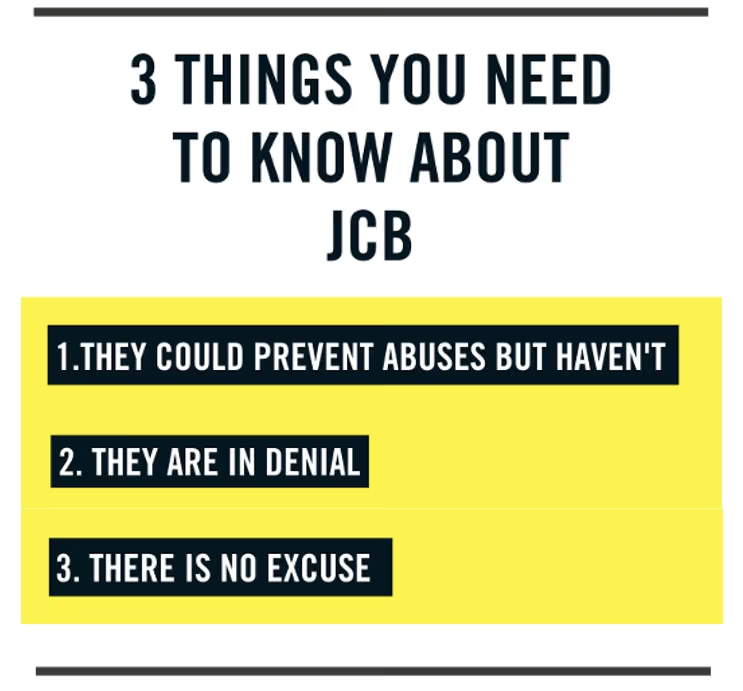
JCB claims to be whiter than white. It says it doesn’t operate in the oPt at all, doesn’t sell direct to Israel and has no responsibility for what is done with its machines. That’s all done though a third-party Israeli-owned distributor…
Five years ago, Amnesty argued that the company could embed human rights conditions into contracts or take sanctions against its dealers by refusing to supply them with equipment or to update their diagnostic technology. Other companies have done so: Hyundai has ended contracts where its dealers in Israel have been involved in home demolitions; John Deere, has remotely disabled agricultural machines it supplied to Ukraine after they were stolen by Russian forces.
In the UK we have the National Contact Point (UK NCP), an independent government body that is part of the Department for International Trade to which complaints have been made by Lawyers for Palestinian Human rights querying whether JCB was meets its human rights responsibilities under OECD guidelines. NCP’s investigation couldn’t prove “conclusively” that “the specific vehicles shown in evidence provided by LPHR came directly through JCB’s distributor, Comasco, rather than on the second-hand market or by other means” – though it did find that JCB neither has a policy commitment to respect human rights, nor carries out human rights due diligence in its supply chain.
It’s all part of a larger story as Irfan demonstrates. In India, for example, JCB has become an unofficial symbol of Modi’s party: “Supporters unwrap snacks from bulldozer-themed packaging, while JCB-themed pop songs play; others are held aloft by the bulldozers as they shower marigolds on those vying for votes. At one event, a far-right lawmaker was greeted by 200 JCB diggers.”
Amnesty has found that JCB has been the “brand of choice” for punitive demolitions against government critics and India’s persecuted Muslim minority, particularly in Uttar Pradesh where what many Hindu nationalists call “bulldozer justice” is prominent.
This Indian theme is developed in great detail in Irfan’s article, citing for instance an Amnesty International investigation of 63 documented demolitions that took place between April and June 2022, finding that JCB machines, while not the only ones used, were the “most widely deployed equipment” and the “brand of choice” in these demolitions.
JCB’s response here, as in Palestine, is to claim that it has no control or responsibility for how its machines are used after they are sold…
This is simply not the case. It chooses to turn a blind eye.
More information
Amnesty International UK recently commissioned a legal opinion “on the question of excluding tenderers for public contracts that conduct business with Israeli settlements in the Occupied Palestinian Territories”. According to Peter Frankental, the Economic Affairs Programme Director at AI UK: “Excluding JCB from public contracts would appear consistent with this opinion at the discretion of the public body concerned.”
Amnesty’s two reports into JCB’s alleged complicity in human rights violations in the Occupied Palestinian Territory and India can be found here and here. An open-source digital map showing the scale of demolitions involving JCB equipment until 2021 can be found here.
You can find the JCB: Stop Bulldozer Genocide Campaign on Instagram here.






Last week the most recent of several delegations went to Camden council’s Pension Committee to call for disinvestment in companies supporting Israel. Mind-bogglingly, councillor Matthew Kirk (Lib Dem, Belsize ward, explicitly opposed to BDS ‘against countries defending democracy’ in principle) alleged that JCB was the most ridiculous company of all to boycott, since it had “only demolished one house in the Occupied Territories, ten years ago, and possibly by accident”! Perhaps now that this report has shown how many horrible things JCB is doing around the world – not least here in UK as JC Bamford is the biggest donor to Reform – councillors might actually listen and learn.