
The Guardian’s Rightward Drift
JVL Introduction
On 11th Feb we reposted an article by Nathan Robinson a (former) columnist on Guardian US How the Media Cracks Down on Critics of Israel.
In it he revealed how one joke led to his being permanently barred from writing for the Guardian.
In this article Ari Paul revisits that story and puts it in the context of a steady rightward drift by the Guardian.
He points out how English-language outlets outside the United States (such as Ha’aretz and the Guardian) became go-to sources for left-leaning readers frustrated by the pro-Israeli and pro-US bias in US Middle East coverage.
But the Guardian is no longer the critical voice it once was. After the Snowden revelations, as Justin Schlosberg is quoted as saying, “the Guardian’s relationship with the security state began to look increasingly more cooperative than antagonistic…”
The bottom line says Robinson is that “the editors want to very tightly police what writers say on Israel/Palestine…”
_____________
Thanks to Ari Paul and Fairness & Accuracy in Reporting (Fair).
This article was originally published by Fair on Mon 22 Feb 2021. Read the original here.
Guardian Columnist’s Firing Over Israel Joke Highlights Paper’s Rightward Drift
Loading article text…

The link to the article on the Guardian web site with the editorial supporting the Iraq war is to the Observer, rather than the Guardian. As far as I know, the Guardian opposed the war, but the Observer played an absolutely despicable role, which is well re-told in the film Official Secrets, about Katherine Gun and her leaks of the GCHQ emails about spying on various UN security council members. There is also a good discussion about the problems they encountered at the Observer with the two journalists involved, Katherine Gun and the film director here:
https://www.democracynow.org/2019/7/19/15_years_later_how_uk_whistleblower
Guardian “problems” with Israel are not new. From “Publish it Not: The Middle East Cover-Up”, by Michael Adams and Christopher Mayhew (1975, 2006):
“[At the beginning of 1968, I (Michael Adams) filed reports] to the Guardian on the situation in Gaza, on the continuing fight of the Palestinians in the occupied territories, and on the state of affairs in Arab Jerusalem, which the Israelis had annexed and where they were expropriating land on which to settle Jewish immigrants inside the Arab sector…..The editor of the Guardian who published the dispatches I sent found himself the target for much criticism and even abuse as a result. A campaign was orchestrated, in which the Israeli Embassy, the Jewish press in Britain and a number of individuals tried to discredit me, and through me the paper. The Jewish Observer published an ‘open letter to the Guardian’, criticising the editor’s irresponsibility and suggesting that he was somehow in league with what the writer called ‘your Arab friends’. A paper called Israel Today… openly accused him of publishing antisemitic material….I felt [the editor’s] confidence in me weakening…”
The editor wrote to Adams “It’s certainly true that the bulk of Jewish readers here believe the Israelis have behaved with astonishing restraint. That’s perhaps why they find it difficult to accept at face value your reporting of intimidation”. Adams last article, about the demolition of three villages (Imwas, Yalu and Beit), was not published, this time on the grounds, given by the editor, that the events had not previously been reported in the British press (shades of the Observer at the time of the Iraq war, where they turned down Ed Vuliamy’s scoop about the CIA). No attempts to check with independent agencies in Israel were made. “As a direct result of the argument we had … the editor put an end to my connection with the Guardian by telling me he would never again publish anything I wrote about the Middle East.”
The Grauniad, under Rusbridger, was a decent liberal investigative newspaper. The rapid decline set in when he left. Now it simply acts as a stenographer for arms of the state apparatus. The opinion section, under Freedland, has morphed into a combination of anodyne pap and vicious bile.
And, correct me if I’m wrong, but didn’t Julian Assange say that it was two Grauniad reporters who had revealed the key to the Wikileaks’ secure drop box? At least most of the right wing rags are happy to acknowledge where they stand and “stab you in the front”.
“Guardian” censorship APPEARS to be spreading to other topics too. Posting quotes from Skwarkbox (eg about the Liverpool shenanigans) isn’t appreciated. Some posts relating to Emilie Oldknowe’s day in court get through, others (apparently very similar) don’t. The time of day when items are posted seems to affect outcomes – different moderators with different views of what’s allowable perhaps?
Behaviour like this diminishes the affection and respect many of us have for the “Guardian” but it’s behaved at least as badly (and probably worse) at times in the past.
Maybe all we can do is wait for another Rusbridger to take over? And to try to keep the small independent press (especially the few left-wing ones) and left-leaning / investigative blogs alive by small donations. Censorship is an insidious evil – what no-one knows about can’t be fought.
I abandoned the Guardian several years ago, and now warn people of its true nature and purpose at every opportunity.
I am one reader the Guardian can no longer take for granted.
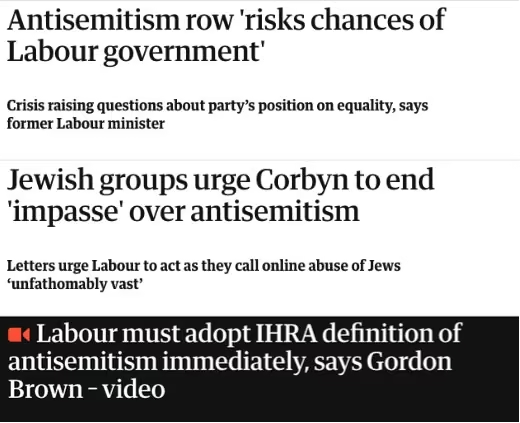
We started to take the Guardian regularly after our marriage in 1967. We gave it up more than half a century later, in 2019, over its relentless hounding of Corbyn and its frighteningly paranoid approach to the anti-Semitism issue, even banning cartoons by their long-term resident cartoonist Steve Bell. I wonder how many other loyal readers they’ve lost in recent years.
It comes as no surprise that The Guardian has become the unofficial “official” conduit for Whitehall “leaks” and the default “go-to” for media releases from prominent establishment departments like the Department of Defence and the Foreign Office.
It is evident to intelligent observers and commentators that The Guardian is now fully under the cloak of the “Establishment”. Its portrayal of Israeli Apartheid in a favourable light and labelling of pro-Palestinian voices as “anti-semitic” [ implied or stated ] is to be expected.
We must see this significant shift to the right, not just in terms of denial of free speech and gagging criticism of zionism, but as a sign that the Establishment feels the need to protect its vested interests under increasing pressure from pro-palestinian, pro-democratic, voices and organisations.
As with any dictatorial anti-democratic racist apartheid regime, “banning” and other attempts to silence dissent, provides fuel to our fire and provides strength and legitimacy to the fight against apartheid. They may have control of “media”, but we are creative and must be prepared to use other legitimate means to keep the struggle against racism and apartheid on the agenda.
Just like South Africa – when it was backed by the worlds biggest Imperialist nations, armed to the teeth and systematically oppressing indigenous Africans – that was when it cracked. We cannot wait for the toll of death, torture, false imprisonment and denial of basic human rights to continue in Palestine. We have to keep pushing in any and every legitimate way open to us.
Whether its fighting against Zionist racism in the Guardian or pushing against Starmers Zionism in the Labour Party, we must take strength from the fact the Establishment and the Zionist Lobby perceives the mood and the need, to go on the offensive: not because it is “winning”.
Last September, the Observer did an interview with Owen Jones:
The headline quote in large print and bold type:
Owen Jones: ‘A lot of people in the Labour party are horrible.’
However, having looked through the actual article itself, I could find no such quote.
Instead, I found this:
“A lot of those people in the parliamentary Labour party—I’m just going to say it—are jumped-up thugs. Vicious, horrible people…”
That is not the same thing, is it?
This is not the only falsification. It twice uses the propaganda term ‘antisemitism crisis’.
C.P.Scott, owner and Editor of the Manchester Guardian as it then was, met Chaim Weizmann at a party in Manchester in 1914. He later said he was fascinated by Weizmann and had been convinced by his Zionist principles. Scott had the ear of Lloyd George, then Minister for Munitions, and when the war effort was in crisis because supplies of acetone -fundamental for the production of cordite, the explosive used in shells – were sequestered by the Germans, Scott introduced Weizmann – a chemist who had invented a way of creating acetone by bacterial fermantation – to LG. CW moved from Manchester to Sheperds Bush and worked for the government to create large industrial sources for fermented acetone. He rubbed shoulders with the war cabinet, and became a very familiar figure in influential circles. The Balfour Declaration came out of a number of different political interests, but undoubtedly CWs influence in Downing St was a major factor. Meanwhile the Guardian was the first newspaper to carry pro-Zionist editorials, and it’s chief political correspondent Harry Sacher became one of the drafters of the Declaration.
Regarding Katherine Viner, she is credited as a co-adapter with Alan Rickman of the diaries that created the script of ‘My Name Is Rachel Corrie’, the story of the American woman killed by an Israeli bulldozer that opened at the Royal Court in 2005 and ran in the West End produced by Alan Rickman and David Johnstone. The wiki on it says ‘The play was scheduled to be transferred to the New York Theatre Workshop in March 2006. However, the New York theatre decided that, because of its political content, the play was to be “postponed indefinitely”, after the artistic director polled numerous Jewish groups to get their reaction to the play.[7] Rickman and Viner denounced the decision and withdrew the show’
I have read the Guardian for many years, but over the 4 years there has been a noticeable move to the right . Journalists such as Freedland are given freedom to post total distortions and misrepresentations regarding Ant Semitism in the Labour party. I was a disgraceful piece of journalism that have ever read. The Guardian allowed this to be printed. It did not allow a critical analyses of the inaccuracies and gross distortion of the facts.
Sadly this has continued even in the letters page. The editorship by Kathrine Viner has made it worse. I am not clear whether she is up to the job of being editor of a left leaning so called newspaper. It does not appear to the case I fear.
The Guardian used to be a decent liberal paper with a number of socialist columnists – Ian Aitken, Jonathan Steele, Jonathan Palmer and two brilliant Middle East correspondents – David Hirst and Michael Adams. I saw Adams speak in Liverpool circa 1968. My class in Jewish school were taken to see a debate in which he was featured. He won it easily.
Today the Guardian is a neo-liberal paper and people should boycott it. Indeed it is more insidious than the Mail because at least we know what the Tory press stands for. We should support 5 Pillars campaign for a boycott and try to persuade those people who make voluntary donations to it and Kath Viner’s £300K+ salary that their money could be better used.
The letters column was the last bastion of free speech but that too has succumbed.
Incidentally the Guardian was not anti the Iraq War. It sat on the fence but the Observer, which betrayed its traditions e.g. opposition to Suez was despicable and never apologised
Last May I wrote an eight page letter to Kath Viner telling her why after forty plus years of being a loyal reader I was cancelling my subscription. I was determined to have my say and not go quietly. I have to give credit to the JVL website and it’s many wonderful articles which I researched and which allowed me to write the lengthy J’Accuse over it’s coverage of Corbyn and alleged rampant antisemitism in the Labour party. I was not expecting a reply but was gobsmacked to receive a very lengthy one the very next day from the Subscriptions Editor (“I have been asked by Kath Viner to reply….”). Which makes me think that they may be getting so many letters from left wing readers leaving that they had various formatted replies prepared in advance!
So right. I discovered the Guardian as a young man in 1964. I became an avid reader. Same goes for the Observer. I stopped reading them a couple of years ago when the attacks on Corbyn and the Left began. It is like living in an Orwellian nightmare. I wonder every day how the Labour Party could be accused of antisemitism. Jeremy is the very last person in Britain to be antisemitic. Grotesquely, it has become accepted.