
Liberalism Inc: 200 years of the Guardian

JVL Introduction
This article reports on a recent conference about the Guardian and its history.
The organisers, from Goldsmiths Leverhulme Media Research Centre, did very well to involve two former Guardian editors (Alan Rusbridger and Gary Younge) as well as some outspoken critics about its approach to media reform and international relations (Brian Cathcart, Mark Curtis and Ghada Karmi).
While highlighting some of the Guardian’s impressive achievements, author Jonathan Coulter draws disturbing conclusions as to where it has been headed in recent years.
He argues that we can hardly hold a ‘Liberal Reformist’ newspaper like the Guardian accountable for being ‘a poor ally for the left’, a matter of concern to many conference participants.
However, we can certainly take it task for betraying the ethical principles of its founders and the Scott Trust that owns it, and to which current executives claim to subscribe – things like telling the truth, arguing based on fact rather than supposition, and the Judeo-Christian injunction not to “bear false witness”.
Coulter finds it has been failing in all these areas, in what looks like a collapse of journalistic integrity, and asks us to call it out in no uncertain terms.
CAMPAIN invites you to add your comments at the bottom of the article on the Campain website.”
This article was originally published by Campain: time to end misrepresentation on Sat 1 May 2021. Read the original here.
Great conference on the Guardian, but it misses a vital punch line
Loading article text…
Never been left-wing. Never been trustworthy. Yellow like the Lib Dem’s.
Thanks for this piece. I’m warmly attached to the “Guardian” – which is often excellent – and it hurts every time its coverage falls below reasonable standards.
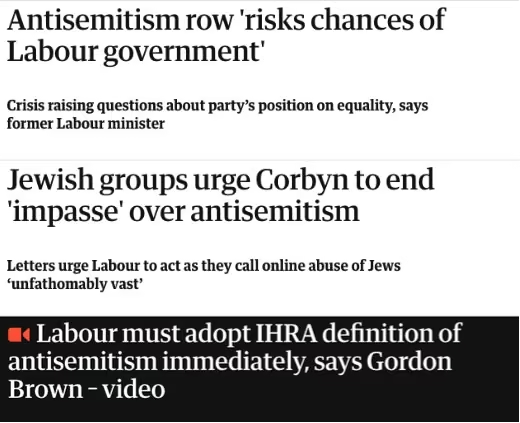
What most irritates me is the determined stonewalling of readers’ criticism of its often fact-free coverage of Corbyn, antisemitism, right-wing Labour, the leaked Labour report, the Forde Inquiry and the huge crisis within Labour created by Evans and Starmer.
I know before posting that any comments I make on these issues are likely to be removed before they can be read. I now self-censor in the hopes of getting diluted versions of what I think out in the public domain – often this approach doesn’t work.
I think I’m always careful not to say anything that could get anyone (me included ) sued or be unnecessarily upsetting.
I resent not being able to express opinions and counter-arguments when what is published in some “Guardian” articles or permitted posts is so unfair and ill-founded.
The anonymous senior General who threatened an armed revolt if Corbyn became PM, and immeditely vanished and was contradicted, was signalling the Establishment’s true position. A self-proclaimed pacifist and enemy of Trident could not be allowed to represent Britaoin at the Security Council or be in charge of the Armed Forces. Everything that happened thereafter, including the antoisemitism ‘crisis’ played into that narrative. That the G was leant on by MI5 is no surprise. That they caved is disappointing but understandable. Unfortunately it leaves those of us who used to believe that the G and the BBC did their best to tell the truth – and the BBC was deeply complicit in undermining Corbyn too – bewildered and deeply diasappointed, and faced with the conclusipon that we do not live in a democracy. We will not be allowed to elect the goivernment we want, unless they approve.
I’m surprised that Jonathan Coulter has not mentioned the most shocking of all the Guardian’s betrayals – Julian Assange.
I disagree with Jonathan that there is much to admire in The Guardian’s history. It was always been a paper of the liberal imperialist establishment and no one represented that better than the pro-Zionist C P Scott. It has never been a friend of the working class.
As for Gary Younge, he long ago became absorbed by the Guardian’s political culture. The only radical journalist today on the Guardian is its soon to be sacked cartoonist, Steve Bell.
This is why, when Younge was questioned about the Guardian’s coverage of ‘antisemitism’ in the Labour Party he could only manage the feeble response that the issue was “deeply toxic”.
The reality was that Younge too had bought into the false antisemitism narrative. See my
‘Open Letter to the Guardian’s Gary Younge – Why the Double Standards Over Israeli Apartheid? – Why is it so difficult to understand that Labour’s ‘Anti-Semitism’ Crisis Has Nothing to do with anti-Semitism?’
https://tonygreenstein.com/2019/06/open-letter-to-the-guardians-gary-younge-why-the-double-standards-over-israeli-apartheid/
These are some of the comments I took issue with by Younge:
‘The fudge on Brexit is most often mentioned, with the party’s ineptitude – or worse, complicity – over antisemitism coming second.’
Younge then went on to compare this ‘complicity’ with the Iraq war and the pauperisation of asylum seekers. He compared Labour’s indifference or hostility to Jews with its hostility to asylum seekers! This suggests that Younge has long ago fallen victim to reactionary identity politics.
In fact the very same people in Labour such as Tom Watson who were to the fore in demonising asylum seekers were also in the vanguard of the fake antisemitism campaign. A more gross analogy is hard to imagine.
Younge went on to say that
‘when Jews do not feel welcome in the Labour party because they are Jews then that is a serious problem…. There are clear moral reasons why anyone, but particularly Jews, might abandon the party.’
Yes the issue was toxic and Gary Younge played his part in making it toxic – to Palestinians and anti-Zionist Jews.
I suggest that people read Media Lens’s ‘Shocking Omissions: ‘Capitalism’s Conscience – 200 Years Of The Guardian’ – John Pilger and Jonathan Cook Respond’
https://www.medialens.org/2021/shocking-omissions-capitalisms-conscience-200-years-of-the-guardian-john-pilger-and-jonathan-cook-respond/
It is no accident that Media Lens was not invited to contribute to the book.
Seems strange that no-one mentioned the paper’s role in rubbishing Julian Assange and ignoring its own role. The Guardian in 2011 published the password (that Assange had given to investigations editor David Leigh on strict condition it be kept secret) to the WikiLeaks file containing the 250,000 encrypted cables for which Mr Assange is now languishing in HMP Belmarsh. Assange published the cables unredacted but he did so – was forced to do so – by the actions of Leigh and the Guardian.
Why was this not debated?
We began taking the Guardian in 1967 and cancelled it a year or two ago over its relentless persecution of Corbyn. It has always been a curate’s egg. Consider its response in 1968, to Enoch Powell’s Rivers Of Blood oration. Rees Mogg, the Editor of the Times, denounced Powell’s rant forthrightly as “an evil speech” and congratulated Edward Heath for sacking Powell from his shadow cabinet. The Guardian, by contrast, assured its readers that “Mr Powell is not a racist”.
I did post this on Campain but I thought this older exchange on a theme that remains current is worth noting here as well: https://electronicintifada.net/content/guardian-zionism-liberal-press–its-missing-contexts/5300
First class analysis of the myth that facts are sacred to the guardian only when they are not in conflict with the editors views
Jonathan Coulter writes:
“After Younge’s talk, I asked “why didn’t the majority of the Guardian staff rebel against the gross misrepresentation in how the Guardian covered antisemitism in the Labour Party”. Various other audience members typed closely related questions. As Mark Curtis noted, the Guardian had endlessly pushed this narrative between Corbyn’s becoming leader in 2015 and the General Election of Dec 2019.
Younge could hardly manage a response, beyond saying that this topic, like the trans debate, was “deeply toxic”…
Younge’s response, or lack of it, bore out what he had just said about the culture of conformity among Guardian journalists, and which may also affect former employees like him. However, I have little doubt it also reflects the fear of being trashed as antisemitic – an ever-present threat that hangs over journalists who dare speak up in support of Palestinian rights.”
There is much meat throughout Jonathan’s excellent blog, but for me this is where he strikes at the Guardian’s jugular. This newspaper (alongside the BBC) effectively lied to its readership during the whole anti-Corbyn/antisemitism farrago of smears and false accusations. It did not tell lies as such, but lied by omission, that omission being any consideration or use of Corbyn’s and his supporters’ valid defences against these charges. The case for the defence did not exist. Allegations became assumptions, then received wisdom. Accusation masqueraded as fact.
The Guardian editorial staff, reporters, columnists and desk editors to a man, to a woman, excised from its news and comment pages any of the reasoned and detailed defences of Corbyn and Labour made by an ever-widening community of commentators, politicians, academics and citizens of the Guardian’s world, many of them prominent Jews. Occasionally they were given access to the Letters Page, but rarely, and usually “balanced” by those more in tune with the Guardian’s poisonous editorial line. It is especially shameful that reporters and columnists many of us admire for their wit, insight and conscience on a range of global and local issues have even since Corbyn’s departure maintained this obnoxious, ungrounded, false position; no mention the assault was created and launched by his enemies within the Labour Party in alliance with Israel and its industrious army of friends and influencers.
What is also astonishing is that The Guardian could be so sure of this antisemitism at a time when there was…and is….no agreement on what actually defines antisemitism.
Tim Llewellyn, former BBC Middle East Correspondent
Brian Burden is right. Not only the Guardian’s response to Powell’s infamous ‘rivers of blood’ speech.
The Guardian also advocated recognition of South Africa’s bantustans and equally appallingly welcomed the coup in Argentina in 1976 that brought a neo-Nazi junta to power.
I had been a reader of the Guardian & Observer for almost 50 years.Whilst not always agreeing with the views propounded, I felt the paper, unlike its rivals, had integrity and told the truth. During the last few years, I have sadly witnessed that integrity crumble. Its lies and calumnies against Jeremy Corbyn, working to bring about his downfall, reduced the publication to the status of a mere propaganda sheet. Last year I came to the stark realization that I could no longer trust it to speak the truth and cancelled my subscription. I haven’t missed it.
At first I thought that Gary Younge’s response to questions about the paper’s ‘use’ of anti-Semitism was embarrassing. But, after further reflection- he’s no longer on the staff there- I found it rather chilling to consider the current reach of Zionist influence. Clearly Gary has.
Good explanatory article. Thank you.
Regulate Regulate Regulate
“Rusbridger spoke of the history of the Guardian, from its foundation in Manchester in 1821 to the present day. The founders were a group of mainly non-conformist (Unitarian) businessmen with links to the cotton trade”
Did this include talking about the newspaper owners position on the Confederacy ?
@Hassan, that’s an interesting question, this article may provide some answers to your question: https://www.theguardian.com/commentisfree/2011/feb/24/1865-guardian-stance-us-civil-war.
Thanks Jonathan. Interesting, but brief piece. Heres something even shorter, and from a few years before; https://www.theguardian.com/uk/2008/oct/16/blackhistorymonth-humantrafficking
One of the commentators of the article you linked states;
“On voting reform, the Manchester Guardian again displayed both its impeccable bourgeois liberal pedigree whilst showing suspicion and utter disdain of the lower orders.
“the qualification to vote ought to be low enough to put it fairly within the power of members of the labouring classes by careful, steady and preserving industry to possess themselves of it, yet not so low as to give anything like a preponderating influence to the mere populace. The right of representation is not an inherent or abstract right, but the mere creation of an advanced condition of society.”
It appears the newspaper has therefore long had contempt for the working class, not that that should be a surprise to anyone.
I have complained to the Guardian through the letters page several times about distortion of the facts. My most recent complaint concerned the almost complete absence in the various analyses of the recent election results of the 2017 election results. Martin Kettle, in an article assessing how local election results link up to General Elections, managed to jump from the the local election results in 2017 to the General Election of 2019! Classic Stalinist tactics of airbrushing history!