
Refaat Alareer – in memoriam
JVL Introduction
Two days after Palestinian poet Refaat Alareer was killed we posted a brief tribute with Maxine Peake reciting his poem, ‘If I must die’.
We follow this up with some further tributes and an article from the Electronic Intifada suggesting that he was deliberately targeted and assassinated by Israel.
In the words of the Euro-Med Human Rights Monitoring Group:
“The airstrike surgically targeted the apartment on the second floor where Refaat was in a three-story building, and not the entire building; indicating the apartment was the target and not possible collateral damage,”
When earlier asked why a previous building he had lived in was bombed he said: “We do not know why the building was targeted. My mother-in-law insists it is because I talk to the media.”
Alameer’s words had pierced the IDF’s armour so someone seems to have decided to get rid of this pestilential priest…
RK
Jewish Currents Shabbat Reading List, 8th December
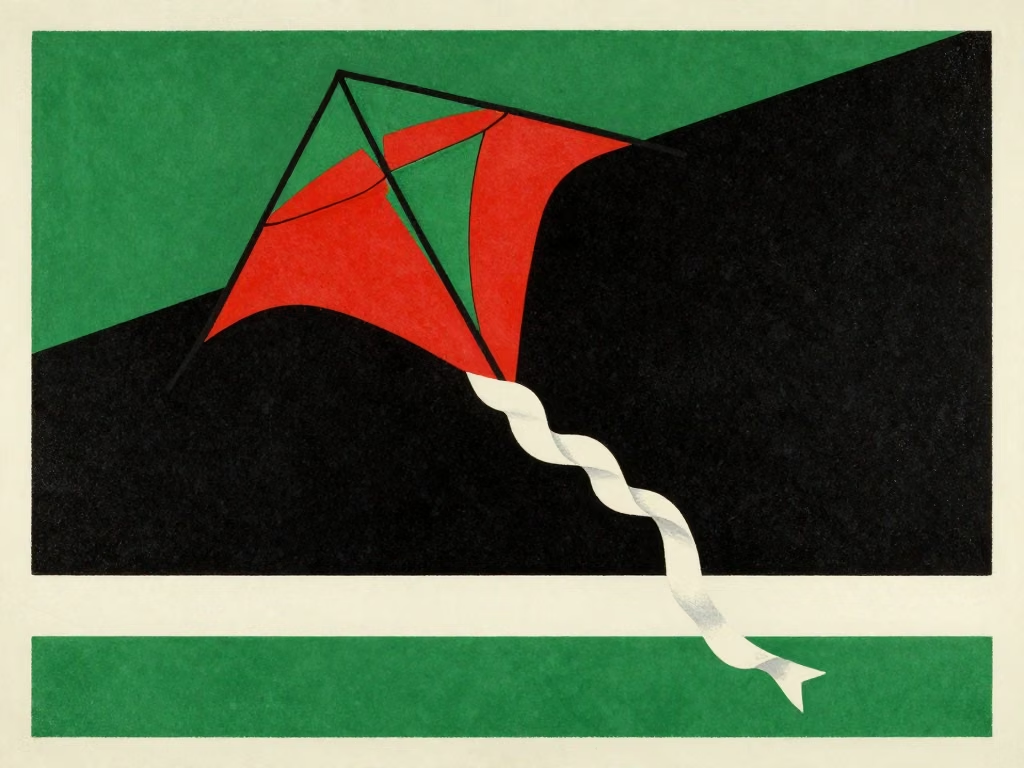
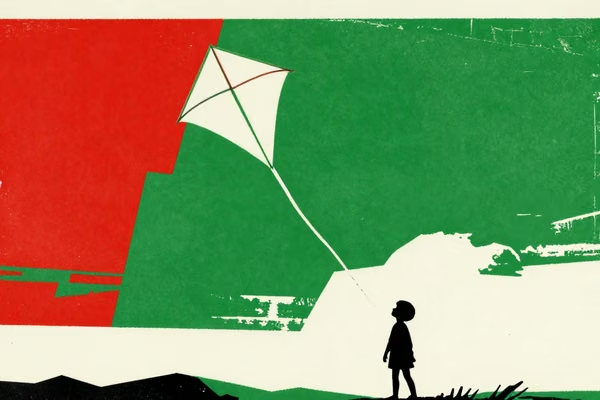
Claire Schwartz (culture editor): On November 17th, the Palestinian poet Hala Alyan posted a 2011 photograph of children on the beach in Gaza, arms outstretched, the clear blue sky punctuated with brightly colored kites. The day the picture was taken, the children broke the Guinness world record for the most kites flown simultaneously: 12,350. The day Alyan shared the photograph, 12,350 was the estimated death toll from this iteration of Israel’s relentless assault on Palestinians living in the Gaza Strip. There is, of course, no common measure to this confluence—only a devastating coincidence: The children’s insurgent exuberance recedes and Israel continues to kill, the world that might have been rattling horrifically inside the one that is.
I have been thinking of these children and their kites since yesterday, when I learned that the Israeli regime assassinated Palestinian writer and professor Refaat Alareer. I have been reading and rereading his final poem:
If I must die,
you must live
to tell my story
to sell my things
to buy a piece of cloth
and some strings
(make it white with a long tail)
so that a child, somewhere in Gaza
while looking heaven in the eye
awaiting his dad who left in a blaze—
and bid no one farewell
not even to his flesh
no even to himself—
sees the kite, my kite you made, flying up above
and thinks for a moment an angel is there
bringing back love
If I must die
let it bring hope
let it be a tale
In the wake of Alareer’s death, the opening line constricts, the conditional already fulfilled. Then: You must live. Trade what the poet left behind so that a Gazan child might have a vision of love beaming back at them. Alareer does not write “your kite,” or even only “my kite,” but “the kite, my kite you made.” He implores the reader: Stitch your life to the wake of my living and make of it something definite: “Let it be a tale.” A tale (like a tail) is what comes after. It is a doubled after that Alareer’s poem charges us with—not only the after of persisting in catastrophe’s wake, but also the after in “to look after,” to care for, to return. As poet and performance artist (and JC artist-in-residence) Fargo Nissim Tbakhi writes: “The past is a future we return to.” On the photograph she posted, the kites’ tails flying every which way in the wind, Alyan overlaid the words: “Oh, the promise of our long, unruly memories.” The glimpses of other worlds that persist might, if we bring them forward with our living, offer a route toward as-yet-unrealized liberated futures. This is the charge I am holding: To make of Alareer’s life a kite, to thrash with the others in the narrow aperture of the poem’s if until it widens toward other ways, until all Palestinians can again touch their sea.
Refaat Alareer was assassinated by Israel
Tamara Nassa, Electronic Intifada, 9 Devember 2023
Israel assassinated the writer and educator Dr. Refaat Alareer.
The Israeli airstrike that killed Refaat and several members of his family on 6 December was “apparently deliberate,” the Euro-Mediterranean Human Rights Monitor concluded.
Refaat had worked closely with The Electronic Intifada and was among the most prominent opponents of Israel’s genocidal war against Gaza.
He was sheltering at his sister Asmaa’s apartment in the al-Daraj area of Gaza City. Around 6 PM on Wednesday, it was “surgically bombed out of the entire building where it’s located,” the Euro-Mediterranean Human Rights Monitor said, citing corroborated eyewitness testimony and family accounts.
Refaat was killed along with his brother Salah and one of his brother’s children, Muhammad. His sister Asmaa and three of her children – Alaa, Yahya and Muhammad – were also killed, in addition to one of their neighbors.
Other family members were also injured by the Israeli attack.
“The airstrike surgically targeted the apartment on the second floor where Refaat was in a three-story building, and not the entire building; indicating the apartment was the target and not possible collateral damage,” the Euro-Med group said.
Refaat had been displaced multiple times within the Gaza Strip after his home was attacked during the second week of Israel’s genocidal assault on the coastal enclave started on 7 October.
Days before he was killed, Refaat had moved with his wife and children to a school run by the UN agency for Palestine refugees (UNRWA) in the al-Tuffah neighborhood of Gaza City.
A close friend of Refaat told the human rights group that he may have been contacted by the Israeli army while at the school.
“He had received an anonymous phone call from someone who identified himself as an Israeli officer and threatened Refaat that they knew precisely the school where he was located,” the group said, citing the close friend.
Israeli forces “were about to get to his location with the advancement of Israeli ground troops,” the group added.
While the Euro-Mediterranean Human Rights Monitor says “the credibility of the threat itself is unclear,” it was definitely one of the reasons that prompted Refaat to relocate to his sister’s home, “believing it was more concealed than an open and overcrowded school where it would have been difficult to hide.”
The group concluded that Refaat was likely targeted by Israeli forces.
“Everything is intentional”
A recent investigation by +972 Magazine and Local Call exposed how the Israeli army is using artificial intelligence to generate more targets to hit in Gaza.
Citing intelligence sources, the report said that “the Israeli army has files on the vast majority of potential targets in Gaza — including homes — which stipulate the number of civilians who are likely to be killed in an attack on a particular target.”
“Nothing happens by accident,” one source said.
“When a 3-year-old girl is killed in a home in Gaza, it’s because someone in the army decided it wasn’t a big deal for her to be killed — that it was a price worth paying in order to hit [another] target,” the source added.
“We are not Hamas. These are not random rockets. Everything is intentional. We know exactly how much collateral damage there is in every home.”
The fact that the home of Refaat’s sister was the only apartment attacked in the building that evening contributes to the conclusion that he was deliberately targeted.
Bombed before
This wasn’t the first time Refaat was bombed since 7 October.
The Israeli army bombed the building where Refaat lived in Gaza City without any warning on 19 October. Two flats were completely destroyed and five others, including that of Refaat’s family, were severely damaged.
Refaat was hosting four displaced families at the time that his building was bombed. All his family’s guests were women and children.
Refaat’s home had a power generator, fuel for a couple of months and solar panels at the time.
“Since Israel’s attack began, we have helped countless numbers of people to pump water, charge their electronic devices and keep their freezers functional,” Refaat wrote in The Electronic Intifada on 22 October.
“I believe that is a reason why our building was hit.”
Others in Refaat’s extended family believed he was targeted specifically for speaking out.
“We do not know why the building was targeted. My mother-in-law insists it is because I talk to the media,” he wrote.
“My mom also raised the same concern.”
Refaat and his family were displaced since that day. They had taken shelter in a hospital and then a school.
The family at one point stayed at the Rantisi children’s hospital in Gaza City but had to evacuate as Israeli forces drew near.
He wrote an article for The Electronic Intifada exposing the lie that Hamas was operating out of the hospital.
Refaat and his family had been targeted by Israeli forces numerous times in the past, killing dozens of his relatives.
His first written contribution to The Electronic Intifada remembered his brother Mohammed, who was killed in an Israeli airstrike on his home in 2014.
“My brother will be martyr number 26 in my extended family,” Alareer wrote at the time.
Other members of Alareer’s family lived, died and were killed under the shadow of Israel’s brutal siege and consecutive assaults on the Gaza Strip.
Character assassination
As though killing him was not enough, trolls supporting Israel and its state ideology Zionism have been trying to assassinate his character as well, before and after his killing.
“For weeks since the start of this war, Refaat has been receiving numerous death threats and hateful messages from Israeli accounts on social media after prominent public figures singled him out for harassment and incitement,” Euro-Med said.
One such public figure was Bari Weiss.
Weiss singled out a tweet Refaat had written about a thoroughly debunked hoax that Palestinian militants had burned an Israeli baby alive in an oven on 7 October.
“Here is Refaat Alareer joking about whether or not an Israeli baby, burned alive in an oven, was cooked ‘with or without baking powder,’” Weiss wrote.
The Times also published an oped by this person:https://t.co/dzTaabSUd4
— Bari Weiss (@bariweiss) October 30, 2023
Refaat received death threats and hateful messages on social media afterwards.
“Many maniacal Israeli soldiers already bombing Gaza take these lies and smears seriously and they act upon them,” Refaat wrote at the time.
If I get killed by Israeli bombs or my family is harmed, I blame Bari Weiss @bariweiss and her likes.
Many maniacal Israeli soldiers already bombing Gaza take these lies and smears seriously and they act upon them. https://t.co/ILUJuB6oVQ pic.twitter.com/vp2iQwi1vW
— Refaat in Gaza 🇵🇸 (@itranslate123) October 31, 2023
Zionist trolls are now using the same tactic to try and assassinate the character of Refaat, an internationally known academic who was loved and respected by generations of Palestinians and people around the world.
Targeting academia
Days before Refaat was murdered, Israel assassinated Dr. Sufyan Tayeh, the president of the Islamic University of Gaza where Refaat was a professor of English literature.
Israeli forces also planted explosives and bombed the medicine faculty at the Islamic University of Gaza this month as well.
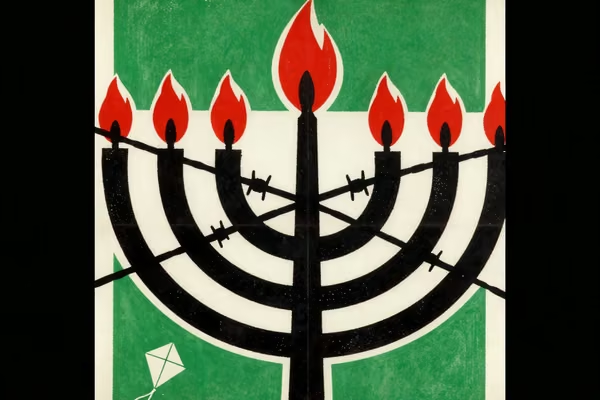
The right-wing commentator Yinon Magal celebrated that attack by calling it a “Hanukkah gift” from a division of the Israeli military.
מתנה לחנוכה מאוגדה 36
האוניברסיטה שהוקמה על חורבות נצרים
ז"ל pic.twitter.com/8kmSHGkto1— ינון מגל (@YinonMagal) December 7, 2023
The fact that the building was not struck by warplanes but rather by soldiers planting bombs there in person, suggests that there was no “risk” to their lives and that they were not targeting Palestinian resistance inside the building.
One picture depicts an Israeli soldier posing next to the medical faculty building with a giant menorah outside as a sign of conquest.
The placard with the name of the building and the donor who helped build it is vandalized with the words “ours now” in English.







Comments are now closed.