
Opposing An Ideological Maelstrom: non-violent political activism?
JVL Introduction
Miriam (Miki) David is a leading member of JVL’s Education Group and a long term activist with Women In Black. Here she outlines a little of the history and the current weekly vigils held in support of the people of Gaza and to show their opposition to Israel’s bombardment and oppression of the Palestinians people.
Although their focus is on all people in Gaza, as feminists, there is a particular interest in women’s experience.
LL
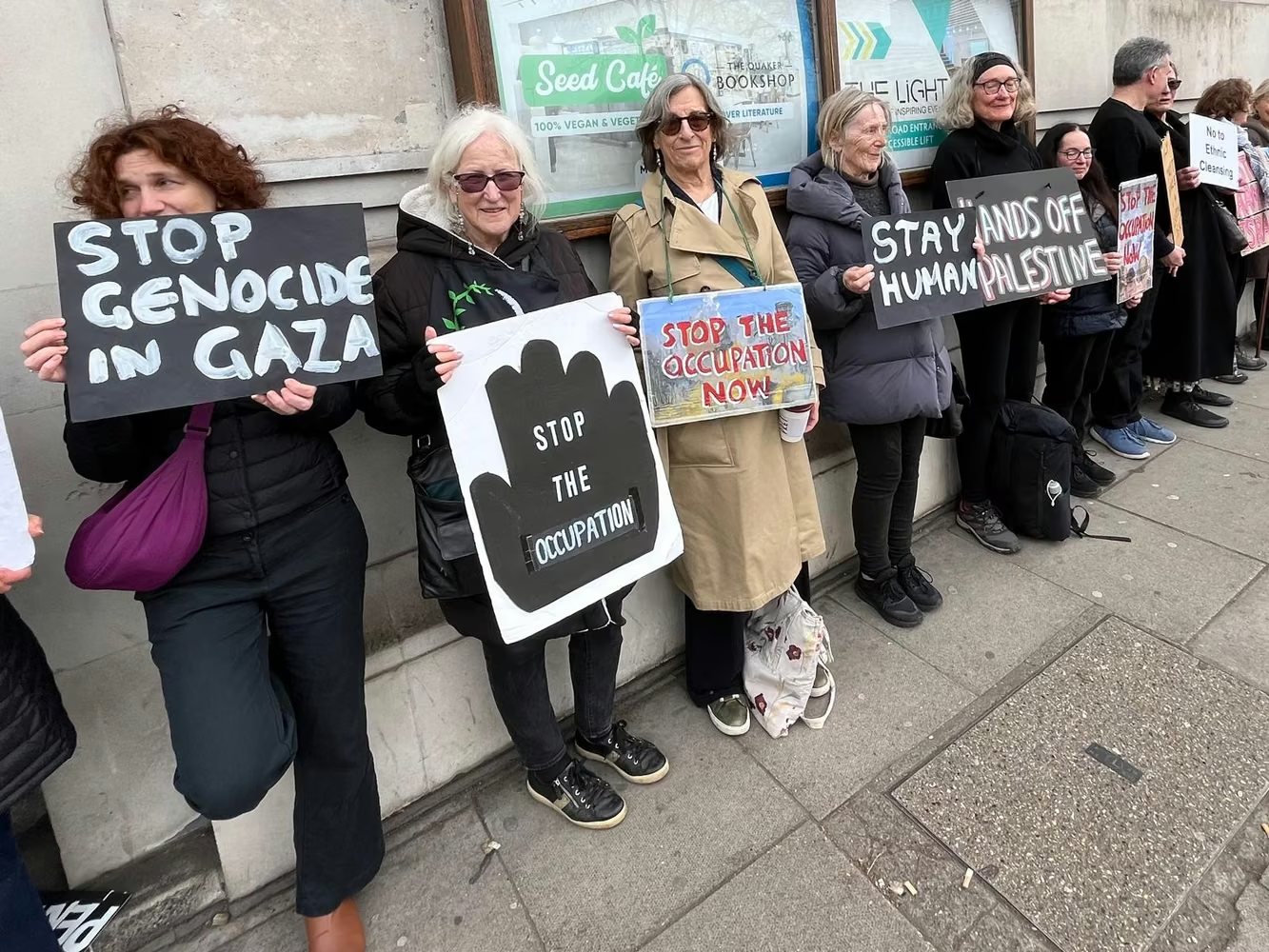
Women in Black(WiB) is an international, loosely bound, feminist collective of women who are committed to campaigning for peace, rather than war, against militarism and violence, and for social, racial or ethnic justice and equality. Many of the mainly women, who gather together in weekly vigils, have been involved in a range of women’s liberation activities, for a very long time – over 50 years. WiB has been campaigning with renewed vigour in particular, against the war in Gaza, and wider Palestine, in the aftermath of the horrifying attacks by Hamas on Israel on 7 October 2023 when many women and children were murdered and taken hostage. The ongoing brutal and violent response by the Israeli government through the IDF on women and children especially has emboldened us as campaigners and activists. Its escalation from the temporary ceasefire from 18 March 2025 has also angered us further.
The weekly vigils, with banners and placards in black and white stating variously ‘Peace not war’; ‘End the Occupation’, ‘Ceasefire Now’, ‘Stop Starving Gaza’; ‘Rebuild Gaza’, where participants are indeed dressed in black are the key form of activism! The original banners took the form of a Hamza. This is both an Arabic and Jewish mystical symbol to ward off ‘the evil eye’. It is hand shaped with 5 similar length digits, like a stop sign. It is also known as the hand of Fatima or the hand of Miriam. So, the original placards were black, with white writing and held on a stick. The black and white symbolism may also have drawn on the Black Sash movement in South Africa campaigning against apartheid. The Hamza is often made into delicate silver jewellery and on seeing the hamza signs I recalled I had a pair of earrings in that shape. I wear them now every Saturday.

In London, the main vigil is held outside the Quaker Meeting House on Euston Road, London NW1 from 12 noon to 1 pm every Saturday when about 40-50 women gather. There are lots of other activities and events not only across London, such as the one near Trafalgar Square near the Edith Cavell statue on a Wednesday evening but also there are now vigils and other actions across the UK, as well as in Australia, Europe, Israel, the USA and the other Americas.
The informal rule is that it should be a silent vigil. This is incredibly hard to achieve when women, including Jewish, Israeli and Palestinian, gather together to demonstrate, as we know from the regular demonstrations that we all attend and campaign for peace and justice for Palestine, especially women and children.
WiB has its origins in the women’s movement, over 35 years ago. Judith Suissa, daughter of one of the originators of the WiB group in Jerusalem, has written a lovely, moving piece about her mother – Ruth Cohen – for the HOWL (History of Women’s Liberation) website (howl-uk.org). She wrote her essay in July 2024, so 8 months ago:
The idea for Women in Black emerged in Jerusalem in 1988, in the shadow of the First Intifada. What had started with stone-throwing in the Occupied Territories had escalated and spread and, as usual in the lives of Israelis and Palestinians, fear mingled with anger, despair and hope. A number of grass roots Leftist movements were already on the scene, ranging from non-Zionist groups like Shasi to Zionist groups like Peace Now, focusing on opposition to the post-1967 occupation, the violations of Palestinians’ human rights, and the dangers posed by the illegal Israeli settlements in the West Bank and the messianic ideology behind them.
While there was disagreement amongst the different movements on what form a future political settlement should take, they shared some core commitments. At demonstrations, the slogan “Israel, Palestine: Two states for two nations” (it scans and rhymes in Hebrew) was often chanted.
Women had played a central role in all these movements but, unsurprisingly for those coming from a feminist tradition, they were often relegated to the margins. The ideological in-fighting within left wing politics is the stuff of parody, and in the face of the ongoing violence and the frustration at the failure of political leaders to address the root causes of the conflict, a group of women decided to step outside this ideological maelstrom and to translate their anger into a simple and visually powerful form of non-violent political activism. (my emphasis)
Women in Black was organized around the commitment to holding a regular, silent vigil, in a visible public space, with a clear message. A group of women, dressed all in black, stood on a low wall in Paris Square in central Jerusalem, for an hour every Friday, holding hand-shaped placards – echoing both the familiar graphic of the Stop sign and the shape of the traditional Jewish and Muslim hamsa – on which was printed, in white against a black background, “End the Occupation.” Some women in the original group were advocates of a secular binational state; others believed in the two-state solution; others were simply concerned about human rights violations. Wary of the risks of ideological factionalism and keen to appeal to as wide as possible a demographic, the group agreed early on that other slogans would not be allowed at the weekly vigils.
My mother, Ruth Cohen (nee Kretzmer), was one of the founding members. Our family had moved to Israel from London in 1981. With roots in anti-Apartheid activism (she grew up in South Africa) and second wave feminism, it seems only natural that Ruth should gravitate towards what was then known as the Israeli Peace Movement.
Although her political views soon crystalised into a position that was more radical than the Zionist Peace Now, she, like my father, Stan Cohen, was not an ideological purist and continued to participate in a range of anti-occupation, anti-settlement, and human rights-oriented activism. In Women in Black, however, it felt like she had found her political home…
When, in the aftermath of the horrific Hamas attacks of 7th October, I was consumed by fear, grief and anxiety for friends and family in Israel, like many, my emotional response was also mixed with horror and anger at the inevitable further violence about to be unleashed on Palestinians in Gaza…
As political movements began to organize around familiar fault lines, I felt the need to do something both more simple and more nuanced than shouting angry slogans. Through a friend, I became aware of an Israeli woman living in London, Miri Weingarten, who had initiated a silent Women in Black vigil in the tradition of non-violent feminist opposition to injustice, war, militarism and other forms of violence. We gathered on a cold Saturday by the bust of Nelson Mandela outside the Festival Hall.
Women in Black vigil in London, February 2024
As Judith continued:
Eight months on from that first vigil in London, WiB are still standing every Saturday, now outside Friends House on Euston Road. Unlike at the original vigils in Jerusalem, the signs are varied, including “Mourn the Dead; Save the Living”, “War crimes do not justify war crimes”, “Free the Hostages”, and “Cease-Fire Now!”. But like the movement of which they are a part, the vigil embodies the values that led to the formation of Women in Black in Jerusalem over thirty years ago.
WIB still hold weekly vigils there [in Jerusalem], as they do in numerous locations around the world. Their presence is a reminder of the importance of taking a stand, and of the feminist message that women, together in a public space, can be a powerful source of solidarity, protest and hope in a brutal world.’ (Judith Suissa July 2024)
Another 8 months on from when Judith wrote her tribute to her mother and the founding of WiB, we are still standing outside the Friends’ Meeting House on Euston Road, London. We still hold the black and white placards, with the Jewish and Muslim Hamza sign and campaign for peace and justice. We also have more varied placards, including ones arguing for ‘rebuilding Gaza’; human rights, a ceasefire and return of the hostages and an end to genocide.
This powerful source of solidarity, protest and hope in the increasingly brutal world was shown again last Saturday 22 March 2025, in the wake of the breaking of the ceasefire by Israel earlier in the week. This was just two weeks after we had combined our campaigning with joining forces with feminists on International Women’s Day (IWD) and the Million Women Rise march. Some of us regularly join the marches organised by the Jewish Bloc and the Palestine Solidarity Committee, when our vigil is over. It is unfortunate that the beginning of the march often coincides with the start of our weekly vigil. But we manage to join forces later.
We had been heckled by a group of French Jews, earlier in March. This was the first time we had faced such abuse and anger, with one of the men being quite violent. Not only did he push his girlfriend out of the way but as it was windy he stamped on one of the black posters that had fallen to the ground. Whilst some of us felt that we needed to respond to the abusive comments, the majority of us feel the powerful solidarity of standing in silence with our placards and slogans and the handing out of leaflets that explain our actions in being there. Nowadays, many car drivers and bus drivers pass us and toot or honk in appreciation. Passers-by take our leaflets with interest. We have fewer rejections than acceptances. We feel that the public around Euston Road is beginning to move in our direction despite the altercation in this depressingly difficult personal and political moment.
Miriam E David, 23 March 2025 (with thanks to Judith Suissa).
Thank you Judith and Miriam. I have fond memories of Ruth Cohen in the late 1960s. So heartening to hear of this movement in an increasingly bleak world.
Julia
Last week we spoke to women taking part in this weekly vigil in Leeds.
May they long continue!
The Women in Black Vigil in Leeds happens every Tuesday from 12:30 -1:30 in Dortmund Sq on the Headrow. Is been going for 5 years now (though originally started as monthly event)
Such steadfastness!
Forgive me for raising an awkward question about these brave women but how does a person like Ruth Cohen, “who had moved to Israel from London in 1981. With roots in anti-Apartheid activism (she grew up in South Africa) and second wave feminism” , make the choice to move to Israel? I just do not understand.