
Magic, rational or critical: embedding inequality or challenging inequality
Understanding and responding to a world where Trumps emerge
Current political developments pose a challenge to the usual ways of framing attempts to analyse them. How can we understand movements in constant flux and leaders who defy categorisation in terms commonly employed by academics and commentators of all ideological stripes?
Mike Cushman proposes a fresh approach by dividing them into three: magical, rational and critical.
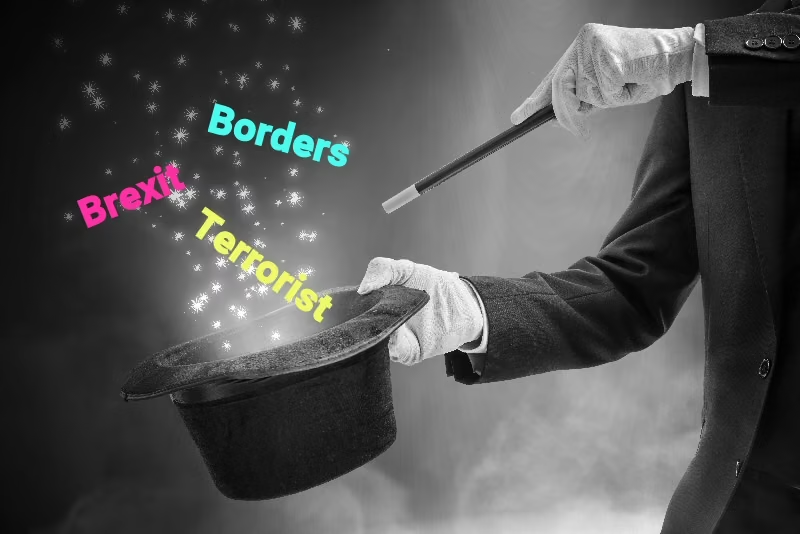
The magical, those of Trump, Farage, Netanyahu and others, try to cast spells, uttering incantations like Brexit, Borders or Terrorist and suggest these will bring about desired results without any mechanism linking spell and outcome.
Realist approaches share the aim of striving to maintain the dominance of corporate capitalism, but try to articulate discernible, if faulty, connections between action and outcome. Think Starmer and Biden.
Critical approaches seek an equitable and sustainable world order, understanding that inequality is the pressing problem we must address and that Reeves-like approaches that substitute growth for fairness are bound to fail.
The urgency to act cannot be overstated as AI brings us further wealth concentration on an unprecedented scale accompanied by the consumption of world-destroying quantities of energy in the process.
RK/NWI
It is challenging to make sense of the complex and chaotic political environment in many, if not most, countries. Simplistic pieties about prioritising the class struggle and strengthening working class opposition are insufficient and are demobilising irrelevancies to the way so many people are experiencing their lives.
I want to suggest a broad lumping of approaches to the current crisis resulting from corporate capitalist domination and financial instability into three types. I use the word lumping to underline that I am grouping some very different ideas together in order to try and disclose some often-hidden phenomena.
The lumps are magical, rational and critical.
The first two are linked by a common desire to maintain corporate capitalist dominance, the third lump challenges it.
First, magical.
Many of these ideas are commonly termed populist which is a highly unsatisfactory term. This is not only because it traduces the history of radical American populist upsurges of the late 19th, early 20th centuries led by William Jennings Bryan which channelled a truly popular opposition to the emerging capitalist behemoths but largely based on farming rather than industrial workers. Even more because it tries to subsume Mélenchon and Le Pen, Corbyn and Farage under one descriptor.
I propose the term magical for two reasons. The proponents often correctly identify the problems: low wages; insecure employment; inadequate housing; etc. But it seeks to address these by the casting of spells, using magical words like ‘Brexit’ or ‘borders’ or ‘Jews’ or ‘Muslims’ or ‘Rwanda’ with no mechanism for linking these spells to the desired outcomes: the mantras of ‘alternative facts’ and conspiracies. This is not accidental, for all their rhetoric of opposition they are funded and enabled by the financial elites they claim to oppose.
Magic requires magicians who use skilful deceit to cast their spells. The patriarchal orchestration of the magician’s act with the diminished female assistant is reflected in the appeal to masculinity and strength of the magician politician.
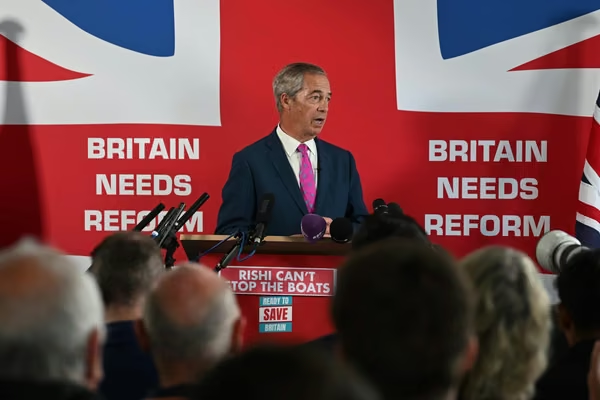
The magicians of this lump are those like Trump, Netanyahu, Farage, Orban and Modi. Though they share some strong similarities with authoritarians like Putin or Sisi, they arise in formerly functioning liberal democratic regimes. While some may develop into Putin-like characters, they pay their necessary dues to democratic formalisms even while they weaken them. The cause for some limited optimism is that the formalisms are not always desiccated into morbidity and some magical regimes suffer electoral setbacks as we have seen in Poland and India.
Next rational
This group are the traditional upholders of corporate capitalism and are bitterly opposed to the magical upstarts. Their measures to ensure capitalist dominance are rooted in a comprehensible set of propositions with actions linked to plausible outcomes by recognisable mechanisms. They are committed to economic and social structures that are inherently and purposefully unequal and cannot make challenging inequality a central ambition. This is the world of Sunak and Starmer, of Biden/Harris and Macron.
All politicians resort to magical invocation at times but for the Rational ones this is not a dominant motif. The Tory Party at the moment is torn between its rational and its magical wings.
The Labour Party suffers from a grey rationality and substitutes growth for ending gross inequality as its ambition. A project that is doomed to political failure as the fruits of growth are captured by a very few and the mass of the population sees no improvement or even further immiseration. The failure of the Biden administration to ensure that the real growth in US output they campaigned on translated into rising wages and improved public services was a large part of ensuring Trump’s victory.
The commonality of aims and separation of mode of action is dramatically illustrated in Netanyahu’s sacking of Gallant. Both are war criminals but Netanyahu is the epitome of magical thinking where performative prescription is sufficient to ensure fulfilment while Gallant tries to link action to outcome.
Finally, but also firstly, Critical
This lump embraces those who see corporate capitalism as the problem to be radically reformed if not replaced, rather than provided with Elastoplast and assistive devices. The roots of these critiques are varied and often competing. They may be socialist, in all its variants, environmental or ethical/religious.
This is the camp of JVL. We hold to what are often called liberal values but are more properly seen as solidarity values but they are values that are far easier to hold from an existence of security. However, personal feelings of security are fatally undermined by poverty, precarity, violence, harassment and discrimination.
We have to be clear eyed about why the rational lump maintains its hegemony over many societies and the only effective challenges to it only come from the magicians.
We have not created any narrative that contests the increasing individuation of global north societies; the deeply embedded belief that the products of technological change are all to be individually owned, even though this leads to sub-optimal and environmentally disastrous outcomes, rather than collectively shared. In Britain the clearest example of this is the social catastrophe of Thatcher’s Right to Buy council housing. The sum of the individual gains by purchasers is overwhelmed by the collective loss.
Successful resistance has largely been based in the trade union movement. The union movement was based in mass manual industries with places of work in common. It is obvious that Uber is very different from Ford, an iron works from a call centre. Places of employment were characteristically linked to places of residence. All of these gave rise to fundamental, sense of collective identity and solidarity. This internal solidarity provided fertile soil for wider solidarity both nationally and internationally. Forgoing individual autonomy for wider gain was an easy choice. This translated into support for a workers’ political party. Unions provided that sense of security which is necessary for the concern for others.
We thus have the paradox that the parties, like Labour or the Democrats, that espouse the solidarity values that most benefit the least well-off increasingly draw their support from moderately well-off professionals and those that would most benefit from them flock to the magicians. This is tellingly exhibited in the realm of human rights which are perceived as for the ‘other’ and not for us. Or in the field of environmental protection where the need for short-term individual survival is counterposed to the essential need for long term planetary existence in a form that allows humanity to continue.
The changing nature of the workplace coupled with the individualisation of society enable the development of service unions, elevating the benefits to the individual whether legal assistance or favourable prices for insurance over self-organisation. This has progressed faster in the USA than in Britain and resulted in even a strong industrial union like the UAW deserting the Democrats in this cycle. The organic links between British unions and the Labour Party are far stronger but they are not unbreakable. Several unions have deserted Labour for left-wing reasons; for cultural reasons it is difficult to envisage a union switching to the Tories but a move to Reform is not unimaginable. Reform often emits workerist demands and often evokes some aspects of traditional Labour demands more forcefully than Starmer. However, their demands for, for instance, better NHS services are not coupled with any demand to reduce, let alone end, privatisation and so remain in the realm of magical incantations. Absent from Reform’s prescriptions are demands for a tax system that addresses inequality.
We have not been able to work out how to challenge the magicians’ appeal to warm emotion by use of cold fact-based arguments. Until we can answer that conundrum is found, the magicians will continue to dominate.
The changing worlds of work and technologies
The material base for much of this is technology. Each round of technological innovation under capitalism allows concentration of the value created in the hands of increasingly fewer owners of the technology. This was the case with mill owners of the 18th and 19th century, the American railroad and steel robber barons of the late 19th century, the motor manufacturers and chemical tycoons of the 20th. Classic Fordist capitalism allowed the concentration of wealth through the application of mechanical technologies. This was effective right from the start of the 20th century through to the 1970s.
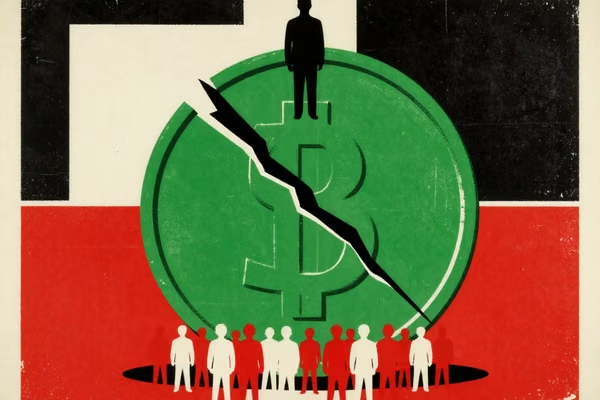
The development of electronic technologies has changed the nature of this concentration. Mechanical technologies as a form of accumulation get replaced by digital technologies that are infinitely more effective at concentrating the rewards to fewer and fewer people. An exemplary episode in this was the 1986 Big Bang digitalisation of British financial markets. There has been a widening of this capture process ever since. Activities called by the Rational lump ‘wealth creation’ but are more accurately termed ‘wealth transfer and concentration’.
The latest step change is the flourishing of AI. This not only produces new and more intense funnels of concentration but changes the nature of what is concentrated. Ownership of creative output, whether books or legal reasoning has previously been dispersed. AI under capitalism permits the alienation of all this output to those that own the hoovers sucking it all into their vast databanks and reselling it for their profit.
The issues of rights, creative work, privacy and so on, and of falsification of knowledge are not unimportant. But they’re not the most fundamental question, which is who benefits, cui bono: it is always cui bono.
The Rational response to this has been to try and tax the profit and divert a proportion to the public good. Blair/Brown Labour had some limited success in this endeavour. They may have been privatising the social provision and that, of course, is not unproblematic but the contract of wealth centralization in exchange for investment in social provision was real. Whatever this contract delivered was undermined by Cameron/Osborne, who maintained the centralization of wealth but, through austerity, removed the reciprocal benefits. The resulting degradation of our social world haunts us now and it is doubtful whether Starmer/Reeves Labour has any proposals to replicate even New Labour’s partial successes.
The critical response must be to seek democratic control of the technologies, to end the theft of creative output and direct the value created to public purposes.
In as far as these technologies have a physical form they are the vast data centres. These are greedy consumers of power and water producing environmental damage on a massive scale. They also depend on the acquisition of scarce minerals though neo-colonial extractivism, producing misery for the miners and environmental destruction at the sites of extraction. Brutal extractivism is, of course not new. The acceleration of capital accumulation in the global north in the 18th and 19th centuries was based on the extraction of human bodies from Africa.
The combination of digital technologies and extractivism presents us with challenges that we have not even the most rudimentary ideas of how to confront. This task must be addressed urgently or the magicians and their mega-rich backers will displace the critical currents and there will be no recovery before our planet is terminally damaged.
After the dinosaurs, us; after us, what?
As Louis Quinze might have said, ‘après Trump le déluge’.





William Jennings Bryan was not a populist. He was a Democrat endorsed by the Populists.
This is a really valuable analysis. But is it true that we have no idea how to oppose it? There are many ideas swirling around in the “critical” lump amongst green and socialist groups. However successful a Corbyn government would have been in practice when faced with the absolute determination of capitalism, the Corbyn movement did manage to inspire mass support for socialist ideas. In other areas trade unions have organised to secure victory even in the new fragmented industries (Amazon, Uber, etc) so the seeds are there. I admit though that the task seems overwhelming at times.
This is certainly one of the best essays that I have read for years. It shows the only way we can progress out of the dreadful situation we are now in.