
Hagode shel Peysekh (with a Socialist Twist)
JVL Introduction
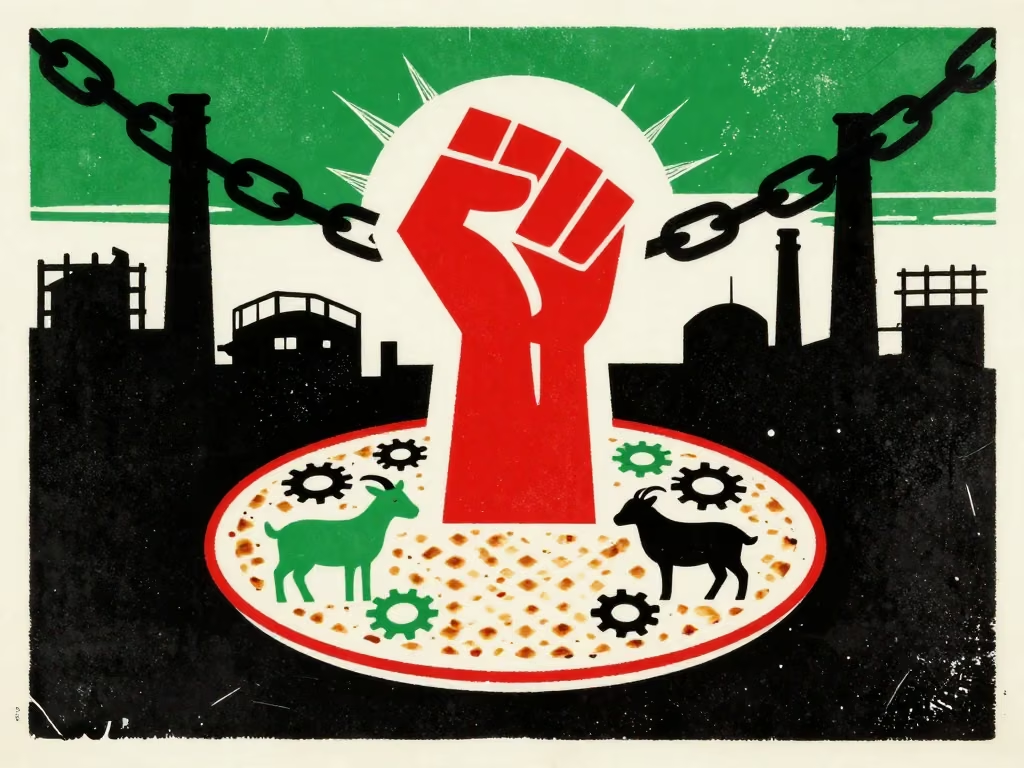
Coronavirus will prevent the Passover Seder being carried out in the traditional manner in large family groups this year, or among groups of friends – a tradition that was long part of the calendar of the Bund, the Jewish secular socialist movement formed in Vilna in 1897. They would produce their own Hagode/Haggadah (recounting of the story of the Jewish liberation from slavery in Egypt). This version, highlighted by Jewish Currents (an American online left wing publication), is from Krakow in 1919. It declares itself a Hagode “mit a sotsialistishen nusekh” – with a socialist twist! It was published by the Jewish Social Democratic party, a party founded by a Marxist revolutionary, historian and economist, Henryk Grossman, that formally affiliated to the Bund in 1920.
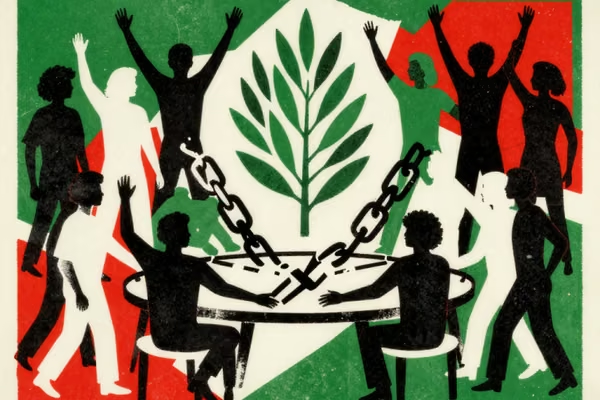
This hagode is closely based on one that Bundist exiles in Geneva published in 1900, which itself updated one written by Jewish socialists in Vilna in 1887. Although the Bund sought to detach its members and supporters from religious concepts, they utilised certain Jewish holidays and traditions, emptying them of religious concepts and replacing them with socialist ideas. The Hagode with a socialist twist relates the Passover story to the early 20th century experience of workers. It promises that liberation will come through their own efforts, not the hand of God!
David Rosenberg
This article was originally published by Jewish Currents on Fri 19 Apr 2019. Read the original here.
Hagode shel Peysekh (with a Socialist Twist)
Loading article text…



I would like to observe a word of caution around the wording that heads this article.
“Coronavirus will prevent the Passover Seder being carried out in the traditional manner in large family groups this year, or among groups of friends …”
The virus itself is innocent of intent or consequence. The conditions we find ourselves living under are a consequence of political decisions; decisions which may turn out to be justified, but which are necessarily made in the light of limited knowledge.
I only say this because human beings, when we make decisions, are inclined to blame nature when those decisions have adverse consequences, and to take credit when they seem to work to our benefit.
I suspect that our lack of humility has a lot to do with the accelerating range of crises that we find ourselves in.