
Bell report is not fair or independent: look at his reference group
Bell entitled his project ‘an independent review’ but independent of what? Independent suggests impartiality, drawing on varied viewpoints and making a critical evaluation of the controversies. Gary Spedding details the homogeneity of Bell’s reference group, almost all linked in one way or another to Israel advocacy organisations.
Such a narrow group avoids grappling with the sensitive issues of balancing the right of some students to express their horror at the genocide in Gaza and the ethnic cleansing of the West Bank with the fears of other students that their identity is under question. Threats to Jewish students or assumptions about their views are of course unacceptable; questioning expressions of support for Israel by students, Jewish or not, is part of debate and learning.
Spedding notes that the review recommends the application of the IHRA working definition of antisemtism. A wider reference group would have insisted on a robust discussion of the nature of the definition and the intense controversy about its utility and effects instead of an uncritical endorsement. This is just one of many examples of bias in the report.

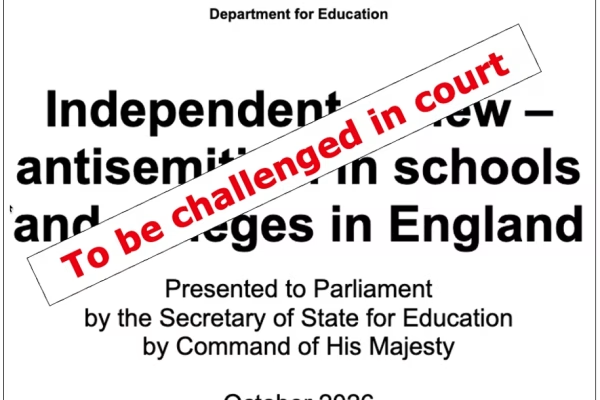
Secretary of State for Education, @LucyMPowell enthusiastically presented the Sir David Bell review into antisemitism in schools and colleges. This review is billed as the ‘Independent review into antisemitism in schools and colleges’.
I’ve spoken to a number of individuals and organisations that submitted evidence to the Bell Review when the call for views from people with relevant lived experience, knowledge or expertise of antisemitism in schools and colleges went out earlier this year.
A number of them have gotten back to me to relay their horror and dismay that the review seems overly focussed on issues such as the presence of Palestine solidarity badges and other imagery in schools rather than the multitude of clear examples where Jewish students have been targeted with antisemitic abuse, discrimination and hatred.
It appears that the review is coming down hard on expressions of Palestine solidarity while being rather light on pupils who do Hitler salutes or make jokes about Jews and money.
Having done a little research I do also have some serious concerns as to the impartiality of this review and also the recommendation that schools adopt the IHRA definition of antisemitism despite it not being possible to make this compulsory, nor is it legally actionable.
If we care about tackling antisemitism in society, ensuring we get to it where it manifests in our schools and among young people, then we need to put a stop to the weaponisation of antisemitism and its use for political football where Israel-Palestine is concerned.
This review is fundamentally biased, ideological, and linked to efforts to tie Jewish identity with support for Israel while suppressing pro-Palestine expression as ‘antisemitic’ and intimidating for Jews.
The reality of course is that young Jews in the UK are way more intimidated and frightened by their classmates doing Hitler salutes, making jokes about the Holocaust, doing gas sounds towards them because they’re Jewish, being physically assaulted for being Jewish, being bullied and isolated for being Jewish, being sexually assaulted (reports of kids demanding to see the circumcised penis of a Jewish school child in year 8), and all the other antisemitic shit that is happening in our schools.
I’m also reminded of what we learned from the documentary film @IsraelismFilm about the efforts to indoctrinate young Jews into seeing Israel as integral to their identity as Jews, that when Israel is criticised they are being personally attacked as Jews, and that they can only see themselves as Jewish if they support and love Israel.
Anyway, below are some very serious issues relating to Sir David Bell, his lack of impartiality, and the failure to declare vested interests of himself and a number of those on the reference group:
- David Bell‘s role as a permanent secretary at the department of education was not disclosed as a conflict of interest.
- David Bell is named on the national council of the ‘National Study Group’, an educational charity, that in its mission statement says that its goal is to “initiate or expand active links and research collaboration between academics, specialists and centres-of-excellence in the UK and their counterparts in Israel.” The ASG is “primarily a UK-Israel operation” and rather worryingly the “only issue on which ASG has firm policy is opposition to BDS. The Charity is totally committed to the universality of knowledge and rejects any disruption to cross-national co-operation.”
- The ASG, of which Sir David Bell is named as a member of national council, provides educational talks about Israel to schools.
- Executive director of the ASG, John D.A. Levy, is on the advisory board of Academic Friends of Israel and a separate charity, the friends of Israel educational foundation.
- The Friends of Israel Educational Foundation carries out hundreds of school talks in the UK.
- Karen Newman is a member of Sir David Bell’s reference group for the so-called independent review. Newman is a vice-president of the Board of Deputies of British Jews, an organisation that carries out Israel advocacy at multiple levels and is constitutionally obligated to take action to advance Israel’s ‘security, welfare, and standing’.
- Karen Newman has previously given evidence to committees of Parliament where she has suggested the mere sight of a Palestinian flag or badge is a threat to Jews.
- Another member of the reference group is Anna Joseph, deputy head teacher at JFS, a Jewish secondary school in London, a school that literally states in its vision and values: “To be proud and knowledgeable about Jewish culture, history, identity, and community, with a love of the State of Israel and learning Hebrew as part of Jewish heritage.”
- JFS London runs residential programs for students in Israel aimed at fostering and promoting the ideals of Zionist modern orthodoxy and also runs a program called JLife, which included a component called the ‘ABC’s of Israel advocacy’ for students heading to university. There was also found to have been a year 13 discussion at one point that emphasised comparison between boycott of Israeli goods with the Nazi boycott of Jewish shops.
- Another member of the reference group for this review is Rabbi David Meyer OBE, who has in a recent trip to Israel met with Prime Minister Netanyahu, wanted for war crimes.
- Rabbi David Meyer is director of Partnerships for Jewish Schools (PaJeS), an organisation that develops educational programs for Jewish Schools. This organisation, in its 2024 J Tracks presentation, set out a number of its objectives which included encouraging Jewish students to become “positive advocates for Israel in the world” and that they should be “emotionally connected to Israel” and that there is a fundamental connection between Israel [the state] and Jewish identity.
- PaJes produced a ‘war in Israel’ set of resources for schools containing a link to a document created by i-gnite, a UK educational and Zionist initiative, entitled ‘Talking points: suggested responses to frequently asked questions about Israel’.
- Another resource that PaJes links to a video from Unpacked, whos parent organisation, OpenDor Media, explicitly states that its mission is to increase Jewish diaspora support for Israel and Zionism. In the video linked to by PaJes the question asked is ‘Has Israel committee war crimes?’. See the video for yourself here.
- PaJes is also partnered with United, an initiative led by Israel’s Ministry for Diaspora Affairs and Combatting antisemitism. The Israeli government describes United as aimed at identifying and strengthening students commitment to the state of Israel.
- Dr Helen Miller, another member of Bell’s reference group, has worked previously at UJIA (United Jewish Israel Appeal), an organisation with a stated mission of inspiring young Jews to forge their own personal relationship with Israel.
Presently, there are only 3 people on the reference group for this so-called independent review that appear to not have any links with Israel advocacy.
Considering all of the above it is my view that Sir David Bell has multiple conflicts of interest as do multiple people on his reference advisory group. None of this has been formally declared in the report or at any point by the department of education.
Bell should have recused himself from carrying out this review.
See also



No comments on this post so far.