
Anti-semitism is on the rise here and abroad. But the BBC’s anti-Labour agenda distracts us from the real threat
Published
by
Richard Kuper
JVL Introduction
David Rosenberg argues that all forms of racism including antisemitism are spreading in our society, particularly since 2010 under various Tory governments. The media aren’t interested in that story.
While accusations of antisemitism against the left are generally quite unfair, we must ensure no vestiges of it appear in our own political arguments.
This article was originally published by Morning Star on Fri 12 Jul 2019. Read the original here.
Anti-semitism is on the rise here and abroad. But the BBC's anti-Labour agenda distracts us from the real threat
Loading article text…




A consistent and much-voiced theme in the right wing press such as in comments and some articles on the Times site is that Labour has ‘done the maths’ and is courting the antisemitic Muslim vote. Muslims are deemed to be culturally antisemitic and the Peterborough by-election of course revved up this belief.
While British Muslims have been surveyed as expressing a higher level of antisemitic tropes than the general population, I don’t think anyone has cross-referenced this with membership of or support for Labour and the left.
Personally, the only possible trope I’ve heard from a Muslim is that Jews are clever – but in the same way that other groups such as those from the Far East are clever, in educating their children in Saturday schools etc. No doubt there are some on the extreme religious end with much worse views, but they are not likely to be Labour supporters.
It’s over a quarter of a century since John Major, in a law and order panic at the time, said, ‘Society needs to condemn a little more and understand a little less.’ The notion never appealed to me and still doesn’t. I sometimes think there’s a leftwing version of the sentiment when it comes to racism, and before I make myself vulnerable to misunderstanding let me hurriedly affirm that the manifestations of racism are wicked, destructive and abhorrent. But why is racism in its many forms so persistent, why do humans resort to it especially in times of social upheaval and economic stress?
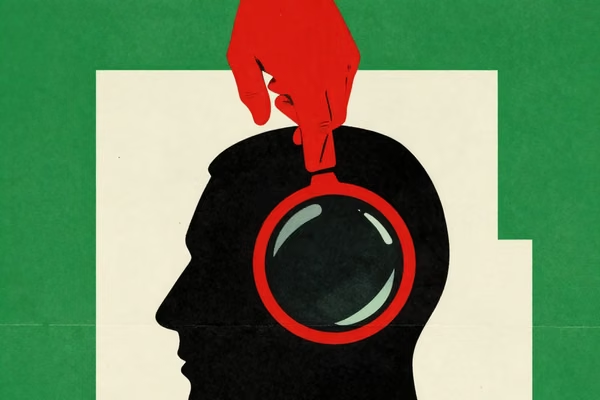
Condemning by itself is not constructive, indeed it’s counterproductive. We need both to condemn and to understand as far as we can. I used to think, but because all the evidence from contemporary anthropological studies points the other way I no longer do, that racism developed through natural selection according to evolutionary processes. A far more useful approach, and one for which there’s now considerable evidence, is to think of racism as a psychological defence mechanism that helps people deal with feelings of anxiety and insecurity.
The work of the social psychologists Sheldon Solomon, Jeff Greenberg and Tom Pyszczynski over the last more than 30 years (and reported very accessibly in their popular book, ‘The Worm at the Core’) has recorded substantial experimental evidence for what they have called Terror Management Theory (TMT). The title of the book was suggested by what the psychologist William James wrote in his 1902 book, ‘The Varieties of Religious Experience’: ‘Back of everything is the great spectre of universal death … the worm at the core of all our usual springs of delight …’
There’s a good brief account of the relevance of TMT to racism and xenophobia in ‘Psychology Today’ here https://tinyurl.com/y67pfwkg
‘Research has shown that when people are given reminders of their own mortality, they feel a sense of anxiety and insecurity, which they respond to by becoming more prone to status-seeking, materialism, greed, prejudice, and aggression. They are more likely to conform to culturally accepted attitudes and to identify with their national or ethnic groups. According to Terror Management Theory, the motivation of these behaviors is to enhance one’s sense of significance or value in the face of death, or to gain a sense of security or belonging, as a way of protecting oneself against the threat of mortality. In [the author’s] view, racism is a similar response to a more general sense of insignificance, unease, or inadequacy. …’
The author identifies ‘five different aspects of racism as psychological defense mechanisms.’ The last one he depicts is ‘the most dangerous and destructive extreme of racism — people may project their own psychological flaws and … personal failings onto another group, as a strategy of avoiding responsibility and blame. Other groups become scapegoats … Individuals with strong narcissistic and paranoid personality traits are especially prone to this strategy, since they are unable to admit to any personal faults, and are especially likely to demonize others.’ (And who does that remind you of? And not just on one side of the Atlantic.)
The author, a senior lecturer in psychology at Leeds Beckett University, concludes that racism and xenophobia are symptoms of psychological ill-health: ‘Psychologically healthy people with a stable sense of self and strong inner security are not racist, because they have no need to strengthen their sense of self through group identity.’ Such healthy people can avoid defining themselves in conflict with others.
Is it possible to maintain, let’s say through robust religious identification, a sense of living a life of significance in a universe of meaning, in such a way as not to feel threatened when encountering a different group with a polar opposite take on the way the world works, a view which, should it prove true, must negate the alternative, ultimately threatening the security if not the very existence of those who hold it? (Wars of religion in Europe for two or three centuries …) First we may try to ridicule and belittle them, then when that doesn’t work we may try to convert them, and finally if that doesn’t work, why, then we have to kill them: so went (goes?) the argument.
And then, human brains being the belief engines they are, there are passionately held political views, such as Zionism and anti-Zionism. Zionism: the tragedy of a political philosophy first imagined as an appropriate response to murderous racism only to reveal, much later, its own murderously racist essence. But say that to someone who gets their Jewish identity through a deep commitment to Zionism, and you destroy what the psychiatrist Dr Robert Jay Lifton has called, with a nod to what later became TMT, a symbolic immortality project: in effect, they feel as if you’ve not only killed them or something profound within them, you’ve additionally annihilated their soul. Not surprising that they react with such uncontrolled vehemence, often to the mildest of criticisms of the Zionist enterprise, or of Israeli policies.
The answer, as others have long been saying, is education, and I would add the kind of education that helps people to gain insight into their motivations and cognitive processes. We need popular television programmes led by good communicators who can talk simply and with lightness. And if possible, with humour.
But the heightened problem we face now is the seemingly almost inevitable prospect of a no-deal Brexit with dire economic consequences, delivered by a government doing its best to mobilise all forms of racism latent in a population threatened with massive job loss, financial insecurity and indeed something approaching semi-starvation. An ideal situation for a wicked government led by an unscrupulous prime minister to set group against group through the time-honoured device of divide-and-rule.