
A proud history – a century of the Bakers’ Union
Last week the Bakers Food and Allied Workers Union, BFAWU, (Bakers’ Union for short), held its 107th Annual Conference in Staffordshire. JVL’s Media Officer, Naomi Wimborne-Idrissi, enjoyed the privilege of speaking to delegates, recalling the union’s long and proud history and its principled stance on issues vital to today’s socialists, including solidarity with Palestine.
Its forerunner, the Amalgamated Union of Operative Bakers, was one of those in at the founding of the Labour Party at the start of the 20th century. But in 2021, BFAWU disaffiliated from Labour in protest at the direction its policies were going under the leadership of Keir Starmer. In September of that year, the union’s National President Ian Hodson fell foul of the Starmer regime’s campaign to oust supporters of previous party leader Jeremy Corbyn and “root out antisemitism”. Ian was expelled and became a leading voice advocating for a new grassroots movement on the left.
In the interview below Ian talks about the history of collective organisation in the baking trade, including the fascinating story of the role of Jewish campaigners within it.
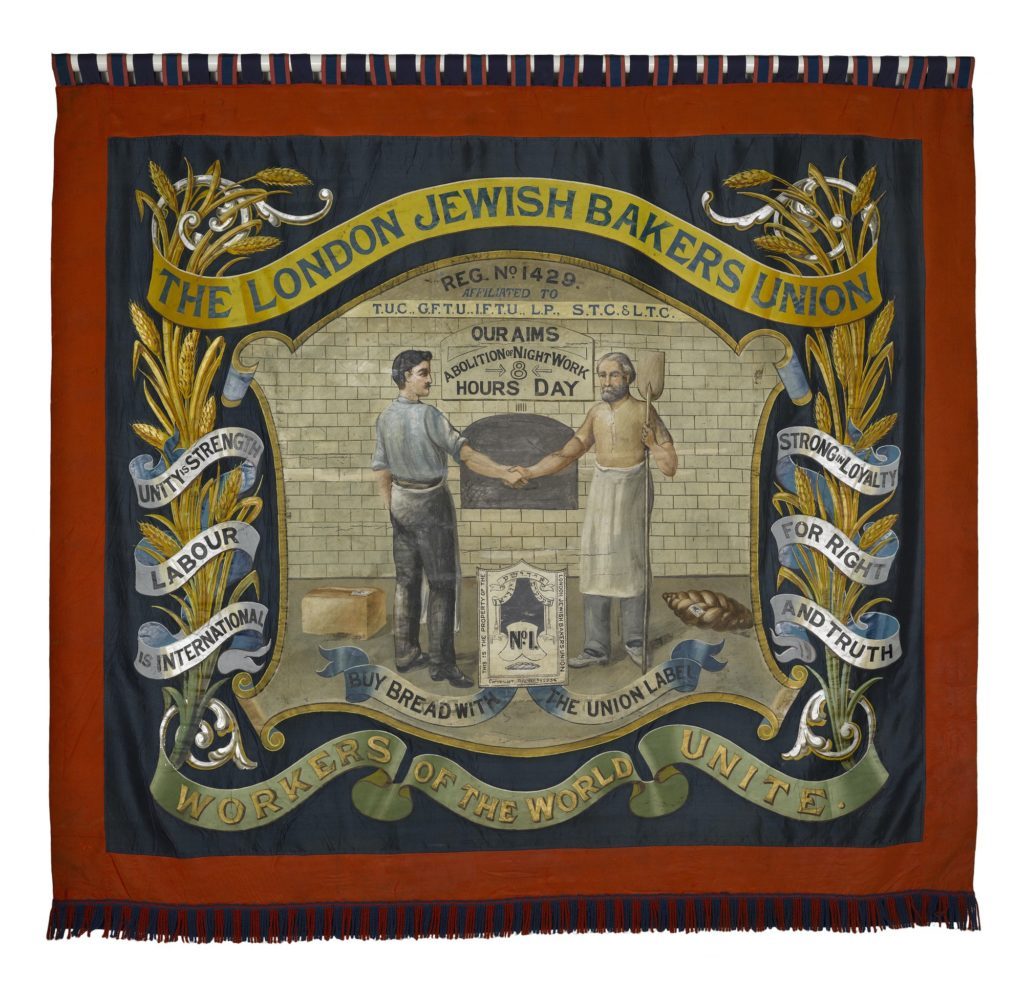
The banner above carried text in English on the front and Yiddish on the reverse, because that was the language understood by most Jewish immigrants when the London Jewish Baker’s Union was formed in 1905. It was the longest-lived Jewish trade union outside Israel, continuing until 1970.
Note: This interview was originally drafted in October 2023 but remained unpublished as our political world imploded. Apologies to Ian for the delay!
Bakers’ Union president Ian Hodson is a mine of information about the history of his small (about 17,000 members) but very significant labour movement organisation.
Before the introduction of Bakehouse Regulations in the 1860s, bakery workers had atrociously low life-expectancy due to their appalling conditions, working long hours for poor pay, using dangerous ingredients including arsenic, often in cellars where they were expected to snatch two hours’ sleep in the course of a 27-hour shift. Many suffered breathing problems and crippling injuries.
Ian explains how disaffection among journeymen bakers gradually coalesced into a movement: “As journeymen, they travelled around, spreading the word about their conditions through the grapevine. Organisers would address workers labouring in basements through grills in the pavements above. In Ireland they were organising as far back as the 1700s. Indentured apprentices had to follow strict rules including no sex or alcohol! What a difference collective organisation makes – average life expectancy then was 32 years, now it’s 69.”
The history of BFAWU dates back to the 1840s with the formation of the Manchester Friendly Association of Operative Bakers. It expanded under the leadership of Thomas Hodson (no relation!) from 1854, to represent bakers in Salford and then a wider area of England. Membership remained below 200 until 1861 when it became the Amalgamated Bakers and Confectionery Workers of England, bringing together unions in Bristol, Cheltenham, Hanley, Liverpool, London, Newcastle, Warrington and Wigan, as well as Manchester. The new union gained prominence when its campaign for improvements in working conditions led to the Bakehouse Regulations Act 1863.
By 1891 the union had 4,000 members, nearly half of them in London where it had set up its HQ. Welsh and Scottish unions also joined. The first UK conference took place in Leicester in 1892. In 1902 there was a big debate which resulted in the union deciding it was time to break with the Liberal Party in order to create a political voice of labour. Members were levied to support on-the-ground organisers building the newly formed Labour Party. The bakers’ union was one of its very first affiliates – an affiliation that ended at BFAWU’s national conference in September 2021. Ian explained, “The decision was based on Labour’s failure to support workers during COVID, not challenging the government, agreeing with everything it said, and then refusing to back the call for a £15 an hour minimum wage.” Within a few weeks of the union’s disaffiliation, Ian was expelled from the party.
“You are men not slaves”
An important figure in the union’s history was Johanna Lahr, a German immigrant married to a journeyman baker in London. She was involved in the Socialists League in which Eleanor Marx was prominent, and corresponded with Friedrich Engels, although Lahr’s own politics developed more in an anarchist direction.
She was active in London in the late 1880s and ‘90s, working to organise bakers as well as dockers, tailors and blacksmiths. Thanks to recent research and documents from the 1880s and 90s provided by members of Lahr’s family, Ian has a fund of knowledge about the early mobilisation among Jewish bakers. “They were getting paid less than everyone else and collaborated with the Amalgamated Union on campaigns for better pay and conditions,” Ian said.
Lahr is on record making rousing speeches, printing and circulating leaflets, helping to form the Jewish Bakers’ Union in London’s East End. Among other bold actions, they surrounded bakeries where employers refused to recognised the union. Ian comments approvingly on their success in having the words “Union Bread” stamped on loaves baked in organised workplaces.
Lahr spoke at a meeting of the Amalgamated Union in October 1889, urging them to be “men not slaves” and calling on them to boycott strike-breakers. In a two-page leaflet titled “The Poorest of the Wage-Slaves” (reproduced below), she praised striking bakers in 1890 for learning “the lessons taught by the skilled and unskilled Labour Strike of the dockers, and the sweated tailors in the East End, which showed what can be done if workers are united and organised.”
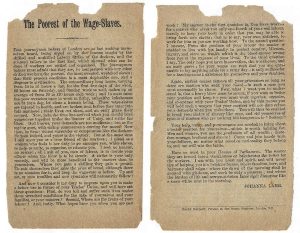
Lahr called on them: “Have no trust in your Houses of Parliament. The sooner they are turned into a washhouse or bakehouse the better for the workers.”
Keir Hardie, who had been a baker’s delivery boy in Glasgow before becoming a miner, spoke in support of striking Jewish bakers after his election in 1892 as the first socialist member of parliament, representing West Ham South in London’s industrial East End.
Unity is strength!
The drive to amalgamate and bring together different sections of the labour force in the bakery and wider food trades was not without its divisive issues.
In the early days both the Jewish Bakers and the Amalgamated Union organised only among skilled bakers. Only after a breakaway National Union of Bakery Trade Workers forced its hand in 1913, did the larger union agree to accept all workers in the industry, renaming itself the Amalgamated Union of Operative Bakers, Confectioners and Allied Workers of Great Britain and Ireland. Its sister Jewish Bakers’ Union followed suit.
A major campaign in the industry was against an enforced 7-day working week. The national union campaigned for Sundays off. Jewish bakers were successful in a fight for a free day on Saturdays – the Jewish sabbath. This left non-Jewish members worrying that they would be forced to continue working seven days as a result. According to Ian, this 110-year-old disagreement has been used recently to accuse the modern union of antisemitism!
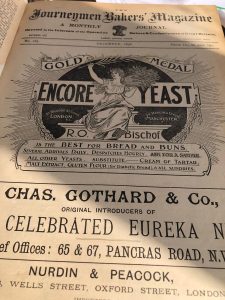
There is no doubt there was racism, towards Jews and others, however. The union’s monthly Journeymen Bakers’ Magazine contains evidence of that, for example a line in its September 1899 edition demanding that “our rulers turn their attention to improving the conditions of the wealth producers instead of acting as agents to Jew financiers and exploiting capitalists.”
Nonetheless, Ian says: “Our union was the only one which allowed migrants to be members, including Jews fleeing the Nazis. During our McDonalds campaign in 2014, we heard from someone whose father had been a refugee pre-WWII and joined the bakers after being rejected by other unions. Back in 1914 women were admitted as full members, which was exceptional at the time.”
By 1970s, the trade union landscape was changing. Most small bakeries had been replaced by large conglomerates. The Jewish Bakers Union’s membership had dwindled and it disbanded, ending a proud history as the only Jewish union outside Israel. Around the same time the amalgamated union adopted the current BFAWU name. Nowadays larger unions USDAW, UNITE and GMB have more food industry members than BFAWU.
Returning to his theme of unity and collective action Ian concludes: “We should remember Johanna Lahr’s words and celebrate what can be done if workers are united and organised.”
- Some further reading: http://www.socialisthistorysociety.co.uk/wp-content/uploads/2022/10/union-bread-min.pdf
Excellent (and worth waiting for!); congratulations to JVL, Naomi and Ian.
Cheers Naomi think that reads well. Thank you for writing it up. Best wishes and solidarity. And thank you for your contribution at our conference.