
Jewish Bloc intervenes in Palestine Action ban appeal
JVL Introduction
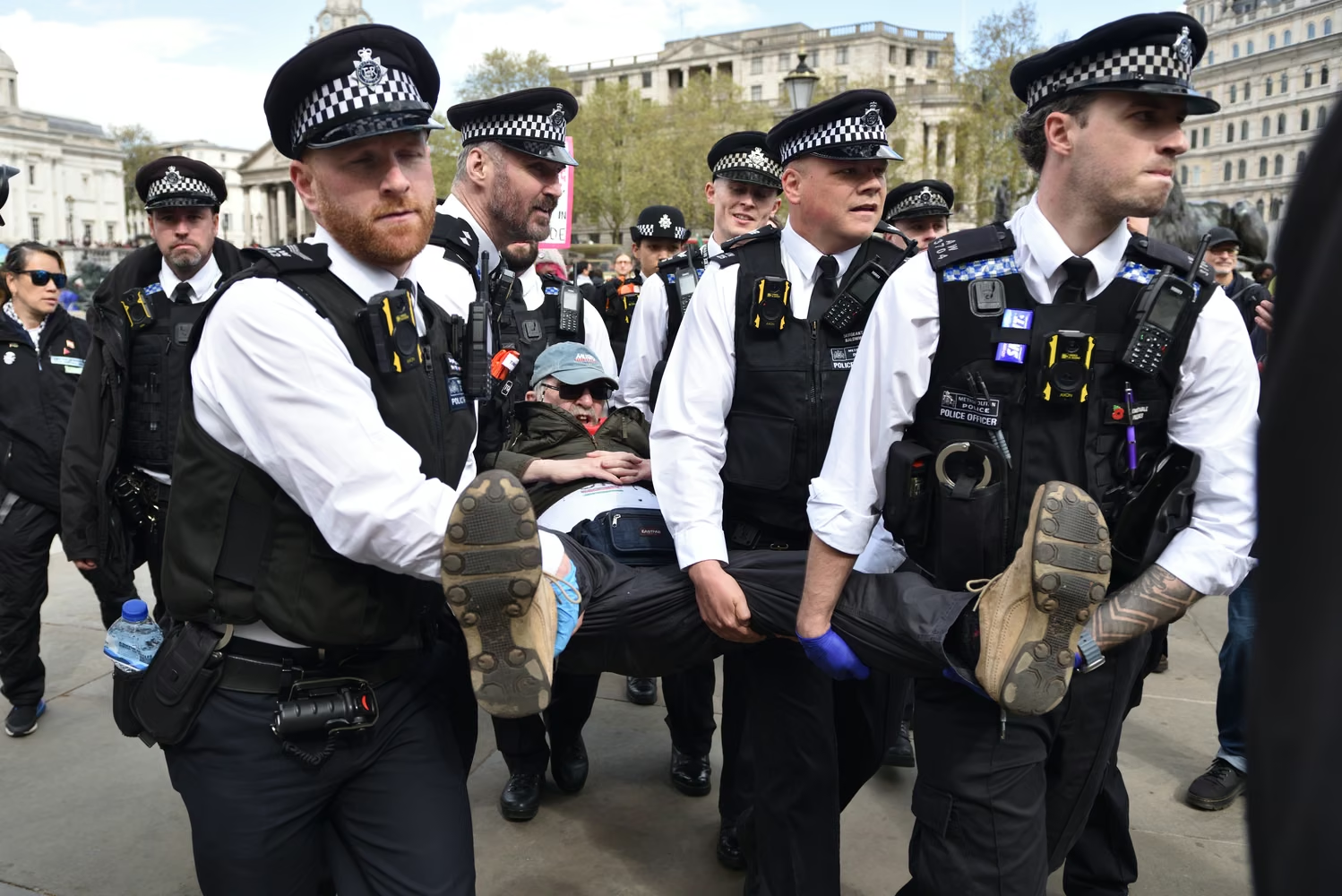
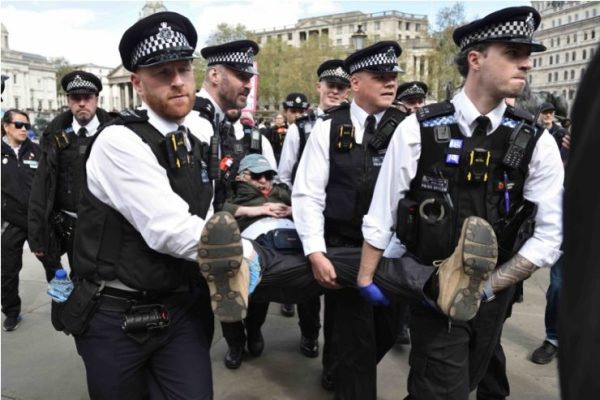
Is the era of mass arrests for peaceful protest against genocide coming to an end?
On Wednesday 4th and Thursday 5th November the Supreme Court finally meets to consider Huda Ammori’s appeal to lift the ban on Palestine Action.
The UK Jewish Bloc has been granted permission to intervene in the appeal. Its submission can be read in full on the Supreme Court website, alongside all the other papers in the case.
This means JBloc groups, including Jewish Voice for Liberation, will be represented in evidence along with other human rights groups such as Amnesty International and PEN International, as well as Ben Saul, UN Special Rapporteur on Counter-Terrorism and Human Rights. They will have the opportunity to counter some of the lies on which the proscription is based, particularly those that wrongfully present Palestine Action as a group that poses a threat to Jews or Jewish-owned businesses.
They will be up against a joint intervention from the Jewish Leadership Council and Community Security Trust arguing that “the UK’s Jewish community is especially vulnerable to Palestine Action (PA)’s violent activities.”
The Jewish Bloc sets out the place of anti- and non-Zionist Jews in the pro-Palestinian movement; considers the relevant legal framework; challenges the claim that proscribing PA is required to protect the rights and freedoms of certain individuals or groups; and addresses the impact of proscription on the rights of the pro-Palestine Jewish community.
The JBloc submission is many pages long. We publish the opening few sections below.
The public are not being allowed into the hearing. The court has provided this link.
IN THE SUPREME COURT OF THE UNITED KINGDOM
ON APPEAL FROM THE COURT OF APPEAL
[2026] EWCA CIV 721
B E T W E E N :
THE KING
(on the application of HUDA AMMORI)
Appellant / Claimant
-and-
THE SECRETARY OF STATE FOR THE HOME DEPARTMENT
Respondent / Defendant
– and –
THE JEWISH BLOC & OTHERS
Intervenors
_______________________________________________________
WRITTEN SUBMISSIONS
ON BEHALF OF THE JEWISH BLOC
_______________________________________________________
A. INTRODUCTION
1. The Jewish Bloc is a diverse coalition of Jewish organisations within the UK, representing Jews who campaign for freedom and justice for the Palestinian people. Members of the Jewish Bloc have in the past supported and been involved with Palestine Action (PA), with a number arrested for conduct allegedly supportive of the organisation post-proscription.
2. The proscription of PA was announced against a backdrop of allegations (explicit and implicit) that it posed a threat to ‘the Jewish community’. In these proceedings, the Respondent makes only passing reference to that supposed threat. However, the characterisation that PA targeted ‘the Jewish community’ qua Jewish appears likely to feature in the written submissions of other intervenors supportive of the proscription decision. That characterisation is a fundamental misrepresentation of the underlying evidence; one which starkly illustrates the very real risk of conflation between, on the one hand, criticism of and opposition to Zionism or the actions of the state of Israel and, on the other hand, antisemitism.
3. It is also striking that the proportionality assessment undertaken by the Respondent (and relied upon by the Court of Appeal (CA)) appears to have failed to recognise the very existence, still less the rights, of a Jewish community which – far from being threatened by PA – is deeply committed to the struggle for Palestinian rights and freedoms. This highlights the further and related risk that Jewish voices critical of the state of Israel are given insufficient weight in the proportionality analysis or are ignored altogether.
4. In this written intervention, the Jewish Bloc therefore seeks, by reference to its specific perspective, to assist the Court on two key points.
a. First, the fundamental fallacy in any suggestion that PA targeted or otherwise posed a threat to ‘the Jewish community’ and/or that it was in any way motivated by antisemitism; and
b. Secondly, the particular impact of the proscription of PA on the Article 10 and Article 11 ECHR rights of the pro-Palestinian Jewish community.
5. It is respectfully submitted that, whether the Court reviews the decision of the CA or undertakes its own proportionality determination afresh, it will be required to conduct an “exacting analysis” of each of those matters.
B. THE JEWISH BLOC
(i) Introduction
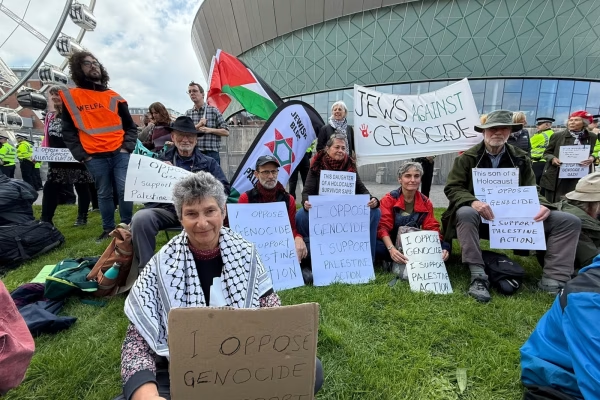
- The Jewish Bloc is a coalition of Jewish and Jewish-led groups – each with its own origin, history and ethos – that formed under the pressure of events in Palestine since October 2023, to campaign for freedom and justice for the Palestinian people. It brings together eleven organisations including Na’amod, Jewish Voice for Liberation (JVL), Jewish Network for Palestine (JNP), the International Jewish Anti-Zionist Network (IJAN) and others, with a combined membership of several thousand. There is great diversity within the Jewish Bloc on political, generational, religious observance and many other grounds. What unites its members is their unwavering support for Palestinian liberation and self-determination, and their Jewish commitments to Tikkun Olam (collective healing, repair) and Tzedek (justice).
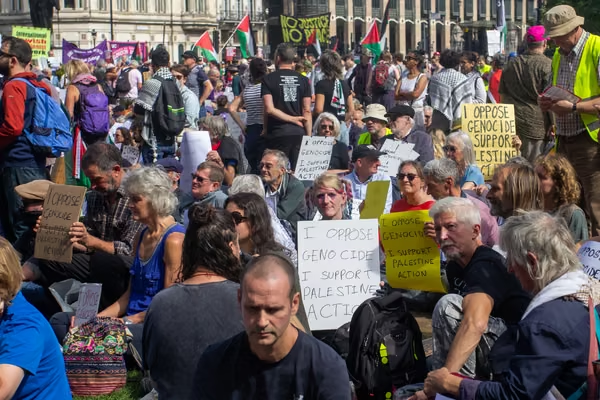
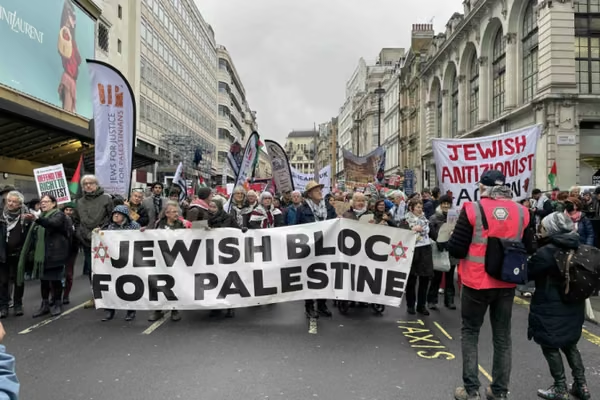
- The coalition formed spontaneously among the many Jewish participants in the first of the National Marches for Palestine in October 2023, and has participated as a Bloc in each of the thirty-six National Marches which have taken place since, in order to demonstrate a Jewish presence. The number of marchers within the Jewish Bloc is always in the multiple hundreds, and has on occasions exceeded a thousand. Their purpose is to display their solidarity with the Palestinian people and to stand against the ongoing genocide.
(ii) Anti-Zionism as an expression of Jewish identity
- Anti-Zionism is a protected belief which has been a part of Jewish identity since before Israel became a nation state. The conflation of Zionism with Judaism is much more recent, the product of “a hundred years of propaganda that feeds off of Jewish intergenerational trauma and the lies that we are not safe unless we have our own settler colonial state”. It is, axiomatically, antisemitic and discriminatory to assume that the entire Jewish population homogeneously holds a singular view of the state of Israel.
- Many members of the Jewish Bloc (which includes the children or grandchildren of genocide survivors) view their pro-Palestine activism as a form of expression of their Jewish life, in which standing against Zionism invokes the memory of family members who were murdered during the Holocaust and is wholly consistent with the Jewish history of militant struggle for justice. This is encapsulated by the words of Marek Edelman, the last surviving commander of the Warsaw Ghetto: “To be a Jew means always being with the oppressed, never with the oppressors.”
(iii) ‘Mainstream’ Jewish voices
- The Jewish Bloc submits that there is a received orthodoxy of ‘mainstream’ British-Jewish opinion, which is given voice through establishment figures, institutions and organisations such as the Chief Rabbi, the Board of Deputies of British Jews, the Jewish Leadership Council, the Campaign against Antisemitism and others including major Jewish newspapers such as the Jewish Chronicle. This orthodoxy speaks from a Zionist perspective and seeks to paint solidarity with the Palestinian movement and/or criticism of Israel as antisemitic. Its spokespersons portray themselves as representative of all British Jews, notwithstanding that (for example) membership of the Board of Deputies is drawn almost exclusively from synagogues and therefore does not speak for the estimated half of all British Jews who do not belong to a synagogue.
- Neither the Jewish Leadership Council (JLC) nor the Community Security Trust (CST) (both intervenors in this appeal in support of the Respondent’s case) have any democratic mandate; claims that either organisation can be viewed as the voice of British Jews must therefore be viewed with very significant caution.
- By contrast, non-Zionist and anti-Zionist Jews – and the organisations such as those which make up the Jewish Bloc – are pushed out of the so-called ‘mainstream’ of British-Jewish opinion, their voices marginalised and delegitimised. As Jenny Manson, co-chair of JVL, explains, “JVL and the larger Jewish Bloc represent an important segment of the Jewish community”; yet it has “been a long-standing reality that pro-Palestinian Jewish voices are rebuffed, ignored or excluded from debates and consultations concerning the Jewish community and issues that impact us.” This is why one of the central messages of the Jewish Bloc during the National Marches for Palestine has been “not in my name”, a phrase which many members see as vital to rebut “the common misconception, fed too often by politicians and the media that Jews wholeheartedly support Israel”.
- The Jewish Bloc fears that proscribing PA will “continue to push anti-zionist Jews out of the so-called ‘mainstream’ of British-Jewish opinion, perpetuating the antisemitic delegitimisation of antizionist British-Jewish voices, and put[ting] all Jewish communities at risk of misguided retaliation”; and that “the repression and proscription of Palestine Action will continue to further marginalise and discriminate [against members] as anti-zionist (and non-zionist) Jews.”
- The Jewish Bloc does not wish to make the same mistake as many of the pro-Israel Jewish organisations by claiming that it speaks for a consensus of the wider Jewish community; what it can do is present the unified views of the members of the organisations within its coalition. This is the basis on which it respectfully invites the Court to recognise that the Jewish community is not a monolith and that British Jews hold a variety of views across all the questions relating to Jewish identity and culture, to the Jewish religion, to Israel and to Palestinian rights. The relevance of that diversity of views to the issues which arise on this appeal is addressed further below.
(iv) Allegations of antisemitism
- One of the ways in which Israel-critical views are silenced is via false allegations of antisemitism. Most of the cases involving antisemitism complaints which are seen by the European Legal Support Centre (ELSC) in fact concern speech or activity which is supportive of Palestinian rights and/or critical of Israel. Since the 2016 adoption by the UK government of the International Holocaust Remembrance Alliance (IHRA) Working Definition of Antisemitism, there is a real danger of the genuine antisemitism which Jews (increasingly) face being cynically elided with complaints about anti-Zionist speech which demonstrates no anti-Jewish hostility. Moreover, groups and individuals identifying as Jewish have themselves been smeared as antisemitic after expressing anti-Zionist views or sympathy for the Palestinian struggle for human rights.
- The sheer numbers of Jewish people who have taken part in each of the marches for Palestine belie the idea – propagated by the JLC, the CST and others – that protesting for Palestinian rights and freedoms and against genocide is inherently antisemitic or intimidating to the Jewish community. That is certainly not the view of the Jewish individuals whose evidence of their experiences within the Palestinian solidarity movement (including, specifically, past support for PA) is before the Court; see, in particular veteran anti-apartheid campaigner and former African National Congress MP Andrew Feinstein; co-chair of JVL (a group of over 1000 paying members), Jenny Manson; and British comedian Alexei Sayle.
Click here to continue reading on the Supreme Court website


Thanks so much for this. I so hope you’ll be “heard”.
Solidarity to you all. You have my support.
It is a dubious state led justice system you’re all up against.
But how i hope for the best outcome for Palestine Action…