
Tell Trump: Hands off the ICC
JVL Introduction
The International Criminal Court, a crucial element in sustaining global legal order, is under existential threat from Donald Trump’s White House.
Here we publish a call to defend the ICC, written by Sue Blackwell, lecturer in Linguistics at the University of Utrecht, who observed the workings of the multilingual court while leading a group of students on a visit in 2023.
In September this year, she represented Labour International (the Constituency Labour Party for members resident outside the UK) at the party conference in Liverpool, where she had hoped to move an emergency motion defending the ICC. As she explains below, it did not make it onto the floor of conference.
Andy Burnham’s government should now work with EU member states to enforce a “Blocking Statute” which could nullify the impact of Trump’s attack, Blackwell says.
Sign this petition calling on the EU to take action now.
_______________________________________________
Brick by Brick: the ICC must be defended
By Sue Blackwell
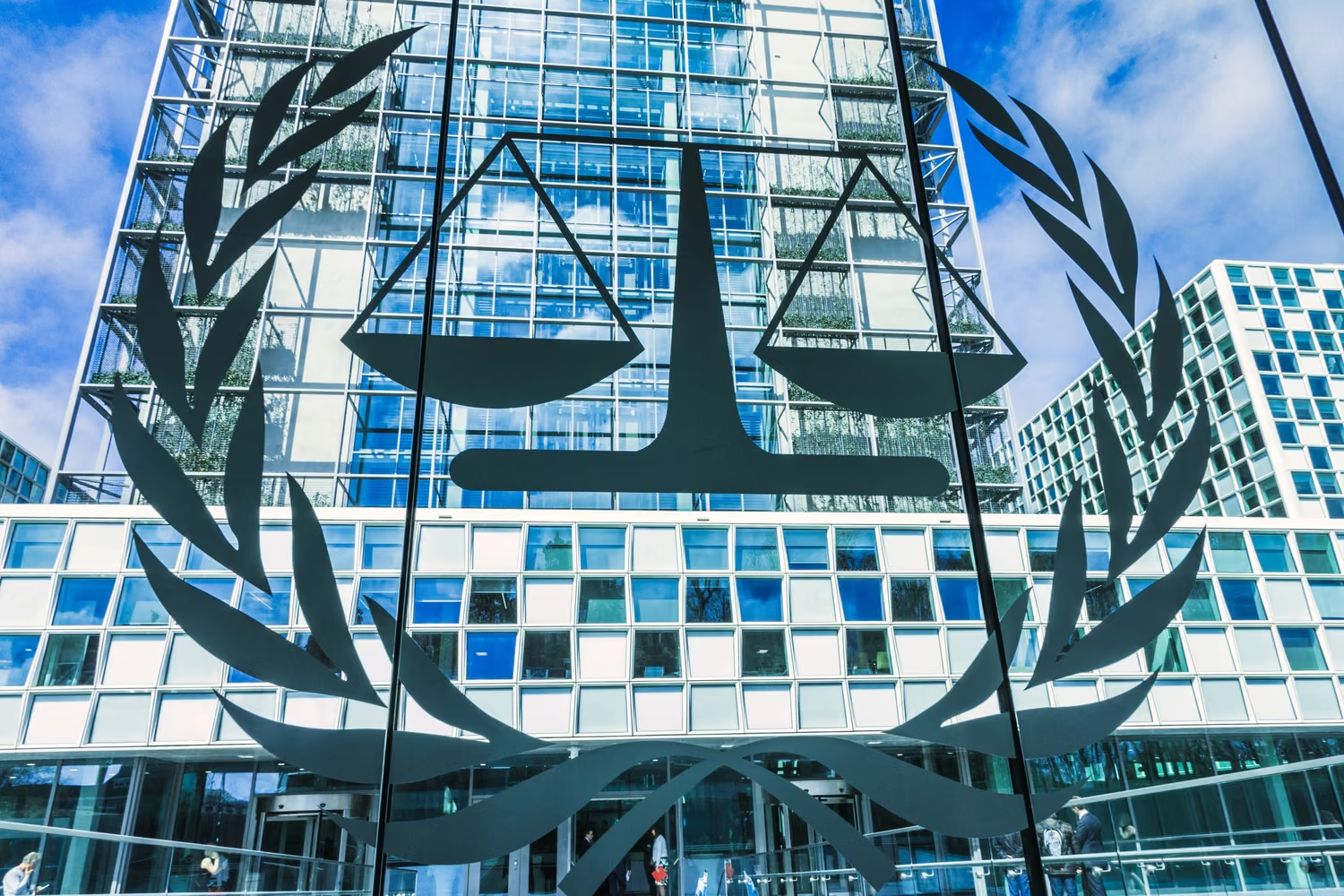
The International Criminal Court in The Hague is a very impressive place. The first thing that struck me as I walked through its corridors was the portraits of its judges on the walls. If you want a model of gender and ethnic diversity, you need look no further than the ICC judiciary. There are currently judges from Japan, Italy, Benin, Peru, Uganda, Canada, the UK, Georgia, Mexico, Costa Rica, Sierra Leone and Trinidad & Tobago; half of whom are women.
The ICC was brought into being by the Rome Statute on 17th July 1998. Whereas the ICJ (International Court of Justice) hears cases against states, the ICC is the court of last resort to try individuals for crimes against humanity (including apartheid), war crimes, genocide and the crime of aggression. It has six official languages and two working languages, French and English. One of the features my students observed on our visit in 2023was the work of the interpreters.
Another striking characteristic of the ICC is the special provision it makes for the representation and protection of victims during its proceedings. Even if they are not giving evidence as witnesses, the victims – organisations as well as individuals – may apply for the right to be heard, which is usually granted.
However, among the 125 States Parties to the Rome Statute, certain countries are conspicuous by their absence.
India and China – neither of which has an exemplary human rights record, especially in the territories they are occupying – are not members of the court.
Russia signed the Rome statute in 2000 but never ratified it, and formally withdrew its signature a day after the court classified the annexation of Crimea as an occupation. (Ukraine joined in 2024). There are currently ICC arrest warrants out for Vladimir Putin and his Children’s Rights Commissioner Maria Lvova-Belova for the unlawful deportation of children from Ukraine to the Russian Federation.
Israel has of course never recognised the ICC and denies that it has jurisdiction over the Occupied Palestinian Territory (OPT), on the basis that Palestine is not a sovereign state. Palestine, on the other hand, joined the ICC in January 2015.
Countries which are not States Parties to the ICC and have good reason to fear it have a track record of imposing sanctions on its staff. In 2021, Israeli authorities cancelled the VIP travel pass of the Palestinian foreign minister on his return to the West Bank from talks with ICC Chief Prosecutor Fatou Bensouda. In 2019 she had opened investigations into alleged war crimes in the West Bank, Gaza and East Jerusalem since 13th June 2014. More recently the ICC has issued arrest warrants for Benjamin Netanyahu and Yoav Gallant, and is rumoured to be also considering issuing warrants for ministers Smotrich and Ben-Gvir.
The US “Hague Invasion Act”
The United States of America has never joined the Court. On the contrary, the American Service Members Protection Act (2002) calls for “all means necessary and appropriate to bring about the release of any US or allied personnel being detained or imprisoned by … the International Criminal Court”. This piece of legislation has been dubbed the “Hague Invasion Act” and was often the subject of jokes by European citizens.
In 2020, in response to the ICC opening an investigation into alleged war crimes committed in Afghanistan, US Secretary of State Mike Pompeo named and threatened two members of ICC staff. Donald Trump, during his first term as President, revoked Fatou Bensouda’s entry visa (a sanction lifted along with some others by the Biden administration in 2021).
These early rumblings from the USA have taken a dramatic turn under Trump’s second term of office. The “Hague Invasion Act” isn’t a joke any more.
A number of ICC judges and prosecutors are already on Trump’s sanctions list, imposing asset freezes, travel bans and restrictions on services from US companies on them and members of their families. The Trump regime imposed similar sanctions on UN Human Rights Council Special Rapporteur Francesca Albanese, apparently in revenge for the arrest warrants for Netanyahu and Gallant, until a judge lifted the restrictions.
Now the USA is gunning for the court itself. In July 2026 US secretary of State Marco Rubio threatened to “dismantle the ICC – brick by brick, if necessary”.
On 20th September the Wall Street Journal reported that the US government was preparing to impose sweeping new sanctions on the entire International Criminal Court. If implemented, these measures would bar US citizens and companies from providing the ICC with money, goods or services without a licence from the US Treasury, and would disrupt the ICC’s IT services and investigations.
The Netherlands branch of Labour International considered these reports sufficiently alarming to bring an emergency motion to the Labour Party Conference. It concluded: “Conference endorses the ICC’s view that the US sanctions are a ‘flagrant attack against an independent and impartial judicial institution’ which ‘undermine the rule of law’. Conference urges the Labour Government to do everything in its power to uphold the independence of the ICC.”
Unfortunately, the Conference Arrangements Committee did not approve the motion. Apparently they didn’t consider the news reports sufficiently substantiated to justify a debate.
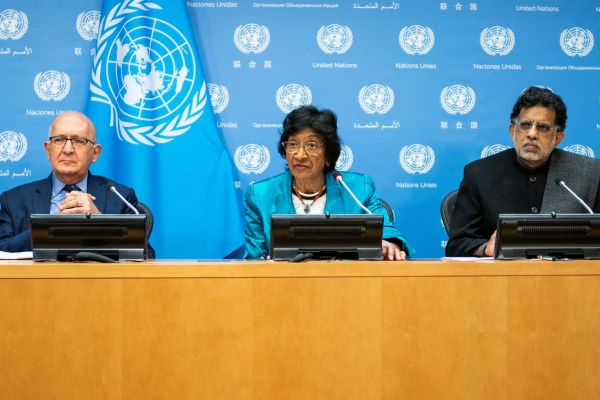
I hate to have to say “we told you so” but the reports were accurate. A week later, on 9th October, Rubio announced the US government’s new sanctions against the ICC, just hours after the Nobel Peace Price was awarded to Navi Pillay, a South African judge at the ICJ who has previously served at the ICC. In 2021, Pillay was appointed chair of the UN Independent International Commission of Inquiry on the OPT. She oversaw the UN report which found that Israel was committing genocide in Gaza. The timing of the US announcement is unlikely to be a coincidence: Trump makes no secret of the fact that he covets the Nobel Peace Prize for himself!
The UK Government, with others, responded by endorsing a Joint Statement of Foreign Ministers on Support for the International Criminal Court, which ends: “We will continue to work together to support the Court’s vital work, uphold the rules-based international system, and advance accountability.”
All good as far as it goes, but what our motion specifically called for was “aligning with the implementation of the Blocking Statute to protect the ICC and its employees from US sanctions, if the EU Commission should choose to invoke it.” The Blocking Statute is a powerful piece of EU legislation that lists foreign court rulings which are deemed null and void in the EU. So for example if a US court orders banks to close the accounts of ICC employees, EU banks could be forbidden to implement this ‘de-banking’.
Some MEPs, such as French socialist Chloé Ridel, are now calling for it to be activated. Although the UK is no longer an EU member state, it could give a strong signal by indicating its willingness to co-operate with the EU in enforcing the Statute.
Of course the ICC has its flaws. The fact that the majority of its prosecutions to date have targeted individuals from the global South, particularly Africa, has led to accusations of bias and institutional racism. Burundi left the court in 2017, followed by the Philippines in 2019. Last year the military leaders of Burkina Faso, Mali, and Niger announced their decision to withdraw from its jurisdiction.
If the ICC now caves in to Trump’s threats and allows exemptions for the US and Israel, the accusations of bias in favour of powerful states will be irrefutable. International law must be seen to apply to everyone, or it is useless. Dutch PM Rob Jetten told Trump at the UN “hands off the ICC and all those other institutions that protect the international legal order”. Let’s hope he means business. Human rights campaigners, and all who believe in justice and accountability, need to be prepared to defend the ICC, “brick by brick, if necessary”.
No comments on this post so far.