
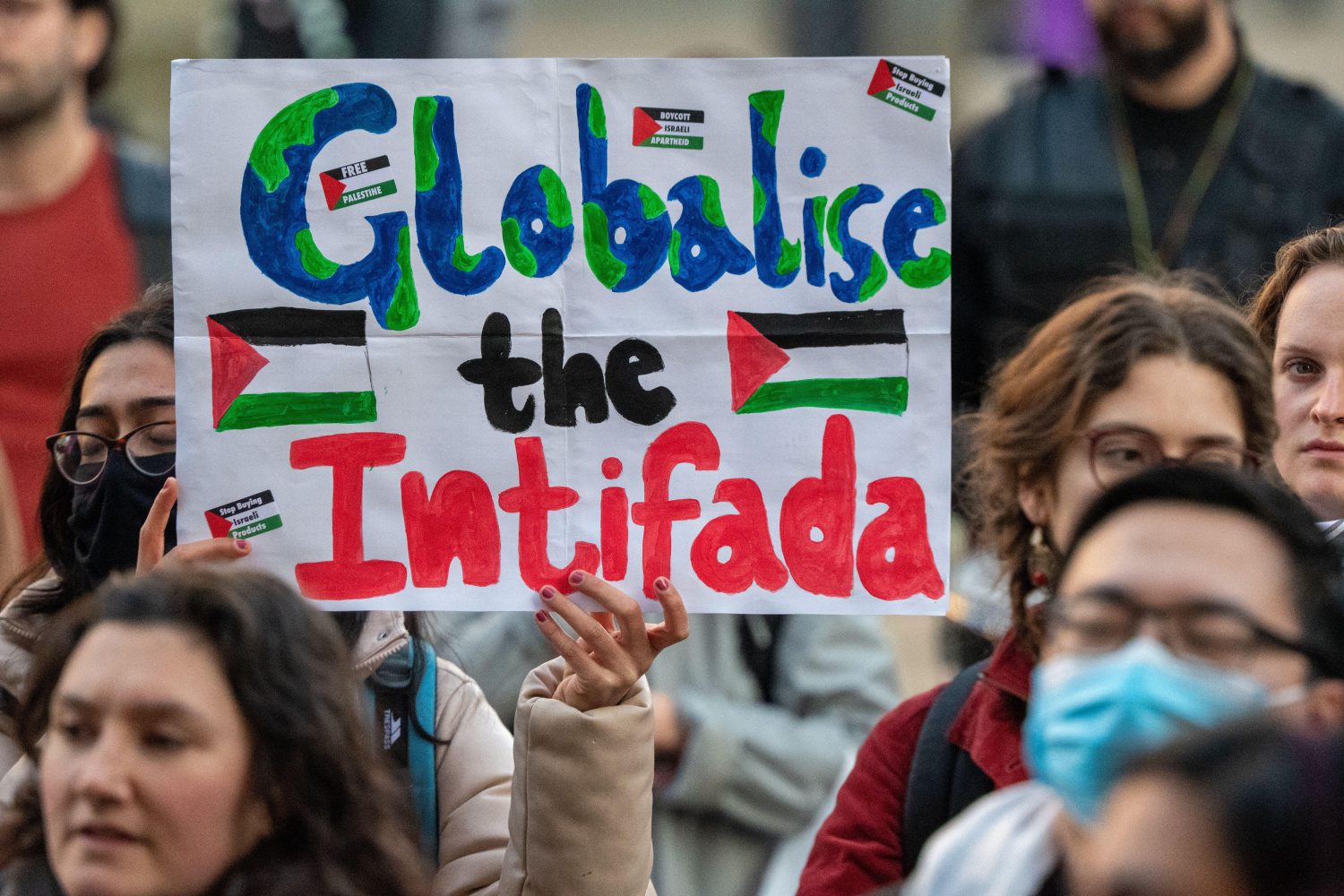
FAQ – Is saying “Globalise the Intifada” a threat to Jews?
JVL Introduction
The Metropolitan police already have a policy of arresting people who chant “Globalise the Intifada” and an outright ban is one possible outcome from a review of UK protest laws by the former director of public prosecutions Ken Macdonald.
We publish below a new addition to our series of Frequently Asked Questions, produced by JVL’s education group, addressing the allegation that “Globalise the Intifada” is an antisemitic justification of terrorism which glorifies and incites violence against Jews. We explain that on the contrary, “intifada” refers to a resistance movement, overwhelmingly peaceful in its origins, that was violently crushed by Israel forces. To outlaw it would be another example of muzzling speech supportive of Palestinian freedom, using the pretext that it constitutes a material threat to Jews.
The slogan will be the subject of an online event at 7pm on Wednesday July 1 titled Should we globalise the intifada? Lessons from revolutionary history. Click here to join leading scholars and activists for a discussion exploring the history of intifadas and anti-colonial uprisings across the Arabic-speaking world, from Palestine to Iraq and Bahrain.
Isn’t the slogan “globalise the intifada” an antisemitic justification of terrorism which glorifies and incites violence against Jews?
The allegation
The slogan “Globalise the Intifada” recalls past Palestinian activist violence, including suicide bombings of Israeli civilians. It should be banned because it threatens Jewish communities by inciting attacks on Israelis, Jews, and institutions supporting Israel.
Brief rebuttal
- – Saying “Globalise the Intifada” is a call to make the movement in solidarity with the Palestinian people global. It is neither antisemitic nor violent. It is a strong and legitimate response to the genocide being experienced by Palestinians in Gaza and the West Bank and the continued indifference of Western governments who allow Israel complete impunity.
- – There is nothing intrinsically violent about “intifada”. The term means “shaking off” in Arabic and came to prominence during an almost entirely non-violent protest movement from 1987 to 1993, known as the First Intifada, when Palestinians rebelled against decades of Israeli occupation and injustice.
- – It is not an incitement to commit acts of violence against Jewish people and there is no justification for calls to ban its use or arrest people chanting t or carrying placards bearing it.
More detail
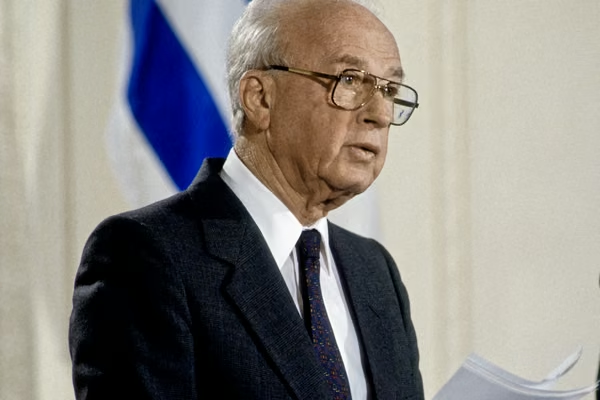
During the First Intifada, a wave of strikes, acts of civil disobedience and stone-throwing against the Israeli military was met with overwhelming violence by Israeli soldiers and settlers. In January 1988, Defence Minister Yitzhak Rabin issued a policy directive instructing soldiers to “break their [Palestinians’] bones”. More than 1,100 Palestinians including 250 children, were killed and 100,000 injured over six years.
According to Save the Children, an estimated 50,000 to 63,000 Palestinian children required medical treatment for injuries sustained in the first two years of the First Intifada alone, including at least 6,500 who were shot by Israeli soldiers. Approximately 120,000 Palestinians were imprisoned by Israel during the six years of the uprising.
The Oslo Accords of 1993 and 1995 failed to reverse Israel’s occupation of Palestinian land, causing mounting frustration and the outbreak in September 2000 of another round of protests which became known as the Second Intifada. It was triggered by the collapse of the Camp David Summit and a provocative visit to the Temple Mount/Al-Aqsa mosque compound by then-Israeli opposition leader Ariel Sharon.
Israeli soldiers and police shot dead at least 47 unarmed Palestinian protesters and wounded around 2,000 others in the first five days. After this, some Palestinian resistance groups resorted to suicide bombings against civilians, resulting in about 1,000 Israeli deaths by 2005. Israel crushed the rebellion, killing more than 3,000 Palestinians.
International law recognises the right of peoples to self-determination which includes the right of resistance to oppression by all means including armed struggle. It is not an unqualified right: groups in struggle must observe international Humanitarian Law and must distinguish between civilians and combatants which the suicide bombings evidently did not.
The phrase ”Globalise the Intifada” seems to have emerged in the solidarity movement around 2022. It was displayed, for instance, on placards during 2024 anti-genocide campus protests at Columbia University and elsewhere, sometimes described by participants as a “student intifada”. It has since been taken up by activists advocating for worldwide boycott action against Israel.
The fact that the UK government is considering outlawing the slogan is another example of muzzling speech supportive of Palestinian freedom, using the pretext that it constitutes a material threat to Jews. It is part of an alarming trend towards censoring speech which some find offensive, regardless of the intent of the person accused.
Further resources
- – A State of Danger, film about the First Intifada, by Haim Bresheeth and Jenny Morgan, BBC (1988)
- – Second Intifada, Makan Glossary.
- – In the face of genocide, the intifada must be globalised, Institute of Development Studies, 15 Nov 2023
- – Don’t Ban “Globalize the Intifada” Peter Beinart, 22 Dec 2025
- – What does ‘globalise the intifada’ mean, and why does NSW want to ban the chant? Guardian Explainer, 23 Dec 2025
- – Organisers challenge Starmer’s threat to ban some pro-Palestine marches, Sammy Gecsoyle, The Guardian, 2 May 2026
- – Yalla intifada! Let’s go, Never Gordon, Zeteo, 28 Jul 2026
Intifada Mondiale!
As an indicator of how bad racism has become courtesy of the lobby, just imagine these prohibitions being applied to Israel’s closely alliedsister colonial projects, Rhodesia & Apartheid South Africa. Yet clearly Israel is the worst of the three its also an exporter of racism and Apartheid. Israel’s Ambassador Alon Leil “”We created the South African arms industry…there was a love affair between the security establishments of the two countries and their armies…Alongside the state-owned factories turning out materiel for South Africa was Kibbutz Beit Alfa, which developed a profitable industry selling anti-riot vehicles for use against protesters in the black townships.” From the Guardian “Brothers in arms – Israel’s secret pact with Pretoria”. https://www.theguardian.com/world/2006/feb/07/southafrica.israel