
The deliberate crushing of Palestinian life
JVL Introduction
We post below two pieces on the dire state of health provision in the West Bank.
The Haaretz editorial posted below sums it up
“Israel’s policy of withholding all the customs and other fees it collects on behalf of the Palestinian Authority has created a kind of chain reaction that harms every aspect of Palestinian life in the West Bank. The worst damage has been to the public health system…”
And Amira Hass provides clinical detail of how the crisis is playing out in her report that more than 11,000 patients covered by the Palestinian public healthcare system have had the surgery they need postponed in the last five months.
It is sobering to read the nitty-gritty detail and to be reminded that none of this is occurring just by chance or mismanagement.
This is what the deliberate enforcing of genocidal policies looks like in practice. Refusing to transfer monies to the Palestinian Authority – which Israel has collected on its behalf – is an act of choice and of will by the Israeli authorities.
It is also an illegal act, illegal in its own right and an act of collective punishment.
Bring on the day when those responsible answer for it in The Hague.
A Slow-motion Execution of the West Bank Health System
Haaretz Editorial, 01 June 2026
Israel’s policy of withholding all the customs and other fees it collects on behalf of the Palestinian Authority has created a kind of chain reaction that harms every aspect of Palestinian life in the West Bank. The worst damage has been to the public health system and its ability to provide proper care, to prevent people with chronic illnesses from deteriorating, and to maintain the quality of lifesaving treatments.
As of May, Israel held some 14 billion shekels ($5 billion) belonging to the PA. As of last week, the Palestinian Health Ministry’s debts had reached around 2.6 billion shekels (almost the entire budget for 2025). Roughly half that amount is owed to Palestinian companies that make or import medicine, and the remainder to private hospitals to which patients have been referred due either to the long waits at the public hospitals or because they cannot provide needed treatment. Hospitals in the West Bank and East Jerusalem have been forced to take cost-cutting measures, including salary cuts. As of last week, only 260 of 1,260 regularly available medications were in stock in PA pharmacies or the Palestinian Health Ministry’s warehouses: Many of the suppliers could no longer afford to continue providing them on credit to their main customer, the Palestinian Health Ministry.
Due to Israel’s ongoing assault on the PA’s treasury, doctors and nurses, like all government employees, are receiving reduced wages, and even that irregularly. Some struggle to afford transportation, whose cost has risen due to the Israeli military’s culture of closing roads and erecting checkpoints, which also creates increasingly long waits.
In early May, the union of public-sector doctors in the West Bank declared a partial strike. That led to the closure of 477 public health clinics, while hospitals are providing only lifesaving treatments. Not many West Bank residents can afford to buy medicine or see doctors privately, especially since another measure adopted by Israel’s government – refusing to let roughly 170,000 Palestinians resume working in Israel – has accelerated the process of impoverishment.
Unsurprisingly, Finance Minister Benjamin Smotrich was one of the main people pushing for withholding the PA’s revenues and preventing Palestinian laborers from returning to Israel, and he has made no secret of this. On May 14, the website of the weekly Besheva published an approving article about the minister and his plans, stating: “The Palestinian Authority’s collapse will be brought about first and foremost by cutting it off from its financial oxygen line” (that is, its income from Palestinians’ own economic activity). But this effort to topple the PA is a slow-motion execution of the entire Palestinian health system.
The government must stop destroying the West Bank with its Palestinian residents inside. It must release immediately the revenues it is holding. And the international community must demand this by using the political tools at its disposal and stop making do with weak verbal condemnations.
The above article is Haaretz’s lead editorial, as published in the Hebrew and English newspapers in Israel.
Acute Medication Shortage Risks Lives of 4,000 West Bank Cancer Patients, Palestinian Health Ministry Says
More than 11,000 surgeries for patients covered by the Palestinian public healthcare system have been postponed since the beginning of the year, the health ministry says. A non-governmental medical center in Hebron announced that it would stop accepting patients referred by the ministry
Amira Hass, Haaretz, 07 June 2026
Life-saving medications for approximately 4,000 cancer patients and thousands of dialysis patients in the West Bank are running out, according to a report released last Wednesday by the Palestinian Health Ministry.
The report states that more than 11,000 surgeries for patients covered by the Palestinian public healthcare system have been postponed since the beginning of the year. The delays have been attributed to shortages of essential medical supplies, reduced working hours by physicians whose salaries have not been fully paid and strikes by medical staff in recent weeks.
According to the ministry, only 19,500 surgeries were performed in hospitals across the West Bank between the start of the year and June 1, compared with 65,000 major and minor procedures carried out throughout 2025.
Residents have also reported various fundraising efforts to help cover the cost of medications, including donation appeals made at the conclusion of Friday prayers in mosques and through local radio stations. The ministry said that 180 of the 520 essential medications it supplies are completely out of stock, including 50 of the 97 drugs used to treat cancer.
The ministry further warned of severe shortages of critical disposable medical supplies, including dialysis filters and surgical sutures, particularly those required for heart surgery and other complex procedures. Cardiac catheterization procedures have also been postponed because of shortages of essential equipment such as stents and catheters. According to the ministry, these shortages have significantly affected the operational capacity of operating rooms.
Further evidence of the deepening crisis in the Palestinian healthcare system emerged last Wednesday when Al-Ahli Hospital, a non-governmental medical center in Hebron, announced that it would stop accepting patients referred by the ministry starting Sunday.
The hospital said it is facing acute shortages of medications, medical supplies and essential equipment. These shortages have resulted from the ministry’s inability to reimburse the hospital for treatments previously provided to referred patients or to repay its mounting debts.
The unprecedented financial crisis facing the ministry, and the Palestinian Authority more broadly, stems directly from the withholding of customs and import tax revenues collected by Israel on the Authority’s behalf.
Under existing agreements, these revenues are supposed to be transferred to the Palestinian Authority after deductions for services provided by Israel, including water and electricity, as well as various administrative fees.
Until approximately October 2025, the ministry continued to make monthly payments to private hospitals and healthcare institutions run by non-profit organizations, even when those payments fell short of covering the full cost of treating referred patients. However, even these partial payments ceased after Israel, acting on the instructions of Finance Minister Bezalel Smotrich, withheld the PA’s entire share of import-related revenues beginning in May of that year.
As Smotrich himself explained, this measure was taken in response to the Palestinian Authority’s appeal to the international community to intervene in order to stop the war on Gaza.
In February, non-governmental hospitals across the West Bank agreed to a proposal from the Ministry of Health for an interim arrangement designed to ease their cash-flow crisis, which was triggered by the suspension of regular government payments. The plan was outlined by Yousef Takrouri, director-general of Al-Ahli Hospital in northern Hebron and president of the Palestine Hospitals Union, in comments to the Palestinian news outlet Al-Hadath.
Under the proposal, hospitals would take out loans from local banks equivalent to ten months of payments owed to them by the ministry. The hospitals would cover the interest payments for two years, while the ministry committed to repaying the principal. However, Takrouri said the Palestinian Authority was ultimately unable to reach an agreement with the banks. By the end of 2025, the Palestinian Authority’s debt to Palestinian banks had reached approximately $3.4 billion.
The ministry has continued its efforts to secure international financial assistance. Last week, it called on representatives of the international community to intervene urgently and help fund life-saving medications for a one-year period at an estimated cost of $50 million. According to the ministry, a similar amount is needed to procure other essential medicines and disposable medical supplies.
On Thursday, an emergency meeting was held in Ramallah with representatives of pharmaceutical importers and manufacturers. According to a report by the Ma’an News Agency, participants warned that the ministry’s accumulated debt, estimated at 1.3 billion shekels as of last month, was undermining their ability to continue importing and manufacturing medicines. They cautioned that the situation could lead to drug shortages across the Palestinian market, extending beyond the government healthcare system to affect the wider population.
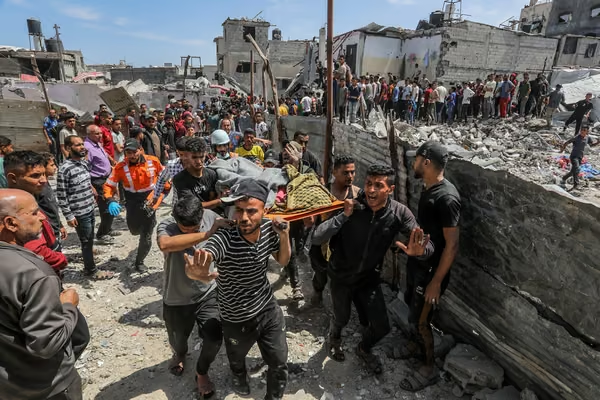
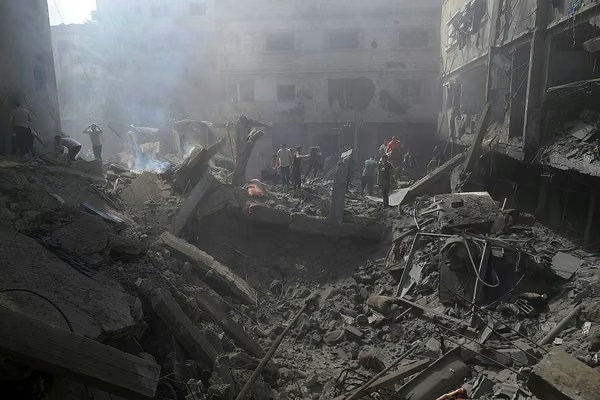
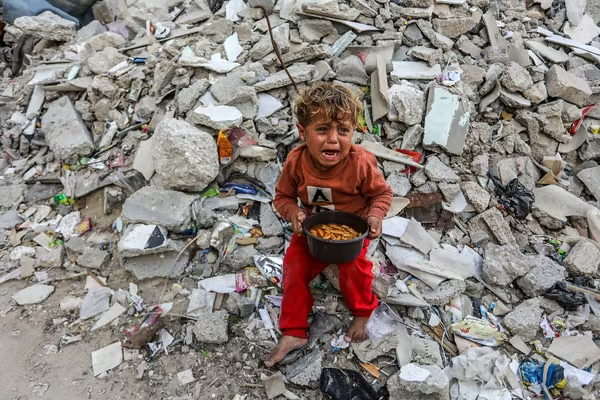
I think it is clear to see this is the ethnic cleansing of the indigenous population. One cannot erase history.
Colonisation is the gift that keeps on giving and violating.
Canada, US, Australia all have their own stories of their horrific histories.
What is astounding is the false histories, indoctrination and the creation of Nationalism.
There is history and there are lies made to be history. Humans use excuses to commit the worse kind of human horror on others. False Nationalisms are created and borders and formed and divisions and prejudices set which enables these horrors.
Religion and characters from these texts are used as the excuse. We sometimes forget the main religions came out of the Middle East by indigenous groups. Some were polytheistic before sions of monotheistic. The early Israelites were polytheistic. We remember bits acceptable to our own personal beliefs. Before religion indigenous people existed and their stories are quite similar to what later is known as religion.
I have read Theodore Herzl’s work and I quote -‘Should the Powers declare themselves willing to admit our sovereignty over a neutral piece of land, then the Society will enter into negotiations for the possession of this land. Here two territories come under consideration, Palestine and Argentine. In both countries important experiments in colonization have been made, though on the mistaken principle of a gradual infiltration of Jews. An infiltration is bound to end badly. It continues till the inevitable moment when the native population feels itself threatened, and forces the Government to stop a further influx of Jews. Immigration is consequently futile unless we have the sovereign right to continue such immigration.’