Israel on World Press Freedom Day – more censorship and killing
JVL Introduction
On World Press Freedom day, May 4, the Israeli/Palestinian magazine +972 marked the occasion with a tribute in their newsletter The Landline to the sacrifices made by journalists battling to tell the world the truth about Gaza and the West Bank and a call for ongoing support for their work.
We publish it below this longer article by Haggai Matar, detailing the ramping up of Israeli censorship, military and otherwise.
He says:
Beyond the unprecedented spike in military censorship, this year’s World Press Freedom Day arrives as a grim milestone for Israeli journalism. In 2024, Israel ranked a dismal 101 out of 180 (a drop of 4 places from the previous year’s ranking) in the Reporters Without Borders Press Freedom Index; that ranking has now dropped even further to 112. This evaluation only reflects the state of journalism within Israel, without factoring in the mass killing of journalists in Gaza.
NWI
This article was originally published by +972 Magazine with Local Call on Fri 2 May 2025. Read the original here.
Breaking new records, Israel sees unprecedented spike in media censorship
In 2024, Israel’s military censor banned 1,635 articles from publication and partially redacted another 6,265 — part of a wider assault on freedom of press.
|
|
||
| In 2024, military censorship in Israel reached the most extreme levels since +972 Magazine began collecting data in 2011. Over the course of the year, the censor completely banned the publication of 1,635 articles and partially censored another 6,265. On average, the censor intervened in about 21 news reports per day last year — more than double the previous peak of about 10 daily interventions recorded during the last war in Gaza in 2014 (Operation Protective Edge), and over three times the non-war-time average of 6.2 per day.
These figures were provided by the military censor in response to a joint request from +972 Magazine and the Movement for the Freedom of Information in Israel, ahead of World Press Freedom Day. While the military censor does not disclose the reasons behind each intervention, Israel’s ongoing war of destruction in Gaza, as well as its conflicts in Lebanon, Syria, Yemen, and Iran, is likely the main reason behind this record surge in censorship. Under Israeli law, any article dealing with the broadly-defined category of “security issues” must undergo military censorship review, and editorial teams are responsible for deciding which piece to submit based on their own judgement. When the censor intervenes, media outlets are forbidden from indicating that censorship has taken place, meaning most of its activity remains hidden from the public. No other self-described “Western democracy” has a comparable institution. It should be noted that, under this law, +972 Magazine is legally compelled to submit materials for review. For more on our stance regarding military censorship, click here.
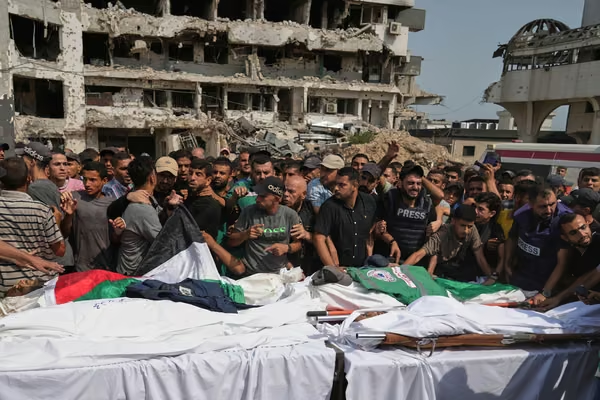
‘The public deserves to know what has been hidden’In 2024, Israeli news organizations submitted 20,770 news items to the military censor for review — nearly double the previous year’s total, and four times the number in 2022. The censor intervened in 38 percent of these cases, a full seven percentage points higher than the previous peak recorded in 2023. Blanket rejections of entire news articles accounted for 20 percent of all interventions, up from 18 percent in 2023. In the preceding years, the average stood at just 11 percent. Israeli news outlet i24 reported on Sunday that Chief Military Censor Brigadier General Kobi Mandelblit asked the Attorney General to investigate Israeli journalists who allegedly circumvented censorship law by sharing restricted information with foreign media outlets. The Attorney General rejected the request. The military censor is not obligated by law to respond to Freedom of Information requests, and it voluntarily provided the figures above. However, it refused to provide additional data we requested, including: a breakdown of the data by month, by media outlet, and by reason for intervention; details about cases where it proactively ordered media outlets to remove content that hadn’t been submitted for review; and any records of administrative or criminal proceedings against censorship violations. (To the best of our knowledge, no enforcement action of this kind has been taken so far.) Additionally, while the military censor would previously provide data on censorship in books — typically those written by former members of the Israeli security establishment — it now withholds this information. And over the past decade, it has also been reviewing and intervening in online publications by the State Archives. In some cases, it has even blocked the release of documents that had already been deemed harmless by the archive’s security experts and were previously accessible to the public. This act of “re-concealment” has faced widespread criticism. Last year, the State Archives submitted 2,436 documents for censor review. While the censor stated that “the vast majority” were approved for publication unchanged, it consistently refuses to disclose how many archival documents it “re-concealed” from the public. Or Sadan, an attorney from the Movement for the Freedom of Information and the director of the Freedom of Information Clinic at the College of Management Academic Studies, told +972 that while he was not surprised by the surge in censorship last year, he was hopeful that “the publication of this data would help minimize the use of censorship tools which, while sometimes necessary, are also dangerous when it comes to the public’s access to information. “Even if certain information cannot be published during an emergency, the public deserves to know what has been hidden from them,” he explained. “Censorship means the concealment of information that a journalist believed the public had a right to know. During times of war, many people already feel that they’re not being told everything, and therefore it is appropriate to review censorship decisions retrospectively.” A war on free pressBeyond the unprecedented spike in military censorship, this year’s World Press Freedom Day arrives as a grim milestone for Israeli journalism. In 2024, Israel ranked a dismal 101 out of 180 (a drop of 4 places from the previous year’s ranking) in the Reporters Without Borders Press Freedom Index; that ranking has now dropped even further to 112. This evaluation only reflects the state of journalism within Israel, without factoring in the mass killing of journalists in Gaza. According to the Committee to Protect Journalists, at least 168 Palestinian journalists and media workers have been killed in Gaza by the Israeli military during the war, more than in any other recorded violent conflict in recent decades. Other organizations place the number as high as 232. In collaborative investigations with Forbidden Stories, +972 revealed a pattern of Gazan journalists killed by the army merely for operating drones, or being attacked by army drones when clearly identified as press. Additionally, Israel treats journalists working for media outlets affiliated with Hamas as legitimate military targets, and on more than one occasion claimed that other journalists it killed were connected to Hamas, usually without presenting any evidence. But journalists in Gaza don’t just have to contend with the constant threat of death from Israeli bombardment, while also often suffering hunger, thirst, and displacement. They also face suppression from Hamas itself, which pressures journalists who criticize the organization or cover protests against it. Israel has compounded this dire situation by blocking all foreign journalists from entering the Gaza Strip for over a year and a half — a move upheld by the Israeli Supreme Court that many journalists around the world condemned as both a severe blow to press freedom and a deliberate effort to conceal what is happening in Gaza. At the same time, Israel has been systematically arresting and imprisoning Palestinian journalists from both Gaza and the West Bank, often without charges, as a form of punishment for critical reporting. This repression has accelerated during the war, as seen in the banning of media outlets such as Al-Mayadeen and Al-Jazeera from operating in Israel. The government has simultaneously come after Israel’s own free press: moving to shut down public broadcaster “Kan,” financially strangling the liberal daily Haaretz, and making deliberate efforts to weaken long-established media outlets, all while bankrolling new pro-government outlets like Channel 14 with public funds. Beyond this, the government has imposed severe restrictions on publishing the identities of soldiers suspected of war crimes, and ongoing incitement against journalists by lawmakers and public figures affiliated with the Netanyahu government have led to several violent attacks on reporters.
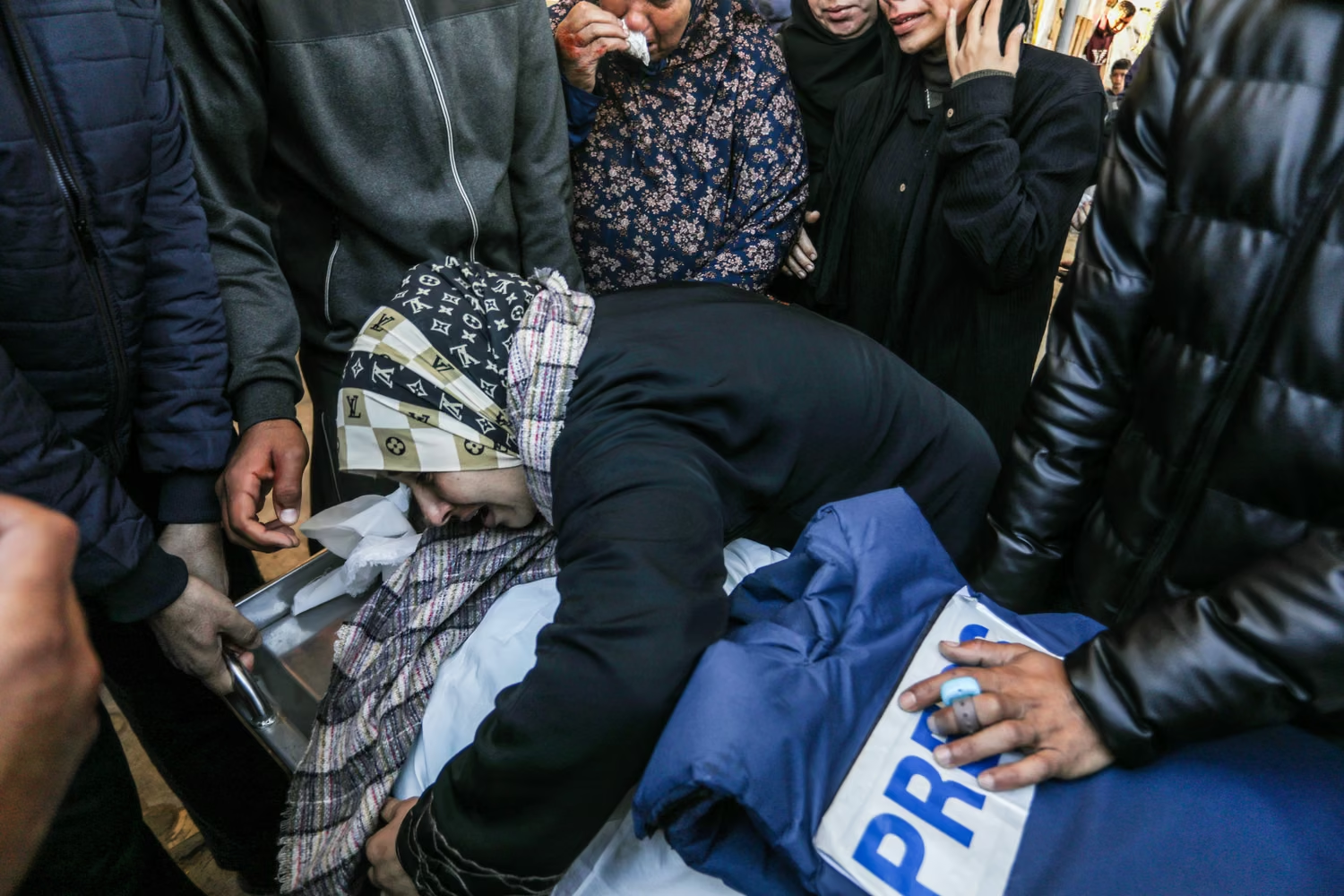
On this World Press Freedom Day, independent journalism is more vital than everMessage from The Landline Being a Palestinian journalist in Gaza is incredibly dangerous. According to the Committee to Protect Journalists, Israel’s ongoing war has killed at least 168 journalists in the Strip, with others placing the figure as high as 232 — amounting to more casualties than both world wars, the Vietnam War, the wars in Yugoslavia and the U.S. war in Afghanistan combined. Over the past year, in collaborative investigations with Forbidden Stories, +972 has revealed a pattern of Gazan journalists killed by the army merely for operating drones, or being attacked by army drones when clearly identified as members of the press. Our reporters in Gaza survive day by day with these constant threats to their lives — and yet they continue to write. We all held our breath reading how Mohammed Mhawish was buried alive by an Israeli airstrike and survived to tell about it. Ibtisam Mahdi wrote movingly about her vocation when death and destruction are everywhere around her. Ruwaida Amer described how the war has blurred the lines between life and journalism, forced to experience the same hunger, displacement, and loss that she reports on. And even after leaving the Strip, Mahmoud Mushata detailed the psychological toll that writing about Gaza continues to exact. Meanwhile, in the West Bank, Israel has been systematically arresting and imprisoning Palestinian journalists, often without charges, as a form of punishment for their reporting. After winning an Oscar as co-director of “No Other Land,” +972 contributor Hamdan Ballal was attacked by settlers and detained by the Israeli military upon returning to his home in Masafer Yatta. This was a stark reminder of the daily dangers faced by those who dare to raise their voices and to use their pen to chronicle the reality of living under apartheid. We are proud to remain a collective of Palestinian and Israeli journalists working to safeguard press freedom in the darkest of times. As Israel escalates its assault on the press — breaking new records for media censorship — your support enables us to continue to bring you voices from the ground in Israel-Palestine. This World Press Freedom Day, join us. +972 Magazine team |
112th among 180 countries? The “only democracy in the Middle East” is in some bad company. And has Reporters without Borders duly factored in its murdering of Palestinian journalists?
Just how much weight RWB gave to the murder of journalists in Gaza is not clear. However they made explicit reference to it in their country page on Israel in their report https://rsf.org/en/country/israel and it obviously contributed to Israel’s further downgrading.