
Jewish politics beyond Zionism: Lessons from Somaliland
JVL Introduction
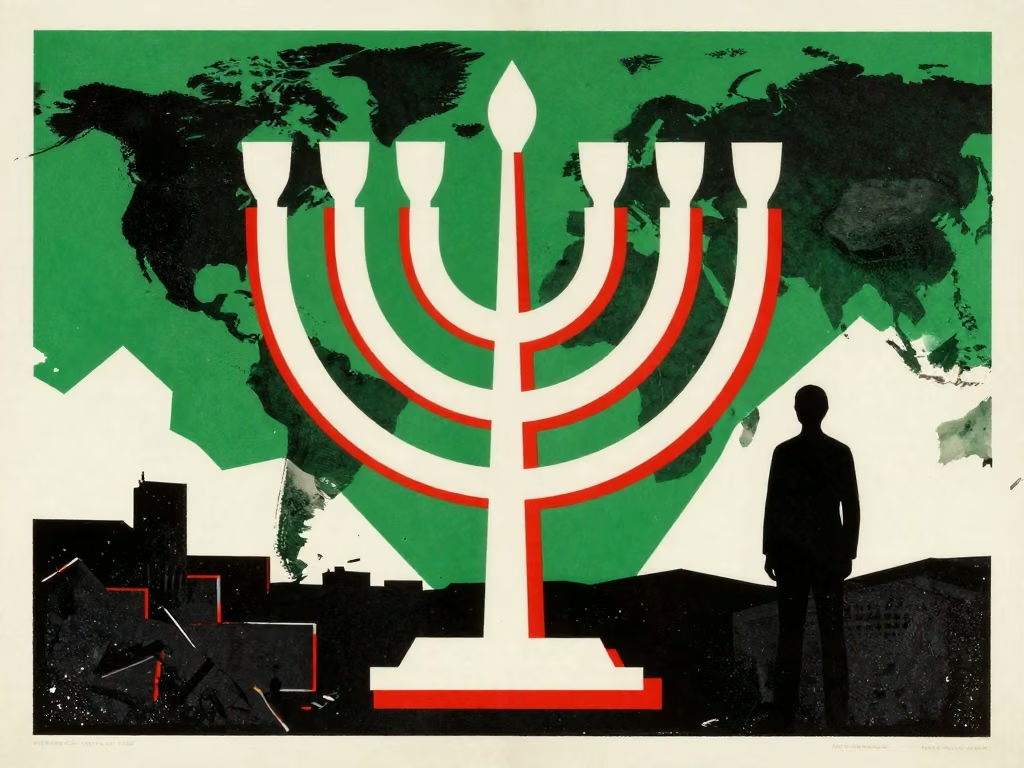
Chanukah – the Festival of Light which began last night – is yet one more occasion for us to witness the triumph of darkness over light in the ongoing destructive instrumentalisation of the worst of the Jewish tradition.
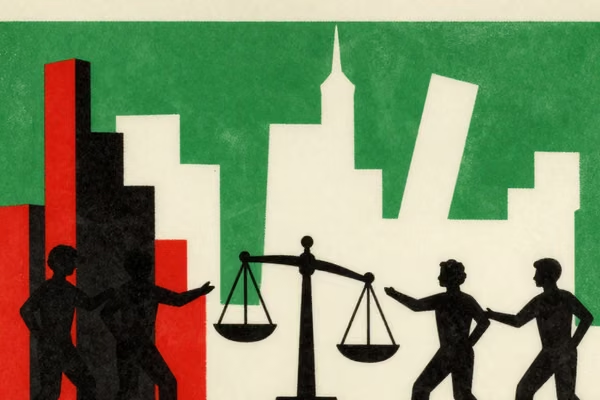
In this essay for The Pickle, Matt Gordon looks at several left-wing alternatives to this instrumentalisation, identifying problems with each.
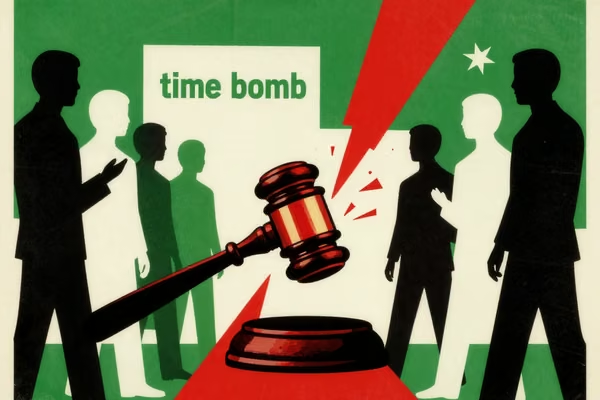
Given the reality of a divided Jewish people, in which different sides tolerate each other at best, Gordon calls for a different approach altogether.
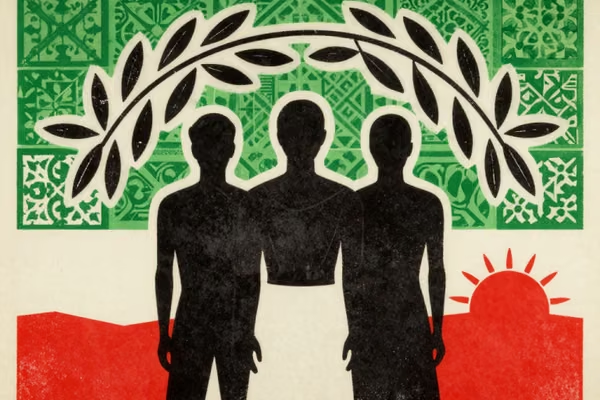
We must look, he suggests at other possibilities for new, non-statist forms of political life with a non-hierarchical, federated distribution of power and resources.
Gordon is able to point to ideas and initiatives which, he believes, can help move us in this direction.
RK
This article was originally published by The Pickle on Fri 8 Dec 2023. Read the original here.
Jewish politics beyond Zionism: Lessons from Somaliland
Vashti editor Matt Gordon explores the potential of non-statist forms of Jewish life, influenced by his decade of living and researching in Somaliland.
Loading article text…
This is really thought provoking and hopeful. I am going to send it to my Quaker meeting. So good to see profound thinking and analysis happening at this terrible time.
It’s good that it is being publicised.
I found Matthew Gordon’s discussion of Somalia particularly interesting, and can relate to his positive comments about Somaliland finding ways of settling disputes without foreign intervention. In 1986, I travelled around Somalia for the European Commission (you won’t believe this!) on a study of the World market for Frankincense and Myrhh – and to assess the case for privatising the industry. These are gums (exudates from wild trees) that Europe and the Middle East had been importing from the countries around the Red Sea since antiquity. In the 1980s they remained Somalia’s number 3 export. I like to call this trade “the oldest profession in the World (bar one)”. During the trip, I visited Erigavo in Somaliland and immediately got the impression that this former British “protectorate” had developed a more robust civil society than in the rest of Somalia which had been dominated by the Italians and was rapidly descending into nihilistic “warlordism” – that subsequently precipitated a civil war and the break-up of the country. In Erigavo, a leading figure gave us a back-handed compliment along these lines: “The Italians gave Somalia Fascism and considerable investment; the British gave us English law and nothing else”. In reality, Britain’s only purposes in taking control of this barren and resource-poor place had been to protect the camel trains supplying food to Aden, and to keep out our old rival, the French. These remained confined to Djibouti, the tiny enclave next door where there was good living for French soldiers and expats. I arrived in Djibouti after weeks of travelling around Somalia on a diet of goat meat, camel meat, goat milk, camel milk, and spaghetti. After a day in Djibouti, I wrote back to my boss with the words: “J’ai abouti a Djibouti. Plus de viande et lait de chevre ou de chameau. Plus de spaghetti. Vive la cuisine Djiboutienne”!