
Direct action works – the Colston statue aftermath
JVL Introduction
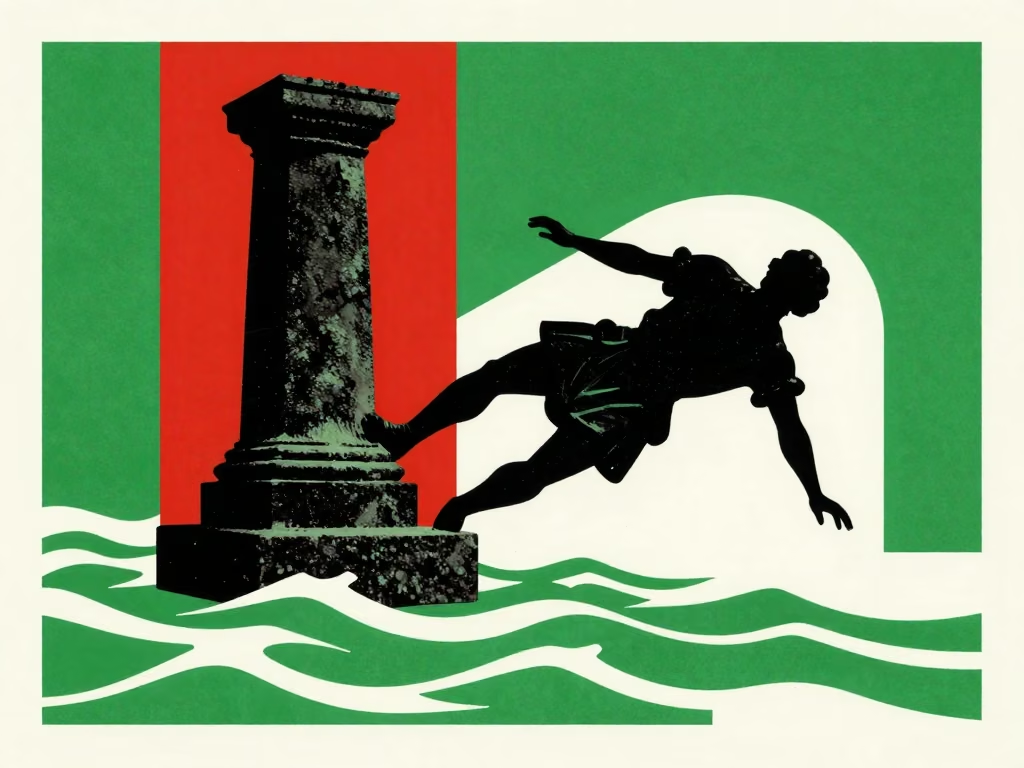
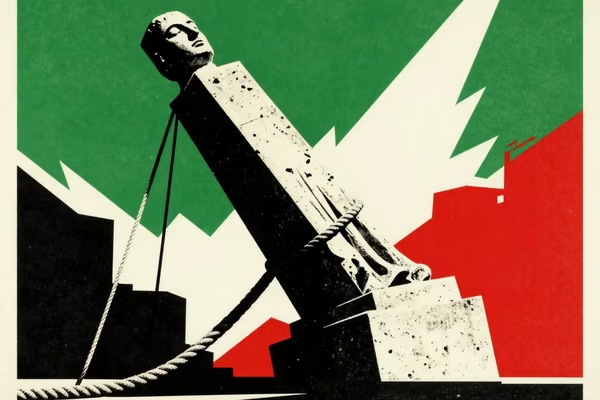
You might recall the furore that followed the felling of Edward Colson’s statue in Bristol on 7th June 2020.
For Priti Patel it was “utterly disgraceful”, “completely unacceptable” and “sheer vandalism”, for Boris Johnson removing statues of figures like Colston was “to lie about our history” .
On the contrary, it is helping the truth be told, as Kojo Koram argues here.
The waves from that event helped change the mood in Britain, so much so that King Charles has recently agreed to open the royal archives for research into the British monarchy’s ties to slavery…
This article was originally published by the Guardian on Fri 7 Apr 2023. Read the original here.
Those who tore down Colston’s statue helped lead us to the truth about slavery and the monarchy
BLM protesters in Bristol were accused, in 2020, of ‘erasing history’. Now we know they have flooded it with light
Loading article text…
It is important to add a few other details to this story. There had been sustained attempts over years to get the statue removed by peaceful bureaucratic channels, to no avail. It stood on Bristol Council land yet even the current Mayor seems to have been in no hurry to have it removed. Worse still, when statue was finally torn down, the Mayor gave the police the Green light to proceed with prosecutions of those who were deemed to have been most responsible. The police delayed for some time following the incident, maybe expecting the Mayor to show clemency as it was on BCC land & for a cause he is reputed to care about. The decision to prosecute & lengthy wait for trial turned upside down the lives & careers of courageous young people, who did indeed help shine the spotlight on the slave trade again & enhance Bristol’s reputation as a City that engages with injustice. Bristol.City Council have cynically both appeared to condemn the toppling yet proclaim their abhorrence of slavery & basked in the attention this action provoked.
I don’t read the Guardian any more, so I’m grateful to you for reproducing this important article and to Kojo Karam for writing it. Many threads are coming together to bring this aspect of our history to prominence: the Colston protests certainly, but also David Olusoga’s television work and books; the National Trust’s efforts to expose the history of slavery woven into the history of their properties and their former owners; and accessible scholarship like Priyamvada Gopal’s Insurgent Empire all help.
I was born and raised in Bristol some 74 years ago and I passed the statue of Edward Colston on my way to school every day and wondered who he was and why was there a statue there. In 1964 I participated in a school project about the history of my city and so I found out about Edward Colston, who wasn’t a Bristolian, but from the City of London. I became obsessed with ‘the history of the slave trade’ and its connection with the ‘American Civil Rights Movement’. My eyes were opened by Dr. Martin Luther King and so too my ears by Bob Dylan, but my teachers, the Christian Brothers, were not so keen, commenting that this part of history was none of our business, but I proudly proclaimed that all injustices are God’s business and for the first time in my life I realised that I must always speak truth to power. That still remains true today in my personal quest to seek justice for Palestine, some sixty years later.
I don’t need any bourgeois historians from Manchester University called David Olusaga, nor Dr.Kojo Koram from Birbeck School of Law, London, in their ivory towers of academic priviledge, and cetainly not the ‘wolf in sheep’s clothing’ aka the Guardian to preach to me about the history of my home city. The toppling of Edward Colston’s statue was not a spontaneous act, but a carefully stage managed and documented event involving a London based Arts & Film company. History must never be ‘whitewashed’.
It is a tenuous link at best, to connect the toppling of Edward Colston’s statue by a small group from Bristol intent on documenting their own ’15 minutes of fame’ with a demand to open Royal archives; this should have been done many years ago. Tearing down staues will change nothing but provide ‘good copy’ for the Guardian; perhaps a more effective way to challenge the evil of the slave trade would be to ask Bristol and other elite Universities to publish their part in history and provide access to a university education to the poorer people of Bristol rather than milk the benefits of ‘overseas’ students. The function of Universities throughout history, was to educate the ‘ruling classes’.
`
Dr Koram’s thoughts on the significance of Colston statue and the act to topple it in June 2020 are instructive. It convincingly demonstrates the centrality of slavery and slave trade within the British empire and its role in enriching the economic elites in British society. Yes, the statue’s dumping into the Bristol harbour did NOT represent an erasure of public history, but an act to RECLAIM it and raise awareness of the nation’s collective responsibility to address the legacy of slavery.
For me toppling the statue brought the Slave Trade into focus but it’s fading from people’s memories. It needs an epic film about the awful Trade, a story that shows all the gory details but giving the Black people personalities, to make it very realistic and not like a documentary, I read a story years ago, it was about an African young man, who was captured while out in the fields, he was beaten to stop him from fighting to get away, he was put on a sailing ship with other Africans and feeling terrified, he described the awful conditions and how those that died on the crossing were thrown overboard, it was a very graphic book, sadly I cannot remember the title. I do remember feeling very supportive while watching the statue being dragged to the dock and shoved into the water, then hearing people condemning them made me very angry and thinking these people need to know every awful thing about the Slave Trade and an epic film should be made which gets people talking about it could be exactly what’s needed. Escape from Sorbibor and Schindler’s List were 2 powerful films that brought the horrors of the Holocaust alive, I don’t mind admitting that I cried while watching both of them. I hope all this makes sense.