Skip to content

Theodor Meron – a great life
JVL Introduction

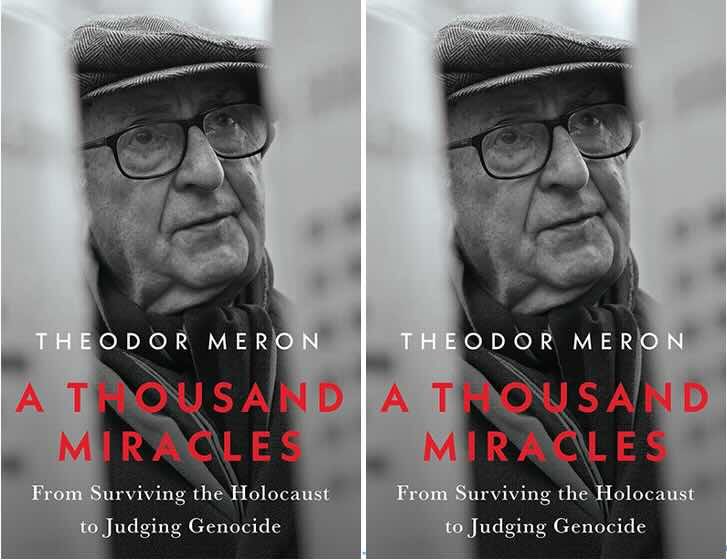
At the age of 92 Theodor Meron’s memoir A Thousand Miracles: From Surviving the Holocaust to Judging Genocide, was published earlier this year. A review by Mike Phipps in Labour Hub, is reposted below.

It is an extraordinary story of a refugee, a legal scholar, a principled adviser to governments, and ultimately a ground-breaking international judge of unusual integrity.

A 9-year old child when the Nazis invaded Poland, Meron spent the next six years surviving atrocious harassment and persecution in which most of his family were murdered.

In 1946 he made his way to Palestine aged 15 was mobilised in 1948 fighting what he believed to be a just war.

Afterwards he studied law in Israel and the UK before joining the Israeli foreign service. In the aftermath of the Six-Day war, he wrote legal opinions for the government. His conclusions that Palestinian house demolitions and deportations violated international law, as did Israeli civilian settlements in the West Bank, were not welcomed.

He left Israel for the US and a distinguished legal career. He contributed to the establishment of the International Criminal Court and served on its tribunals concerning war crimes in former Yugoslavia and Rwanda.

In 2024 Meron was part of an ICC  panel that called for Israeli leaders to be prosecuted for war crimes and crimes against humanity in Gaza – leading to President Trump’s imposition of sanctions of the ICC itself.

Few career lawyers and scholars survive the incredible pressures they are under to bend to political realities. Theodor Meron did so, and with great distinction.

RK


This article was originally published by Labour Hub on Mon 1 Jun 2026. Read the original here.

An inspiring memoir by an architect of international humanitarian law

Theodor Meron’s memoir follows an extraordinary journey — from the Częstochowa ghetto and a Nazi forced-labour camp to the founding of the International Criminal Court, the landmark genocide trials of Rwanda and former Yugoslavia, and his recent role advising the ICC on cases in Israel and Gaza.

Meron’s happy childhood was cut short at the age of  nine when the Nazis invaded Poland. Fleeing with what they could carry, his family headed first east, then southwest,  on foot, sheltering in ditches when German planes attacked. Like many others, they were forced to live in a ghetto. Coming home one evening in 1943, he found Germans surrounding his and neighbouring houses: the residents were loaded onto trucks, driven out of town and executed. “I would never see my mother and my maternal grandparents again.” He, his father and uncle were put in a labour camp, where they stayed until liberation two years later.

Meron lost most of his family to the Holocaust. Furthermore, anti-Jewish sentiment in Poland did not disappear after the defeat of the Nazis. “The new communist regime was trying to gain popularity by adopting a nationalistic, even antisemitic tone.” An outbreak of anti-Jewish violence in July 1946 in the city of Kielce led to 42 Jews being killed and more than 40 wounded.

“Resuming our pre-war lives was a pipe dream.” Meron, who had had only three years of primary schooling, set off for Palestine at age 15, and studied hard to pass his high school exams.

In Haifa, relations between Jews and Arabs, once good, soon became tense, following the 1947 UN partition of Palestine into a Jewish and Arab state. When neighbouring countries invaded, Meron and other high school boys were mobilised to fight. “We all honestly believed that we were fighting a just war… Only later did I learn that the Israeli army used pressure and violence to force much of the Arab population to flee and become refugees, creating an intractable humanitarian and political problem.”

In 1950, Meron moved to Jerusalem to study Law and four years later enrolled at Harvard in the US, before going on to Cambridge University in the UK. In the mid-1950s, he started work in the Israeli foreign service where he stayed for about twenty years. In the aftermath of the Six-Day war, he wrote legal opinions concluding that civilian settlements in the West Bank violated international law, which his political masters did not want to hear and disregarded. He also gave opinions that stated that the demolition of houses and the deportation of Arabs suspected of subversive activities constituted both violations of the Fourth Geneva Convention and collective punishments.

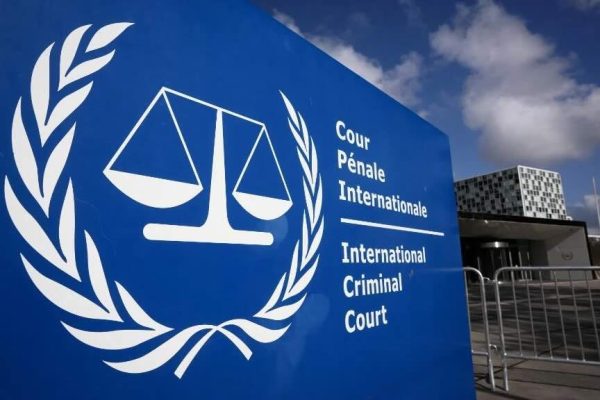
The International Criminal Court

Finding the political pressure restrictive, Meron left Israel for good and moved to New York to pursue an academic career, teaching human rights at New York University. In 1998 he was part of the US delegation to the international conference that established the International Criminal Court. A few years later, he worked at the US State Department on international law and in 2001 was elected as a judge by the UN General Assembly for the International Criminal Tribunal for the former Yugoslavia (ICTY), soon assuming its presidency. He also served on the International Criminal Tribunal for Rwanda (ICTR).

This was important work. During his tenure, Meron made key legal pronouncements on the crime of genocide, perhaps most importantly confirming it could be committed in even a small area or region, and that the 1995 Srebrenica massacre was indeed genocide. The author argues that both tribunals succeeded in bringing a substantial number of high-level suspects from the former Yugoslavia and Rwanda to justice. In particular, “The most singular achievement of the ICTY and the ICTR has been their focus on and success in prosecuting and elaborating the crime of rape. This is in stark contrast with the Nuremberg and Tokyo trials. In the ICTY alone, 80 individuals, or almost half the 161 accused, had charges of sexual violence included in their indictments, and 36 were convicted for such crimes.”

Speaking at the 2015 commemoration of the Srebrenica genocide, Meron said: “Those who devise and implement genocide seek to deprive humanity of the manifold richness its nationalities, races, ethnicities, and religions provide. This is a crime against all of humankind, its harm being felt not only by the group targeted for destruction but by all of humanity.”

In 2004, the ICTY published a list of five accomplishments: “Spearheading the shift from impunity to accountability”, pointing out that, until very recently, it was the only court judging crimes committed as part of the Yugoslav conflict, since prosecutors in the former Yugoslavia were reluctant to prosecute such crimes; highlighting the extensive evidence-gathering that tribunal judgments produced; “bringing justice to thousands of victims and giving them a voice”; fleshing out several international criminal law concepts which had not been ruled on since the Nuremberg Trials; and “strengthening the Rule of Law”, referring to the tribunal’s role in promoting the use of international standards in war crimes prosecutions by former Yugoslav republics.

That said, the ICTY inevitably came in for criticism, perhaps most significantly for over-lenient sentences and excessively long trials. The tribunal’s rejection of an invitation from the UN General Assembly president to participate in its debate about their work also came under attack, although Meron sidesteps these controversies in his memoir.

in June 2022, at the age of 92, Meron was appointed as special adviser of the prosecutor of the ICC on international humanitarian law. He was involved in the case that led the ICC to issue arrest warrants for President Vladimir Putin and Maria Lvova-Belova, the Russian commissioner for children’s rights, for the war crime of unlawful deportation of children from Ukraine to the Russian Federation. Many of these children were adopted by Russian families and given Russian nationality, despite their status as protected persons under the Geneva Conventions.

In 2024, Meron was part of an ICC  panel that called for Israeli leaders to be prosecuted for war crimes and crimes against humanity in Gaza. In response, President Trump issued an executive order imposing sanctions on the ICC, threatening, in Meron’s view, its very survival. Meron says: “The sanctions regime imposed on the ICC prosecutor in February 2025 is a major retrogressive step, which will inevitably promote impunity and make it much harder for the ICC to perform its mission.”


Mike Phipps’ book Don’t Stop Thinking About Tomorrow: The Labour Party after Jeremy Corbyn (OR Books, 2022) can be ordered here.

No comments on this post so far.

Leave a Reply

Your email address will not be published.

This site uses Akismet to reduce spam. Learn how your comment data is processed.