
The Polish Government’s War on Jewish History
JVL Introduction
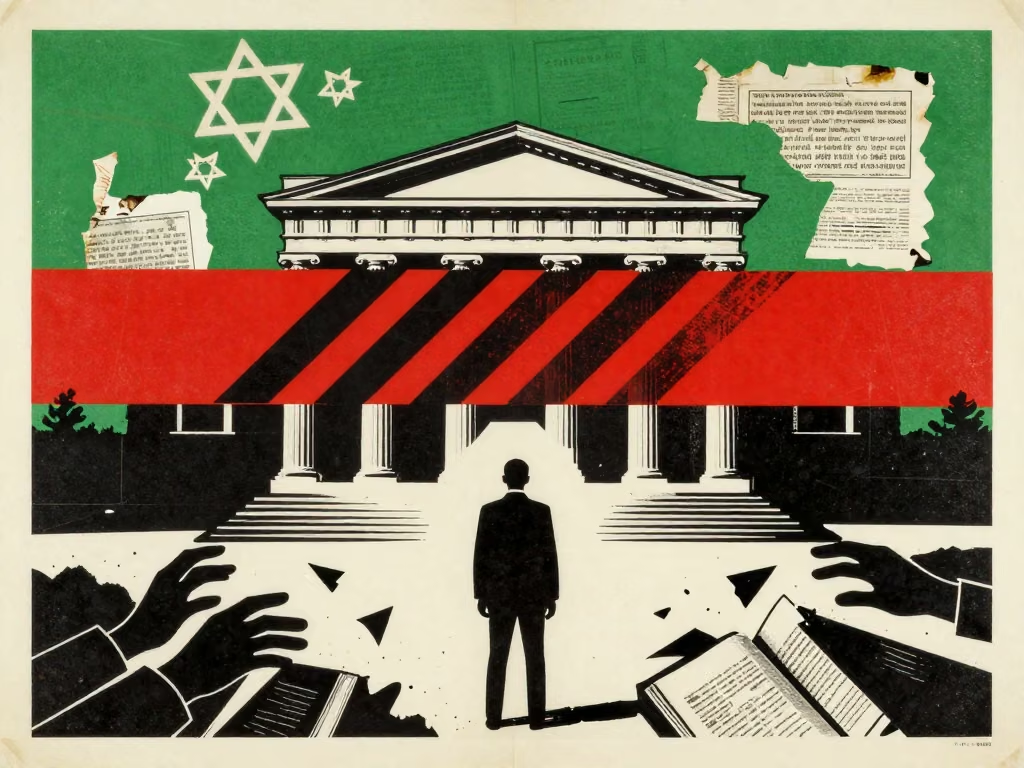
Historian Dariusz Stola has resigned as director of Polin, the Museum of Polish Jewish History in Warsaw. This is because the minster for Culture of the right-wing Polish government has persistently refused to renew his appointment, despite the backing of the other two of the Museum’s three founding bodies.
Stola’s crime? Publicly opposing a proposed law that would have criminalized discussions of Polish complicity in Nazi atrocities; and the xenophobic rhetoric associated with the ruling Law and Justice party.
In this interview, published in Jewish Currents, Stola discusses the Polish government’s campaign against independent cultural institutions which challenge its desire to control the narrative of Poland’s past. It is a direct threat to the recent flourishing of Polish Jewish History.
This article was originally published by Jewish Currents on Tue 3 Mar 2020. Read the original here.
The Polish Government’s War on Jewish History
Loading article text…








Sad.
Actually, a visit to Poland in the 1970s was seminal for me in terms of education about the Holocaust, and the way in which the territory was turned into a patchwork of atrocities.
And the suffering was shared, in my recollection, and remembered as such , despite historical antisemitism. Had that not been so, the impression made would not have been what it is
It was my first personal encounter with the massive difference of the experience of WWII between the UK and continental Europe.
The exploitation of antisemitism in Poland by those in power has taken many different forms in different periods. In contemporary Poland antisemitism manifests itself in the ethnic cleansing of dark chapters of the historical record, while politically Polish nationalists are happy to make common cause with the Israeli propagandists in their demonisation of Islam, and their political support for Zionist ethnic cleansing of Palestine. It was not always so.
Few people are aware that there is a striking similarity between the present political conflation of antisemitism with antisemitism in the UK, and events which occurred in communist Poland 52 years ago.
In 1968 as an exchange graduate student in Poland, I bore witness to a such an ideological conflation which had almost exactly the “dual” characteristics of the conflation which we are now witnessing in the UK.
At that time there was a power struggle unfolding in the top levels of the ruling communist party between (i) the old guard associated with the leader Gomulka, many of whom, for historic reasons, were of Jewish antecedence (though Gomulka himself was not), (ii) a Polish nationalist faction with culturally repressive and antisemitic tendencies led by a certain General Moczar, and (iii) a third group of pragmatic “modernising technocrats” . Eventually Gomulka’s group lost power, as did Moczar’s group, but not before a virulent official “anti-Zionist” campaign in the media, led by the Moczar group, had resulted not only in the expulsion of the Jewish members of the communist elite, but also in the coerced emigration from Poland of most of the remaining members of the small but significant Jewish intelligentsia, Only a relatively small minority of those expelled had any particular Zionist sympathies, and an even smaller number were religious Jews.
What is interesting in this historical episode is that
(a) anti-Zionism was part of official ideology, whereas antisemitism was not
(b) anti-Zionism was being used as a thinly veiled cover for antisemitism.
(c) the primary domestic political purpose of the fake “anti-Zionism” campaign was in reality a relatively narrow political one: to weaken the dominant faction of the communist party in order to engineer a takeover.
(d) the secondary political function of the fake “anti-Zionism” campaign was to justify the geostrategic realpolitik of the locally dominant superpower, the USSR.
It was a truly shameful episode which forced several thousand Jews into emigration, most of whom had at that time no Zionist inclinations whatsoever. While Moczar’s fake “anti-zionist” campaign reached hysterical proportions within the Polish communist party, it was in my experience not particularly popular with the general Polish population at that time, who tended to regard it with the same sort of disinterested apolitical cynicism that characterised their general attitude to official state propaganda. The student body and radical intelligentsia, reacting to the leftist zeitgeist already awakening over the whole of Europe, condemned this ideological fraud.
How does this relate to our current situation in the UK? Suppose that we interchange “antisemitism” with “Zionism” in (a), (b), (c) and (d) above, replace the past tense by the present, and “communist party” by “labour party”, and the USSR by the USA:
This results in the following:
(a)’ anti-antisemitism is part of official ideology, whereas Zionism is not.
(b)’ anti-antisemitism is being used as a thinly veiled cover for Zionism.
(c)’. the primary domestic political purpose of the fake “anti-antisemitism” campaign is a relatively narrow political one: to weaken the dominant faction of the Labour party in order to engineer a takeover.
(d)’ the secondary political function of the fake “anti-antisemitism” campaign is to justify the geostrategic realpolitik of the locally dominant superpower, the USA.
This represents a striking ideological dual of historical events in another European country 52 years ago.
As has often been remarked, the conflation of distinct concepts only serves to increase the sum of human misery.