
Some reflections on Holocaust Memorial Day
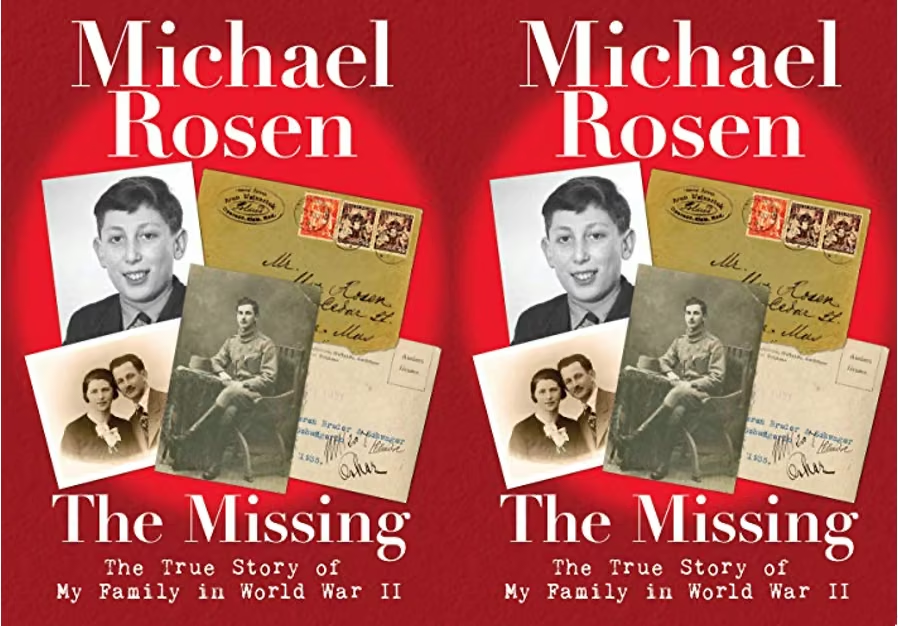
JVL Introduction
Giving a series of radio interviews today, Holocaust Memorial Day, has led Michael Rosen to post some quick thoughts and questions about the responses he gave.
RK
This article was originally published by Facebook on Tue 27 Jan 2026. Read the original here.
Some reflections on Holocaust Memorial Day
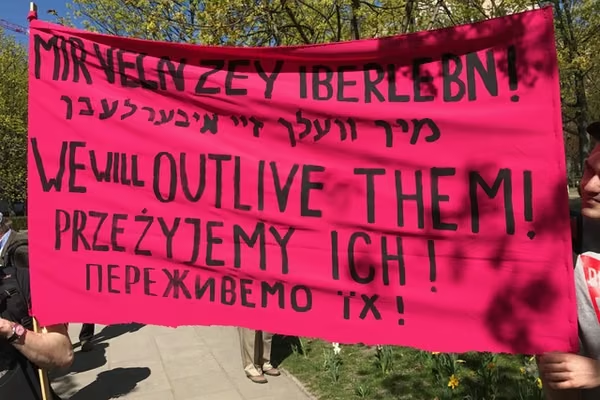
Today I spent an hour and a half in a studio at the BBC, talking to 12 local radio stations, one after the other, about Holocaust Memorial Day. I talked about people in my family (Jews) who were arrested, imprisoned, deported and killed in Auschwitz. I talked about how I got to find out the details of how each of them was trapped as the net closed in round Jews in France (where my father’s uncles and aunt lived.) I talked about how the Nazi project was to not only eliminate living Jews but to try to remove them from German history and that my project to ‘find’ them and write about them, was to not let them disappear from memory, or from being known.
Several themes emerged in the interviewers’ questions and the answers I gave – and in my thoughts.
1. The Holocaust was a way of eliminating people. It wasn’t a war in the usual sense of the word. It wasn’t a fight between two or more combatants. You could say that it was a war on people.
2. The Holocaust was carried out by the Nazis and their collaborators. If we say ‘Never again’ or anything similar, one of the things we have to do is investigate what it was that the Nazis did, before they came to power and during the time they were in power. This involves facing up to the fact that they were the largest political party when they won power, that they brought in two key acts of parliament (the Reichstag Fire Decree and the Enabling Act, which mean that a) they had total dictatorial power and b) that they eliminated most of the political opposition through terror, imprisonment and violence). That their ‘project’ progressed as their rule progressed and as the war progressed. In short from persecution to genocide.
3. Much as we’d like to say that the Nazis were ‘beasts’ or ‘animals’, the really distressing and difficult thing to say is that they were human. And not only that, some of them were clever. We have to try to understand what does it mean to be the kind of clever human who can be someone who can organise, run and enact genocide – several genocides.
4. There was a Nazi project. They wrote about it and explained it. They enacted it. It involved on the one hand producing a new kind of human, one that would require them to eliminate elements that they thought prevented this human from becoming its true form. On the other hand, it involved creating an empire by absorbing lands in the east. In order to achieve this twin aim, the Nazis had ‘get rid’ of people. Millions and millions of people.
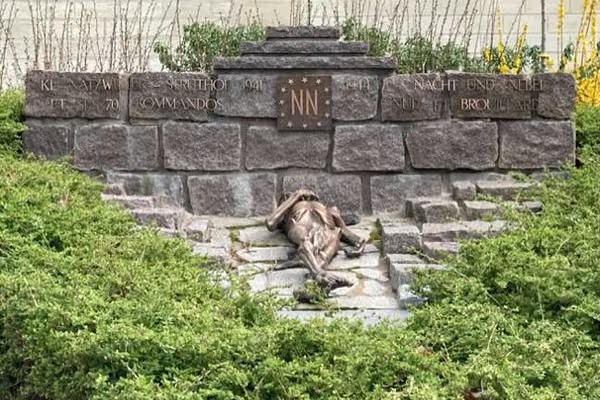
5. If we say ‘never again’, it is possible to say, this means ‘never again for Jews’ or ‘Jews must never again be targeted in that way’. It is also possible to see ‘Never again’ as a hope or wish that there should never again be that kind of genocide for anyone. I’m of this second school of thought, which is all well and good, but since 1945, when that aspiration surfaced there have been acts of genocide. One of the reasons we can and should say it’s about all of humanity and not only Jews is that the Nazi project involved killing millions of people who were eg Poles (ie non-Jewish Poles), Roma and Sinti people, Russians, gays, mentally ill and physically disabled people, Afro-Germans, and even people who refused to swear an oath of loyalty such as Jehova’s Witnesses, and thousands of civilian oppositionists – socialists, Communists, trade unionists, in camps like Dachau and Sachsenhausen.
6. For those that say, there have been many other terrible acts of genocide down through history, shouldn’t we commemorate them? I say yes. I wish there were other Days when we mark the transatlantic slave trade and plantation slavery, or the Bengal Famine or Stalin’s starvation of the Ukrainians, or the Famine in Ireland etc. There should not be any kind of league table. Each of these terrible moments of mass suffering should be moments we dwell on, investigate and learn from. How did they happen? Why did they happen? I guess I think, it’ll be hard to progress unless we do investigate and understand these things.

Having listened today to some in the easily accessible media, could I please say a sincere `thank you` Michael for those thoughts. I`m sure others will agree, there is much political `distortion` and ignorance surrounding Holocaust Memorial Day. Thank you once again.
I wonder how many of the terrible events on your list appear on the school syllabus in this country? Ignorance allows atrocity to persist.
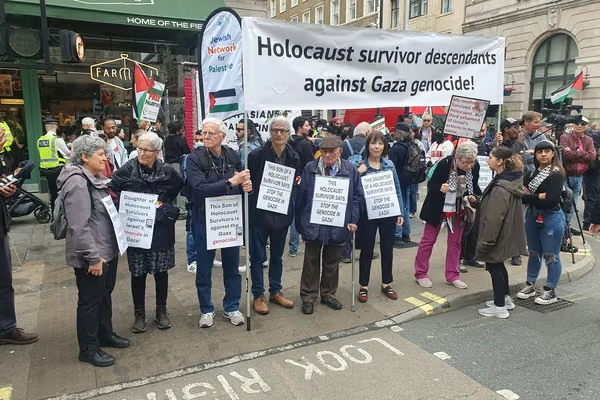
Great comment by Michael Rosen showing the wider scope of the Holocaust than the 6 million Jews that need to be memorialise and that Never Again should be for anyone who is being dehumanised. Seeing this was a BBC interview, would they have censored Michael if he brought in the genocide of Palestinians in Gaza and the West Bank, showing thY the people who suffered the Holocaust had not learned the lesson of Never Again, but have not ended the genocide but are making it their endless policy of expansion of Greater Israel until no Palestinian entity is left.
Painful and shameful omission of Gaza. I guess that is why he is invited by the BBC to speak on the subject.
Michael has been out spoken on Gaza on all outlets. Do not over-interpret what he wrote in one post
As Mike Cashman has kindly pointed out, I’ve been speaking and writing about Palestine and Palestinians for decades: poems, speeches at meetings, taking part in benefit nights, and more recently on social media, nearly every day. In fact, some of my poems are read out loud by others, or filmed and used to express solidarity with Palestinians. On the point ‘I guess why he is invited by the BBC to speak on the subject’: I think there’s a problem about the chronological order. I wrote the above article after I did the local radio interviews, not before it. So I’m not sure what this article has got to do with being asked or not being asked to be on the BBC. What I didn’t say in the article that the ‘peg’ for the interviews was that I’ve been doing workshops to do with the Holocaust for the last 10 years or so. My most recent book of poems that includes many poems about Gaza is called ‘Words United’ and is published by Culture Matters. All profits go to Medical Aid for Palestinians. There’s a follow-up volume coming out in April or May. I also published a book called ‘The King and the Tutor’ which is a series of satires on how rulers (in particular Israeli rulers) justify their violence, ethnic cleansing, mass killing etc.
Why did he not mention Gaza? It is not history, it is here and now and everyone knows it is going on, unlike some genocides in the past which only became apparent later on.
Rada – I take it you are not familiar with Michael Rosen? As Abe implies above, he would have undoubtedly been censored by the BBC if Gaza had been mentioned. However, I think his writing here cleverly lead us to think of the events in Gaza without implicitly mentioning it. He is an absolute master with language and a fine and honourable man.
I am grateful to Michael Rosen who has stood up for Palestine for many years, but I feel this was an opportunity lost and plays into the hands of those who use the Holocaust to justify special protection of Zionism, not Judaism , and use it to silence and ‘morally blackmail’ any pro Palestine, genocide-awareness talk. To have mentioned the word Palestine while talking about the absolute horrors and dehumanisation of the Nazis, to show the parallels in literature, demonising and dehumanising, the Times cartoons which only show Palestinians as Hamas, etc etc, would have been intensely powerful. By omitting it, it has continued the story that the Holocaust rises above every other atrocity in moral depravity, and gives more fodder to the zionist racism and the current silencing of Palestinian voices. Just one mention of Palestine would have been enough. A lost opportunity to comment on really Never Again for Everyone. I think Stephen Kapos might have made a different point.
Shukrun Michael, keep up the good work.