
Seven Jewish Children – a film for Gaza (and five poems)
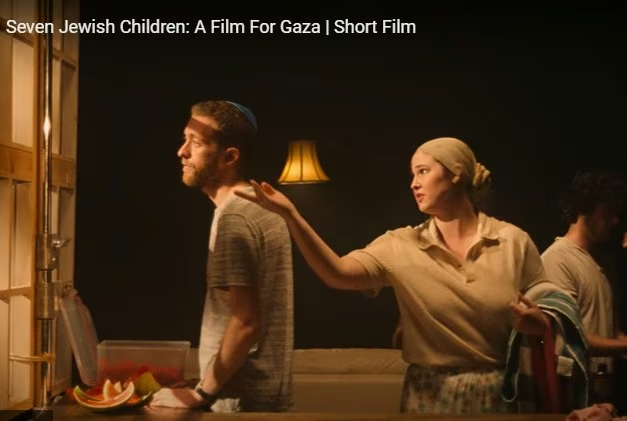
“Seven families, seven daughters, seven key moments in history.”
Poems read at the premiere of Omri Dayan’s film Seven Jewish Children
Chipo Chung read There Was No Farewell
by Taha Muhammad Ali
We did not weep
when we were leaving-
for we had neither
time nor tears,
and there was no farewell.
We did not know
at the moment of parting
that it was a parting,
so where would our weeping
have come from?
We did not stay
awake all night
(and did not doze)
the night of our leaving.
That night we had
neither night nor light,
and no moon rose.
That night we lost our star,
our lamp misled us;
we didn’t receive our share
of sleeplessness-
so where would wakefulness have come from?
Khalid Abdalla read Under the Rubble
By Mosab Abu Toha
She slept on her bed,
never woke up again.
Her bed has become her grave,
a tomb beneath the ceiling of her room,
the ceiling a cenotaph.
No name, no year of birth,
no year of death, no epitaph.
Only blood and a smashed
picture frame in ruin
next to her.
•
In Jabalia camp, a mother collects her daughter’s
flesh in a piggy bank,
hoping to buy her a plot
on a river in a faraway land.
•
A group of mute people
were talking sign.
When a bomb fell,
they fell silent.
•
It rained again last night.
The new plant looked for
an umbrella in the garage.
The bombing got intense
and our house looked for
a shelter in the neighborhood.
•
I leave the door to my room open, so the words in my books,
the titles, and names of authors and publishers,
could flee when they hear the bombs.
•
I became homeless once but
the rubble of my city
covered the streets.
•
They could not find a stretcher
to carry your body. They put
you on a wooden door they found
under the rubble:
Your neighbors: a moving wall.
•
The scars on our children’s faces
will look for you.
Our children’s amputated legs
will run after you.
•
He left the house to buy some bread for his kids.
News of his death made it home,
but not the bread.
No bread.
Death sits to eat whoever remains of the kids.
No need for a table, no need for bread.
•
A father wakes up at night, sees
the random colors on the walls
drawn by his four-year-old daughter.
The colors are about four feet high.
Next year, they would be five.
But the painter has died
in an air strike.
There are no colors anymore.
There are no walls.
•
I changed the order of my books on the shelves.
Two days later, the war broke out.
Beware of changing the order of your books!
•
What are you thinking?
What thinking?
What you?
You?
Is there still you?
You there?
•
Where should people go? Should they
build a big ladder and go up?
But heaven has been blocked by the drones
and F-16s and the smoke of death.
•
My son asks me whether,
when we return to Gaza,
I could get him a puppy.
I say, “I promise, if we can find any.”
I ask my son if he wishes to become a pilot when he grows up.
He says he won’t wish to drop bombs on people and houses.
•
When we die, our souls leave our bodies,
take with them everything they loved
in our bedrooms: the perfume bottles,
the makeup, the necklaces, and the pens.
In Gaza, our bodies and rooms get crushed.
Nothing remains for the soul.
Even our souls,
they get stuck under the rubble for weeks.
Juliette Stevenson read My Son Throws a Blanket Over My Daughter:
By Mosab Abu Toha
At night, at home, we sit on the floor,
close to each other and
far from the windows and the red
lights of bombs. Our backs bang on the walls
whenever the house shakes.
We stare at each other’s face,
scared and yet happy that we were lucky,
that our lives were spared this time.
The walls wake up from their fitful sleep.
Flies gather around the only lit ceiling lamp
for warmth in the cold night,
cold except when missiles hit
and heat up houses and roads and trees,
scorching an adjacent neighborhood.
Every time we hear a bomb
falling from an F-16 or an F-35,
our lives panic. Our lives freeze
somewhere in-between, confused
where to head next:
to a graveyard, to a hospital,
or to a nightmare.
Our lives keep their shivering hands
on their wristwatch,
fingers ready to remove the batteries
if and when needed.
My four-year-old daughter, Yaffa,
in her pink dress, hears a bomb
explode. She breathes in deep,
covers her mouth with her dress’s
ruffles.
Yazzan, her five-and-a-half-year old brother,
grabs a blanket warmed by his sleepy body.
He lays the blanket on his sister.
You can hide now, he assures her.
As for me and my wife, Maram, we pray
that a magic blanket would hide all the houses
from the bombs and take us to somewhere safe.
Sara Masry read Write My Name
By Zeina Azzam
Write my name on my leg, Mama
Use the black permanent marker
with the ink that doesn’t bleed
if it gets wet, the one that doesn’t melt
if it’s exposed to heat
Write my name on my leg, Mama
Make the lines thick and clear
Add your special flourishes
so I can take comfort in seeing
my mama’s handwriting when I go to sleep
Write my name on my leg, Mama
and on the legs of my sisters and brothers
This way we will belong together
This way we will be known
as your children
Write my name on my leg, Mama
and please write your name
and Baba’s name on your legs, too
so we will be remembered
as a family
Write my name on my leg, Mama
Don’t add any numbers
like when I was born or the address of our home
I don’t want the world to list me as a number
I have a name and I am not a number
Write my name on my leg, Mama
When the bomb hits our house
When the walls crush our skulls and bones
our legs will tell our story, how
there was nowhere for us to run
Ami Dayan read IF I MUST DIE
By Refaat Alareer
If I must die,
you must live
to tell my story
to sell my things
to buy a piece of cloth
and some strings,
(make it white with a long tail)
so that a child, somewhere in Gaza
while looking heaven in the eye
awaiting his dad who left in a blaze—
and bid no one farewell
not even to his flesh
not even to himself—
sees the kite, my kite you made,
flying up above
and thinks for a moment an angel is there
bringing back love
If I must die
let it bring hope
let it be a tale.
Comments are now closed.