
Not anti-Jewish to back Palestine, Bishop of Gloucester says

JVL Introduction
We post here three items from the Church Times.
First a report on the Bishop of Gloucester, Rt Revd Rachel Treweek, who had the temerity to ask:
“Why can we not condemn the actions of this government of Israel regarding Palestine, and at the same time condemn anti-Semitism in the UK? The two things are entirely different and should not be conflated or cancel each other out.
Baroness Deech was quick to the rescue. Citing the IHRA working definition (which she misquotes, including in the definition a couple of its examples), she focuses on the crime of double standards, “evident when multiple questions are raised about Israel and no other foreign country”, of which the Church is found guilty.
In a masterpiece of compression, Chris Oakes-Monger responds to Deech, dissecting and demolishing her three key arguments in the space of a handful of incisive paragraphs.
An inspiration to us all!
Not anti-Jewish to back Palestine, Bishop of Gloucester says
James Macintyre, Church Times, 03 June 2026
Anti-Semitism can be condemned at the same time as opposing the actions of the current Israeli government, she says
THE Bishop of Gloucester, the Rt Revd Rachel Treweek, has expressed her “deep disturbance” at the binary nature of the debate on anti-Semitism, which, she says, can be condemned at the same time as opposing the actions of the current Israeli government.
In a blog on her diocesan website, the Bishop, who has travelled regularly to the Holy Land and also recently spoke out against the rise in anti-Semitic attacks in the UK, expresses her dismay “at our inability to hold different things together in tension at the same time”.
She asks:
“Why can we not condemn the actions of this government of Israel regarding Palestine, and at the same time condemn anti-Semitism in the UK? The two things are entirely different and should not be conflated or cancel each other out. Jews in the UK are not responsible for the actions and decisions of a foreign government and we need to be extremely careful not to create false dichotomies.”
Earlier this year, she told the Church Times that the British Government was “complicit in the occupation” of the West Bank, and said that sanctions were needed to send a “strong message” to the Israeli government (News, 2 February). She made those remarks after returning from a joint visit to Palestine and Israel with the Bishops of Chelmsford and Norwich, Dr Guli Francis-Dehqani and the Rt Revd Graham Usher.
In her new article, Bishop Treweek writes:
“Whilst a spotlight is rightly shone on the heinous anti-Semitism which insidiously prevails in this country, I am deeply perturbed that people are seemingly discouraged from also shining a spotlight of scrutiny on the heinous actions of the Israeli government meted out on the Palestinian people in Gaza, the West Bank and East Jerusalem, not least for fear of being accused of fanning anti-Semitism into flame. This is not a zero-sum space, and it is not incompatible to shine a spotlight on both of these issues at the same time.
“Until recently, the spotlights on the atrocities of the government of Israel in Gaza and the West Bank seemed to have been switched off, or at best were merely flickering, not only because of the focus on the war with Iran but also because of the appalling anti-Jewish behaviour in our communities in the UK.”
**********
Criticism of Israel must not apply double standard
From Baroness Deech, Church Times, 12 June 2026
Madam, — I write in response to your report (News, 5 June) of the attempt by the Bishop of Gloucester in her blog to differentiate between antisemitism and criticism of Israel. Many Jewish people experience little significant difference between antisemitism and obsessive unfounded criticism of the world’s only Jewish state. Nevertheless, it is this boundary that the International Holocaust Remembrance Authority seeks to delineate in its working definition of antisemitism.
The basic definition is as follows: “Antisemitism is a certain perception of Jews, which may be expressed as hatred toward Jews. Rhetorical and physical manifestations of antisemitism are directed toward Jewish or non-Jewish individuals and/or their property, toward Jewish community institutions and religious facilities. Manifestations might include the targeting of the state of Israel, conceived as a Jewish collectivity. However, criticism of Israel similar to that leveled against any other country cannot be regarded as antisemitic.”
It is then amplified by examples, of which a very pertinent one is this : “Applying double standards by requiring of it a behavior not expected or demanded of any other democratic nation.”
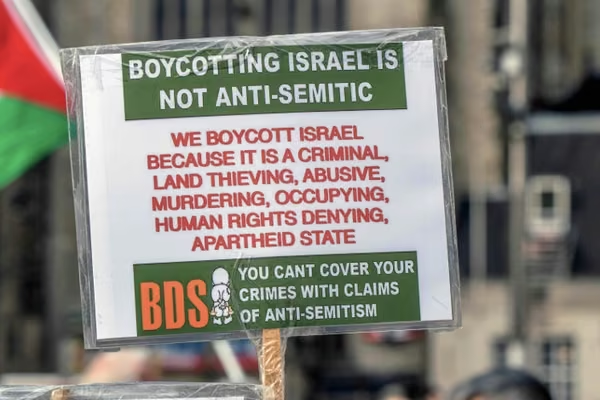
Double standards are evident when multiple questions are raised about Israel and no other foreign country. They are evident when the unjustified words “apartheid” and “genocidal” are applied to Israel, when those words could well be used validly of, for example, China and the Uyghurs, India and the Dalits, Myanmar and the Rohingya, and Saudi Arabia and religious minorities.
We do not hear loudly from the Church about the dead children in Yemen, Syria, Sudan, Nigeria, and Iran, or the kidnapped Ukrainian children. We do not hear protests about the checkpoints in Belfast dividing two communities. Only when Jews are involved are there such loud condemnations. The Church’s preoccupation with the Jewish state, as if it were the worst — the Jew among nations — amounts to double standards, because the ethical difference between the attitude to Israel’s conduct, its casus belli, and the conduct of other states at war is clear. Genocide and apartheid are inflammatory words designed to stir up hatred and to re-contextualise the actual genocide of the Jewish population in the Second World War.
The declared goal of Hamas and its potential state is the murder of all seven million Jews in Israel. Hamas enjoys the overwhelming support of Palestinians in Gaza and the West Bank. It is unacceptable to ignore these facts while pronouncing anathemas on Jews targeted for a second Holocaust.
Jews have survived (just barely) 2000 years of hatred initiated and incited by the Church: the Crusades, the Inquisition, the expulsions, the blood libels, ghettoes, the charges of deicide and supersession, Martin Luther’s vilifications, the forced conversions, the pogroms, and other crimes too numerous to mention. It seems to many of us that this history imposes a certain responsibility on the Church to stand with Jews around the world and for the safety of Israel against those who plan to murder us.
DEECH
House of Lords, London SW1
**********
Criticism of Israel versus antisemitism: a response to Baroness Deech
From Mr Chris Oakes-Monger, Church Times, 19 June 2026
Madam, — The arguments in Baroness Deech’s response to the attempt by the Bishop of Gloucester, the Rt Revd Rachel Treweek, “to differentiate between antisemitism and criticism of Israel” (Letter, 12 June) deserve careful examination.
Her case can be summarised under three main heads: first, that the definition of potential victims of antisemitism necessarily includes the State of Israel and, in her view, by extension, its current government; second, that criticism of that government should not exhibit “double standards by requiring of it behaviour not expected of other democratic governments”; and, third, that somehow criticisms of the current policies of the Israeli government morph seamlessly into a threat to all Jews.
The IHRA definition of antisemitism, which she cites, is controversial precisely because it provides space for apologists for the Israeli government to claim, in defiance of plenty of evidence to the contrary, that perfectly valid criticism of that government is based on hatred towards Jews. This then enables them to shift discussion away from the war crimes of the Israeli government into a debate about what we are allowed to say about them.
She then moves on to cite as evidence of antisemitism the “unjustified words ‘apartheid’ and ‘genocidal’ applied to Israel, when those words could well be used” of other states around the world. Pointing out their potential use elsewhere does not, however, make them unjustified. Again, she is simply attempting to distract the debate from the behaviour of the Israeli government. There are no double standards; there is plenty of criticism from the Church and others of all of the other governments she cites, and there are widespread campaigns to get the Foreign Office to raise issues or cease arms sales to the states involved.
The fact that protest is much louder in the case of Israel is mainly because of the complicity of our own government, the continuing arms sales, logistical support, diplomatic cover, and the failure to back sanctions and to back the cases at the International Criminal Court and International Court of Justice. Should those of us who criticise Israel and our own Government do less in case the criticism becomes loud enough to be considered antisemitic?
Her letter does not deal with the existence of actual apartheid laws in Israel which apply different standards to Jews and non-Jews. Nor does she mention the illegal occupation, the murder by settlers of Palestinians and the theft of their land, the detentions without trial and the evidence of torture, the bombing of schools, hospitals, and civilian homes, the slaughter of children, the assassination of journalists, or the recent seizure of new land in Lebanon and Syria and the displacement of another million people.
If there is, as she implies, no effective difference between antisemitism and criticism of the Israeli government, then many British and, indeed, Israeli Jews must be antisemites. Surely, too, it must be antisemitic, in itself, to suggest that all Jews support the Israeli government’s war crimes. The appalling history of antisemitism from the Church, which she fairly points out, cannot be a justification either for supporting Israel, right or wrong, or for silencing its critics.
CHRIS OAKES-MONGER
Four Marks, Alton, Hampshire
***********

Indeed. “Israel is no worse than the government of Myanmar” is hardly the winning argument the Baroness seems to think.
Deech’s ” — the Jew among nations — ” isn’t that very, very anti-Semitic?
All the other genocides mentioned as justification for the Israeli genocide do not fund our politicians.
There are no friends of Myanmar amongst the UK politicians. There is no direct funding of po;iticians . they do not influence the BBC and other news outlets the way the Zionist interests do. Zionists also condemn prominent Jewish historians and any other jew who criticises them as anti semitic.
The Zionist state has never wanted peace. It only exists through the confiscation and displacement of the Palestinians. Israel will never find peace by just killing the populations who hate them. They try but simply cannot kill everybody they do not like.
All this does is show how europeanised and colonialised her views are.
2000 years ago the jews were not Europeans in the Middle East.
Education in Israel teaches black and brown jews are inferior. I guess that shows how race and persecution still exists. I wonder if Deech recognises this fact.
Regarding the Uyghurs etc..they are actually indigenous to their lands. They have not plonked themselves in those countries in the last 80 years or so.
Does she really care about jews that were persecuted or is it the easiest weapon at hand to use to bewail antisemitism? That tactic is getting boring.