
Long read: Lessons from the 2019 election result
Published
by
Richard Kuper
JVL Introduction
Many evaluations of the general election results have now appeared.
We’re trying to select a limited number of these for reposting, ones that offer new or different angles, insights, evaluations. Ones that make you think.
This one, from Christine Berry’s blog, is quite long. But it does just that. She cites five lessons
1. Brexit and the right-wing nationalist moment
2. Leadership
3. Right policies, wrong message
4. The hollowing out of democracy
5. Organising – wide but not deep
Long read: Lessons from the 2019 election result
Loading article text…






Wow, great read – long but really thorough and incisive. My own view is that the leader is always the main factor, and less so his/her policies or politics which of course also feed into the final outcome for better or worse, particularly if they are bold policies. Leadership, likeability and looking like a winner is the critical factor and changes over time. Boris comes across today as a winner and has a record to back that up so that screw ups are forgiven/forgotten, similarly Blair in his time, and Bill Clinton. Corbyn and May both come across as losers which made it a more even match. Unscientific yes, but empirically backed up.
“Instead, people turned out to vote for Johnson in droves. ”
This is simply incorrect.
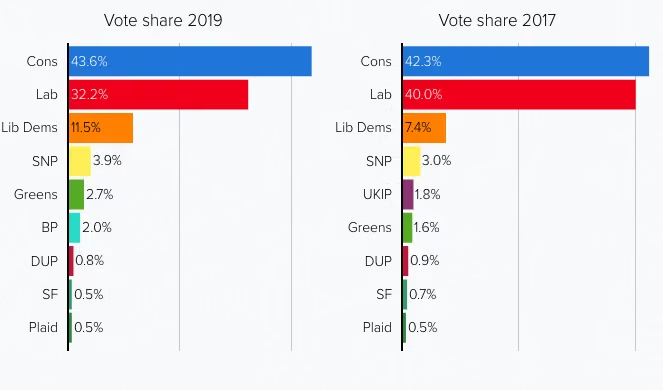
The Tory vote share increased by a mere one percent whereas Labour’s vote share dropped by eight percent. The Tories did not win convincingly, it was Labour that lost decisively. Johnson failed to convince half the country to support him. If we had a fair electoral system we would have had a hung parliament with the Tories as the largest party. We have an electoral system that doesn’t tell the truth and that is a fundamental flaw in our politics. Apparently the electoral system has even deceived the author about the true nature of the result. Anglo Saxon politics is a very strange beast: Trump “decisively won” the Presidential Election when his opponent got more votes !
This is the single best reflection on the reasons for the disastrous election result that I have read. It is terrifically honest, thoughtful, wide-ranging and multifaceted. I have but two comments.
The first relates to Brexit itself, where I think the author has missed a major trick. She writes about the way Labour’s ‘focusing on material economic conditions was ultimately not enough to neutralise the other meanings of Brexit, namely post-imperialist English nationalism and rage at the political class’. She is absolutely right that the feelings of many Leavers went far deeper than even the best economic programme could assuage. But instead of just sweeping them aside with the description ‘post imperialist English nationalism’, I want to suggest that we take a good hard look at this nationalism, especially the fact that it is ‘English’.
At the some time, we should introduce some humility into the way the the English left runs a mile from issues around national identity – from what Dan Jarvis MP and former soldier, whose lesser but similarly thoughtful and restrained reflection JVL has also printed, calls ‘patriotism’. Alone perhaps in the ENTIRE WORLD the English left sneers at and disregards the desire for ordinary people to want to feel positive about their national identity. It never even things about the subject. If issues around such identity surface in our politics, they are inevitably designated ‘irrational’ (thus ignoring and evading the importance of irrationality in our everyday lives – and not that different from calling Leave voters stupid, ignorant and brainwashed), ‘right wing’, usually ‘racist’ and often a ‘post imperialist relic’. None of which are surprising, since the left has nothing positive to say on the subject and so makes no contribution to constructing a positive and progressive role within our politics for a sense of who and what our nation is.
Perhaps, along with all its rethinking arising from this election, the left needs to ruminate on how it rejects, avoids and despises the ordinary desires of ordinary people in England to feel both proud about who they are, and in control of their own destiny – which desires we never deny the people of South Africa, Algeria, India, Jamaica, indeed any post-colonial state, but of which we are deeply ashamed when it comes to England. Those of us who are Jewish and on the left should maybe also remember how moving it was when French Jews, meeting Netanyahu after the murders in the kosher supermarket in Paris, greeted his injunction that they should emigrate to Israel: they told him who they were – French Jews – by standing up and singing the Marseillaise. Leaving said the fact that we don’t have a suitable national anthem to match the Marseillaise (and why is that a matter of joking, rather than political concern?), would we have had a comparable statement of who we were, had those murders taken place in London?
My second comment concerns the need to build alliances, which I have rarely seen put better. I just want to add that it should include enthusiastically and selflessly campaigning for electoral reform. Not just because ‘our electoral system systematically fucks the left’ – a description that I could not better – but it is right, democratic and in the interests of the people of this country that we have an electoral system which meets their democratic needs.
I think the key is that while Labour MPs were infighting and arguing about brexit and Remain they lost sight of why so many people from the most deprived areas voted Leave in first place. There has been for some time a complacency about safe seats and safe Councils while within those areas frustrations have built up and a huge disconnect between the middle aged to elderly voter who wishes for past times when there wasn’t so many homeless on the street and people had jobs that had 40 hours a week paid work. Milliband talking about immigration rather than cuts just helped fuel the right wing narrative that it was the “influx of EU migrants” that caused the problems, not the international banking crisis and the austerity cuts. The arguments going on in the Labour Party today show they still haven’t got it. The problem is that most of the narrative is owned by rightwing press. It is going to need some bold publicity to overcome that. It is also going to need a return to basics and some of the good parts of old Labour, support for communities by helping them not patting them on the head. Bringing back the previously outsourced services back in house or at least with local providers. Labour Councils can do a lot if they help communities take the initiative. Hard for the rightwing to hold the narrative if on the ground the local person sees it is the Labour Party that is helping them survive. We need Labour to once again be community based and responsive to local needs. Waiting for Labour to win a General Election and get funding back is not an option as it leaves the poor and vulnerable with nothing.
Labour doesn’t have to wait until the next general election there is something it can do now: move Labour’s Head Office to a Northern Town (not city) and hold NEC meetings there. Yes that might be inconvenient for the metropolitan elite but that would be a good thing as they would get to experience first hand how the other half live and things like crap public transport. One of the reasons people voted for Brexit is that they came from deprived communities and felt ignored. Moving Labour’s Head Office would provide powerful symbolism and prove that Labour is prepared to listen.
“For the Many not the Few” should be transformed into “By the Many not the Few”. Labour needs to prove that it will stop being a Top Down organisation and become a political party that really involves local people not just decides what is best for them.
“One of my own big mistakes going into this election was to under-estimate the influence of the media: after 2017”
Amongst all the breast-beating and navel-gazing that has succeeded the election, this is the one aspect above all that had a massive influence.
Had it not been there, there would have been no easy win, and other factors would have grown in salience. But any analysis has to highlight the quite unprecedented nature of the propaganda campaign that places us closer to states such as Turkey rather than advanced democracies.
I have no doubt at all that this did indeed make the crucial difference.
What is striking even now is that, in comparison with its obvious relevance, this is the factor that receives least attention, even from the Party that was skewered by it. There is a culture of not appearing to flinch at the most significant wound, and the one that is most infected.
One factor left out of this excellent and honest analysis, is that Local Labour Authorities are made to do the Tories’ dirty work. The gradual withdrawal of adequate funding to fulfil the legal obligations means that many LAs have no option to pursue locally unpopular policies such as opening up green belt land for development, or selling off parks. Local people often cannot see the link with central government and blame the local party. Devolved government/management was one of the most effective policies designed by Thatcher’s think-tanks.
Quite enjoyed reading this.
I am not momentum – I am more of a Social Democrat, having been a communist leading up to Tianenman Square and the collapse of the Soviet Union I am no longer convinced that widespread nationalisation is a solution to everything – of natural monopolies? I can buy that.
However one issue – Corbyn didn’t just hunker down wrt the Lib Dems – he did it with the more centrist parts of the Labour Party as well.
We need to compromise – and take some of Momentum’s more radical ideas and temper them.
We also need to be focused and utterly ruthless over the next 5 years.
Every Tory misstep brought to light and contrasted with our projected policies.
As someone who put in an awful lot of effort over the 4 years a lot of what you said rings true for me too. I never really understood the almost bolt-on approach of community organisers that seemed to be shipped in without much thought about what local activists from the branches and CLP’s were up to…It was just a bit clumsy and often when we’d built trust up in the local community by helping their campaign around the crap bus services get bigger and bigger, along comes a dictat and suddenly we’ve gone from a grassroots things to a ‘crowbar our PPC’ in there and bring out the all singing, all dancing twitter/FB campaign filming…
Another thing we totally cocked up with I think nationally was ignoring just how hated Labour Councils have become…
Yes this is for various reasons and some of them fair that were very hard to disagree with (bad local decision making around road building, selling off of land, expenses, scandals ala Private Eye’s Rotton Borough’s and of course the sheer amount of deadwood we have) but also some of them unfair due to the massive cuts in central funding…Why national didn’t put forward those funny dynamic films around the utter hollowing out of Council funding I do not know but the attacks on our council came up loads on the doors step…
We worked our arses off and had a brilliant mix of people, we did lots of the groundwork through the fantastic work of our councillor, members and our PPC but alas it wasn’t to be and though we held back a lot of the swing towards the Tories the message, and on the whole I’d say for every 10 people we got to speak to 9 were supportive and 1 was Brexit, IRA, Council we were scuppered by the Tory support in other, more affluent wards…
My main gripe is that even on a CLP level we spent inordinate amounts of time discussing attacks from within our own party or ‘positions’ and it felt like we were always going into this with one hand behind our backs as people on the doorstep kept saying even our own MP’s can’t stand Corbyn, or ‘he’s racist etc etc’…
Does anyone know what percent of youth voted labour ?
Some youth feel estranged from labour and groups like JVL because they see labour and JVL as middle class ivory tower verbose intellectuals far removed from reality.
In all honesty our message was so academic our leader so uncharismatic that our red wall came tumbling down.
Nobody it seems is listening
YouGov have published some interesting data on voting by age and other factors https://yougov.co.uk/topics/politics/articles-reports/2019/12/17/how-britain-voted-2019-general-election
The Party did not just dither over Brexit between 2017 and 2019 it changed it’s policy. This was a gift to the Tory’s and the right wing media. It was easy for them to portray the Party as “not respecting democracy”. I don’t believe that Corbyn ever supported this change but as the majority in the Party did he went along with it. The fact that Corbyn was forced to advocate a second referendum after saying the opposite in 2017 made it easy for the Tory’s and their media to portray him as “untrustworthy like all the rest”.
Most people acknowledge that there was a smear campaign against Corbyn
from the moment he became leader. What is not acknowledged often enough is that much of the campaign was orchestrated from within the PLP and by senior figures within the Party. If the majority of the PLP had been supportive of Corbyn from the start then I think Labour would have been the largest Party in 2017.
We need to understand the roots of the anti-Corbyn agenda in the right wing of the Party and the “rest of the establishment”. Are we allowed to discuss Iraq/weapons of mass destruction? and Israel/Palestine?
Less than 30% of registered voters voted Tory, the largest electoral constituency was the non voters. A big factor in this must be our undemocratic electoral system. Labour needs to make a much bigger issue about this than it has done in the past. In effect our system is the “parliamentary dictatorship of the largest minority”. A bit like the referendum actually. Unfortunately hardly anyone criticized the lack of criteria attached to the referendum at the time.
Thanks Mike for the link to voting stats by age, which makes fascinating reading.
It seems MY source of voting patterns by age is inaccurate!!
Probably the best wide ranging review so far. If I had to add anything it would be to hit home harder on the lack of clear, straightforward messages during the campaign. We need to do some things in a more professional manner (which I hasten to add does not mean diluting our message but just presenting it more cogently. Having said that our campaigning ability is not equal in every constituency and the level of the game needs to rise as it is the only advantage we have over other parties.
I can live with a lot of this analysis. However, I don’t think it delves enough into the underlying issues of Brexit and the xenophobia and racism in certain white working class areas. The Tory leaflet which focused on the impact of immigration and “health tourism” on the NHS shows they understood this was still a dog-whistle issue.
Reading this via JVL it remarkably ignores the impact of the greatly exaggerated and weaponised claims of antisemitism – most notably in the same way as Brexit indecision – in making Corbyn look weak. He was pinned against the ropes on the issue for months and failed to come out fighting.
The notional moving of troops around the country has never chimed with me. It is belief in enthusiasm above reality, and often ill-judged. The lack of evening canvassing made it hard to mobilise much of our membership in this campaign but we are probably still utilising less than 10%. Mobilising local members is better than transporting people in.
The Party does have to build community involvement and organisation – but here I think Labour Councils who implement and mask Government cuts (often in the name of claiming their own success) are a real issue. They are often the hand that delivers the Tory blows and they strongly resist community campaigns that portray them as accepting of the situation and as not leading a resistance.
Finally, I don’t accept the asserted need to build alliances. I could live with merging with the Greens, since they established firm Left economic policies, but the LibDems (and in Scotland the SNP) pose an on-going threat to our Party and must be squeezed relentlessly if they are not to be a conduit for many of our votes to flow away – especially in local elections. The product of such alliances is always unclear.