
Cosmopolitan Ottomans
JVL Introduction
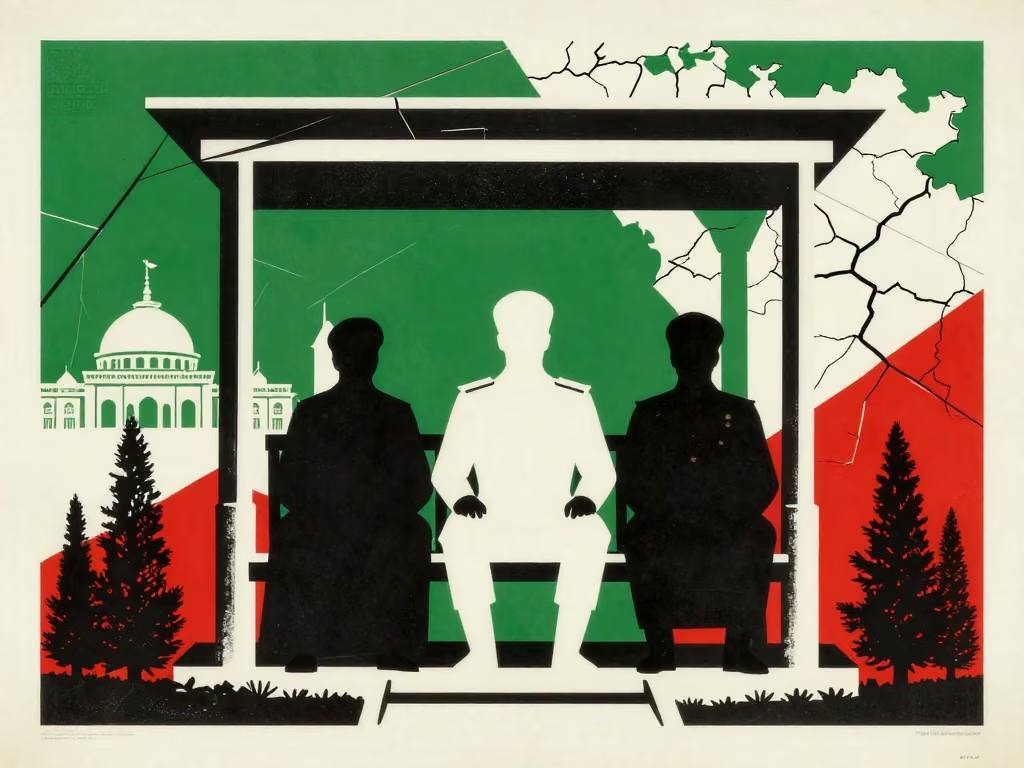
In this essay which first appeared in Aeon in October 2019 Professor Ussama Makdisi looks at the role of Western powers in the breakup of the Ottoman Empire and the construction of the modern “Middle East”.
So much western history operates with simple stereotypes about the decline of the Ottoman Empire into the ‘sick man of Europe’ after the middle of the C19th.
In this last phase of colonialism Western intervention was supposedly not even colonisation, but tutelage, in which “a so-called ‘mandate’ system dominated by ‘advanced’ powers was established by the new British-and-French-dominated League of Nations to aid less-able nations”.
The reality was much more complex and interesting than that.
As Makdisi says: “the truth is that the final Ottoman century saw a new age of coexistence at the same time as it also ushered in competing ethnoreligious nationalisms, war and oppression in the shadow of Western domination. The violent part of the story is well-known; the far richer ecumenical one, barely at all.”
This article was originally published by Aeon on Thu 17 Oct 2019. Read the original here.
Cosmopolitan Ottomans
European colonisation put an abrupt end to political experiments towards a more equal, diverse and ecumenical Arab world
Loading article text…


Call me old-fashioned and strangely sentimental, but, for some time now, I have thought it a great tragedy that we overthrew the Ottoman Empire.
Great place, the Ottoman Empire…ask the Armenians.
John, I think the tragedy is, they replaced rapacious colonialism, with rapacious colonialism.
Sadly, the recommendations of the King-Crane commission were ignored, by smaller, less intelligent men, who possessed little foresight.
As today, they could only see ‘the bottom line’ and how it would benefit them and not the people of the region.
Graeme Atkinson28th April 2021 at 23:59
“Great place, the Ottoman Empire…ask the Armenians.”
____________________________________________
But it was the breakdown of the Ottoman Empire and the rise of Turkish (and other) nationalism which led to the Armenian genocide. Before that Armenians had been known as the millet-i sadika “loyal nation” because of their general acquiescence to Ottoman rule: https://encyclopedia.1914-1918-online.net/article/armenian_genocide
In the 19th century, Armenians held very significant positions in the Ottoman administration: https://hetq.am/en/article/31219#:~:text=Armenian%20commanders%20and%20grand%20viziers,in%20a%201609%20naval%20battle.
Graeme – Our horror at the fate of a huge number of Armenians should not blind us to history. During the expansion of the Russian Empire into the southern lands there was ethic cleansing in Ukraine, where a couple of million Jews and Muslims were either murdered or driven out, often by Armenian mercenary gangs operating on behalf of Russia. [They were fellow Christians.] There was also a spate of terrorist attacks by Armenian groups that, in part, led to a reaction which resulted in the slaughter of many innocent Armenians. It’s not as simple as one set of people being the “good guys” and one set the “bad guys”.
So the Armenians brought it on themselves?
I would be careful with using the dodgy arguments touted above. I cannot believe that supposed socialists can praise the Ottoman Empire ( or any other empire).
Whatever there might have been before in the Ottoman utopia, all that changed with the genocide.
The fact that the Ottoman Empire colonised a swathe of western Asia and parts of Europe and North Africa did, indeed, deny self-determination to the people who lived there. A negative for them, along with any other empire.
The fact that the Ottomans, for much of the empire’s existence, gave sanctuary to Jews who were persecuted in Christian Europe was one positive that came out of it.
During the 19th and early 20th century the Ottoman Empire was characterised in Christian Europe as the evil empire of the East. In fact it was much like any of the other empires in Europe.
Please read things that people write carefully. Nobody is saying that the Ottoman Empire was was utopia. Nobody is saying that “the Armenians” brought the massacres on themselves. History is complex and we need to understand why things played out as they did, and to remember that our critique of empire should not lead us to see nationalism as its antithesis.
goldbach29th April 2021 at 21:33 “Our horror at the fate of a huge number of Armenians should not blind us to history. During the expansion of the Russian Empire into the southern lands there was ethic cleansing in Ukraine, where a couple of million Jews and Muslims were either murdered or driven out, often by Armenian mercenary gangs operating on behalf of Russia.”
__________________________________________________________________
I couldn’t find any reference to this on the internet (which doesn’t necessarily, of course, mean you are wrong).
However, it is irrelevant to the genocide of the Armenians in Anatolia, who were Ottoman subjects, and as such had nothing to do with the actions of Armenians in the Russian empire, who were Russian subjects – let alone making Anatolian Armenians somehow ‘co-responsible’ for the actions of Ukrainian Armenians.
In fact, even as the Armenians of Anatolia were being massacred, Armenian senior commanders served in the Ottoman Empire, fighting the allies at Gallipoli, amongst other things: https://www.independent.co.uk/voices/comment/armenian-hero-turkey-would-prefer-forget-8612890.html
Raphael Lemkin, who invented the term ‘genocide’ used the Armenian genocide as his prototype: https://en.wikipedia.org/wiki/Raphael_Lemkin
Large numbers of Turkish citizens now openly acknowledge the Armenian genocide: https://en.wikipedia.org/wiki/I_Apologize_campaign, and books about the subject, such as Fethiye Cetin’s My Grandmother are taught at Turkish universities: https://en.wikipedia.org/wiki/Fethiye_%C3%87etin
The German-Turkish Green politician Cem Ozdemir was the driving force behind the German parliament’s recognition of the Armenian genocide in 2016: https://en.wikipedia.org/wiki/Cem_%C3%96zdemir, and the German-Turkish film-maker Fatih Akan, made a drama on the subject, The Cut: https://en.wikipedia.org/wiki/The_Cut_(2014_drama_film)
If ‘descendants’ of the perpetrators can – at potentially great cost to themselves – admit that the Anatolian Armenians were the victims of genocide, the least we can do is not muddy the waters about what went on.
I have just been listening to Peter Ustinov’s abridged autobiography ”Dear Me” which is on BBC Sounds at the moment. It was first broadcast in 1978, I think. One of the most interesting revelations was that his parents’ heritage was so diverse; his father (who made a significant contribution to the war effort) was born in Jaffa, Palestine and had an ancestry which included Ethiopian Jewish royalty. It’s a shame that this became a source of such embarrassment that knowledge of it was suppressed as the community became sensitive to Western racism perhaps? It seems that for all its negative points, the Ottoman empire was really a very diverse with a lot of co-existence at local levels.