
Chronicle of a death foretold… review of Asa Winstanley

JVL Introduction
JVL web editor Richard Kuper casts a critical eye over Asa Winstanley’s Weaponising Antisemitism in this review published in Political Quarterly.
As with all articles reposted on this website, this review represents the views of its author and is not a statement of a collective JVL view.
LL
Labour Party expels Jews for ‘antisemitism’
Richard Kuper, Political Quarterly, October 2023
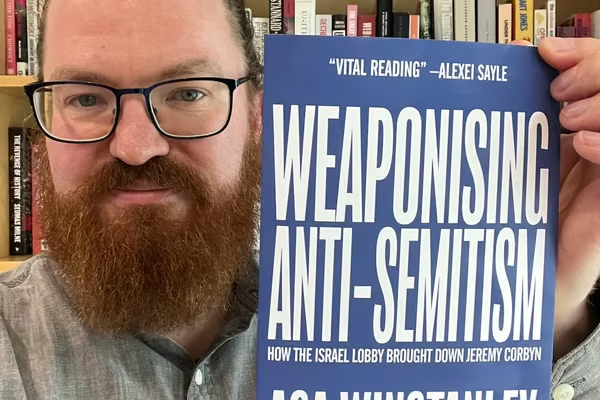
Weaponising Antisemitism. How the Israel Lobby Brought Down Jeremy Corbyn, by Asa Winstanley, OR Books, 320 pp. £15
This book will divide its readers. Those who know about or participated in the bitter internecine wars that followed the election of Jeremy Corbyn as leader of the Labour Party in Britain will be infuriated or feel vindicated by turn. (This includes your reviewer who was an active participant.) Those who know little about the last eight years of British politics may well be bemused that so much turned on what someone (often Corbyn) said or didn’t say, meant or didn’t mean, by some off-the-cuff remark made some years earlier.
The author, Asa Winstanley, has spent the better part of the last twenty years as a journalist and an associate editor of the online website, Electronic Intifada, researching and writing about Palestine and Israel and followed developments closely. Perhaps the book is best read as a whodunnit except, in Brechtian fashion, Winstanley emblazons the killer on the front of the book before we begin: it was the Israel lobby that brought Corbyn down. It truly is a chronicle of a death foretold.
The story is told broadly chronologically, with thematic material interwoven where a wider focus is required. It starts with Corbyn’s totally unexpected victory to lead the Labour Party, built on a growing discontent on the left in general and channelling much wider social discontent. It was a rejection of the neoliberalism of Tony Blair’s Labour Party, the fallout from the deceitful war in Iraq and then, of course, the years of austerity that followed the banking crisis of 2008/9.
But, if Corbyn was wildly popular with some, he was bitterly resented by others. Winstanley alludes to many of his enemies early on, particularly the British security establishment (some thirty-four major stories appeared from 2015–19, casting him as a danger to British security), and the mainstream media, implacably hostile from the start. But, above all for Winstanley, it means the Israel lobby, fearing Corbyn for his enthusiastic support for the Palestinian cause.
Winstanley focusses on the Jewish Labour Movement—effectively revived from 2015 in order to combat Corbyn—Labour Friends of Israel, the Board of Deputies of British Jews, the Community Security Trust, the Jewish Chronicle and Jewish News newspapers, as well as the Israeli embassy and the Israeli Ministry of Strategic Affairs, tasked with undermining the Boycott, Divestment and Sanctions (BDS) movement worldwide. He chronicles their various attempts to intervene in the debates and is adept at drawing out the evidence for their interventions, both overt and covert.
We are taken through the unfolding story as a narrative of ‘Labour’s antisemitism’ came to dominate the headlines: Oxford University’s ‘antisemitism crisis’ in February 2016; Al Jazeera’s exposure in The Lobby of an Israeli agent actively intervening in British political life; the campaign against Ken Livingstone; the rise of the International Holocaust Remembrance Alliance’s Working Definition of Antisemitism to the status of holy writ; the split among Jews as left-wingers became increasingly defined as inauthentic— not ‘real’—Jews; to the defeat of Labour in the 2019 general election and Corbyn’s replacement by ‘continuity candidate’, Keir Starmer, only for him to turn his back rapidly on everything he had stood on, and everything that the movement around Corbyn had represented.
One of the few continuities has been the ‘war on antisemitism’. In pursuit of his pledge to ‘tear antisemitism out by its roots’ we now have the bizarre situation in which at least sixty Jewish members of the Labour Party have faced charges related in one way or another to what the party treats as antisemitism. It suggests that something is awfully awry, that the ‘war against antisemitism’ was never what it was said to be.
An aside: your reviewer was a bit player in this. I was found guilty, without a hearing, of ‘undermining the Party’s ability to combat racism [=antisemitism]’ but never told what I was accused of beyond this, or how I had erred, apart from being directed to an article of mine in Red Pepper almost four years earlier, in which I see nothing meriting any such accusation. Neither I, nor anyone else in the party or beyond, can have learnt from this minor persecution anything useful about what constitutes antisemitism, its relation to other forms of racism or how to combat it. That clearly wasn’t its purpose. I was told not to do it again—but have no idea what it is I must not do! I remain a member in good standing of the party.
I agree with much of the story as Winstanley lays it out and find much of his evidence compelling. He argues that the antisemitism crisis was a ‘manufactured crisis’. And the manufactured nature of the crisis is borne out by Winstanley’s forensic analyses of the Oxford University crisis, which was the initial trigger, and the subsequent crises around Ken Livingstone, Jackie Walker, Marc Wadsworth and many more. In all these, the dominant narrative represents a greater or lesser distortion of the reality it claimed to represent, in which these cases were portrayed as mere tips of the iceberg of latent, widespread, cavalier and entrenched ‘antisemitism on the left’ which had entered the Labour Party with Corbyn’s victory. Winstanley is at his best when he questions and probes and undermines the dominant narrative. It simply does not stand up to scrutiny.
None of this is deny that there was and is some antisemitism in the Labour Party as there is in the wider society (clearly present, but much less prevalent than anti-black racism or Islamophobia or Gypsy-Roma-traveller hatred). Evidence also shows it to be much more prevalent on the far right than anywhere else in society. But this antisemitism is only tangentially related to Winstanley’s story of how perceived racism on the left towards one of the least oppressed ethnic groupings in British society came to be presented nationally as ‘an existential threat’ in the absence of any credible evidence. Winstanley reveals much that is relevant to this story of the weaponisation of antisemitism.
But, I find unconvincing the underlying explanatory thesis of the book—that the Israel lobby did it. There was, rather, a confluence of interests in undermining Corbyn and a more nuanced weighing up of these would be in order. All these interests appear at different points in Winstanley’s narrative, but somehow pale before the overriding significance accorded the Israel lobby. Most understated, I believe, is the Labour Party machine itself, for whom Corbyn was anathema, threatening all the accommodations Labour had forged with the establishment, Parliament and other structures of the British state. The Labour Party machine worked hard to undermine Corbyn from day one. Its role was most clearly seen in its exclusion of thousands of putative members in the run-up to the second leadership campaign; its diversion of resources from winnable to safe seats in the interests of right-wing MPs in the 2017 election (the Ergon House scandal); and in how it ran Labour’s disciplinary processes as part of the factional battle against the left in the party. The evidence for this is clear in both the leaked Investigation into Antisemitism in the Labour Party report (2020) and the Forde Report (2022). These leave no doubt that ‘antisemitism’ became at times the weapon of choice in a battle against the left, both nationally and locally. But that doesn’t mean it was the Israel lobby that did it. So many others had their own interest in Corbyn’s defeat and were busy plunging in whatever daggers they could find.
Winstanley does cite Lord Ashcroft’s post election survey, which finds reasons other than the antisemitism crisis (and, by implication, the Israel lobby’s role in it) for Labour’s defeat. In fact, Labour’s failure to deal with the antisemitism crisis comes in at fifth, and Winstanley’s attempt to square the circle with his underlying thesis is unconvincing (‘The poll’s findings amounted to a defeat for the Israel lobby … [but] the lobby in alliance with the British establishment, the Labour Party right and the Israeli state itself had succeeded in convincing a significant chunk of the wider British establishment that there probably was no smoke without fire’).
Nevertheless, despite this disagreement, I commend this book highly as an essential source for anyone trying to understand the Corbyn phenomenon, one of the most radical movements ever to attempt to disrupt the British establishment in modern times.
It provides rich material for evaluating its defeat.
Richard Kuper was a founder member of Free Speech on Israel and is the web editor of Jewish Voice for Labour









Vexatious claims of Anti Semitism are hate crimes and should be prosecuted
Taste of their own medicine, at some stage they, be it Israel or Red Tories or both, will face their comeuppance for their historical crimes against democracy and humanity
But dont hold your breath
For some encouragement in the short term the ICC are under extreme pressure to lay charges against the Jewish State and their genocidal representatives and apologists
The American empire is collapsing and it will take Israel down with it
A very good review Richard. Without a doubt the “Israeli” lobby played a significant role in the overthrow of Corbyn but the entire weight of the British ruling class from the military and secret services to its quislings in the Labour movement played no lesser part in achieving their objective. I came across this apposite quote earlier today.
“This is the gulf that lies between the attempts to conceal the obvious bankruptcy of official socialism and its representatives’ desertion to the bourgeoisie and their governments, as well as the attempts to reconcile the masses with this complete betrayal of socialism, on the one hand, and, on the other, the efforts to expose this bankruptcy in all its magnitude, to expose the bourgeois policy of the “social-patriots”, who have deserted the proletariat for the bourgeoisie, to destroy their influence over the masses and to create the possibility and the organisational basis for a genuine struggle against the war.”
from: “To the Workers Who Support the Struggle Against the War and Against the Socialists Who Have Sided With Their Governments.”
V I Lenin, December 1916
We shouldn’t underestimated the strength of Israeli Influence in local Diaspora politics. Israel was a close ally of Apartheid South Africa who used infiltration into local agencies abroad, including the Anti Apartheid movement to counter boycotts etc. Nathanyahu perfected this strategy by increasing the Diaspora involvement in supporting Israel in their own countries.
As there has been no peace process and as it became more and more difficult to defend Israel’s treatment of the Palestinians, the Israeli state has had to redouble it’s involvement in the a propaganda war.
One of the aspects of Corbyn’s policies that created most uproar in established circles was his support for the Palestinians.
A confluence of interests must be correct. Israel was already alarmed by big demonstrations in London against its 2014 attacks on Gaza. With Corbyn, a life-long supporter of Palestinian (and other) human rights, looking the likely winner of the Labour leadership election by July 2015, it decided to ramp up efforts to delegitimise and undermine both Corbyn and the PSC-led movement in UK, and decided to appoint Mark Regev as the next UK Ambassador. But the UK Army and Security chiefs who spoke openly of refusing to accept Corbyn as a future PM were not acting principally because of Israeli concerns, despite close ties. American concerns would have carried more weight. They had their own issues which were aligned with the ruling class and their newspapers. Corbyn’s social democratic proposals could not be allowed to have any chance of being implemented. A well funded campaign of antisemitism was a convenient weapon to use. That’s my analysis, without reading the book.
The Israel Lobby have got exactly what they want and need from the major British opposition party at this time : namely no opposition at all. Which, given the current genocidal behaviour of Israel, rather gives weight to Winstanley’s argument as to who had most reason and resources to do this.
There are some surprising omissions. Asa doesn’t mention the former Chief Rabbi’s assertion that Corbyn’s 2013 remark that two (notoriously disruptive) Zionists lacked a sense of irony was “the most offensive statement made by a senior British politician since Enoch Powell’s 1968 ‘rivers of blood’ speech”.
Nor does he mention the current Chief Rabbi’s claim in the run-up to the 2019 general election that “the soul of the nation [was] at stake.”
Finally, if you’re looking for someone who might have been orchestrating the antisemitism scam, it seems odd not to recall the “Prince of Darkness” Peter Mandelson’s observation, “I work every single day in some small way to bring forward the end of [Corbyn’s] tenure in office. Something, however small it may be – an email, a phone call or a meeting I convene – every day I try to do something to save the Labour Party from his leadership.” As it happens, he said that in conversation with Stephen Pollard at an event hosted by the Jewish Chronicle.
As (still) a Party member I agree with the confluence of interest analysis. Most Labour MPs and Party staff resented – even hated – Jeremy Corbyn. Had they supported Jeremy we might well have won in 2017. I don’t know but suspect the weaponisation of anti-semitism made many Jews who were not involved in the Party afeared that growing anti-semitism in the UK would directly affect them. This has also undermined anti-racism generally, and made discussion as to what is oppressive behaviour much more difficult. Unlike the 1930s anti-semitism is not something that a substantial part of the electorate support but that fear will linger through a few more generations yet. What is happening in Gaza doesn’t help reassure.
A confluence of factors is what did it really.
And we should not forget that, unfortunately, Corbyn made some serious mistakes.
Dodging questions made him look bad and denied him the opportunity to get his views across and the badly botched appointment of Keir Starmer put him in the ideal position to cause trouble.
Sir Keir Starmer – the continuity candidate.
I believe that JC had proposals to create a social democratic government which the establishment felt very threatened by conciquently they used Jeremy’s support for the Palestinians and his criticism of the Jewish regime as antisemitism which the media used to blacken his name and authority. The Oxford dictionary describes antisemitism as a person hostile to or prejudiced against Jewish people.I have no evidence that JC is an antisemite.